


Smart Lock Manufacturers in China: OEM, App Control, Security and Export Guide

Many overseas buyers first ask a Chinese supplier for a fingerprint smart lock with an app.
However, a smart lock quotation is not only about the front panel design, unlocking methods or unit price.
A smart lock is a combined product of mechanical hardware, electronic components, firmware, app control, cloud service, cybersecurity, export documentation and after-sales support.
A sample may look modern and work well during a short video test, but the real sourcing questions are deeper. Does the lock body match the door? Does the app work in the target country? Is the firmware maintained? What happens if the battery dies? Can the product meet the required certification and connected-product security rules?
This guide explains how global buyers can compare smart lock manufacturers in China, understand OEM and ODM options, evaluate app control and security, check export requirements and reduce inspection and after-sales risks.
For broader door hardware sourcing topics, read: 🔗Door Hardware Manufacturers in China: Locks, Hinges and Door Closers.

Why Smart Locks Are More Than Door Hardware
A traditional lock is mainly a mechanical product. If the lock body, cylinder, handle and key system are suitable, the buyer can usually evaluate quality through materials, machining, durability and installation compatibility.
A smart lock is more complex.
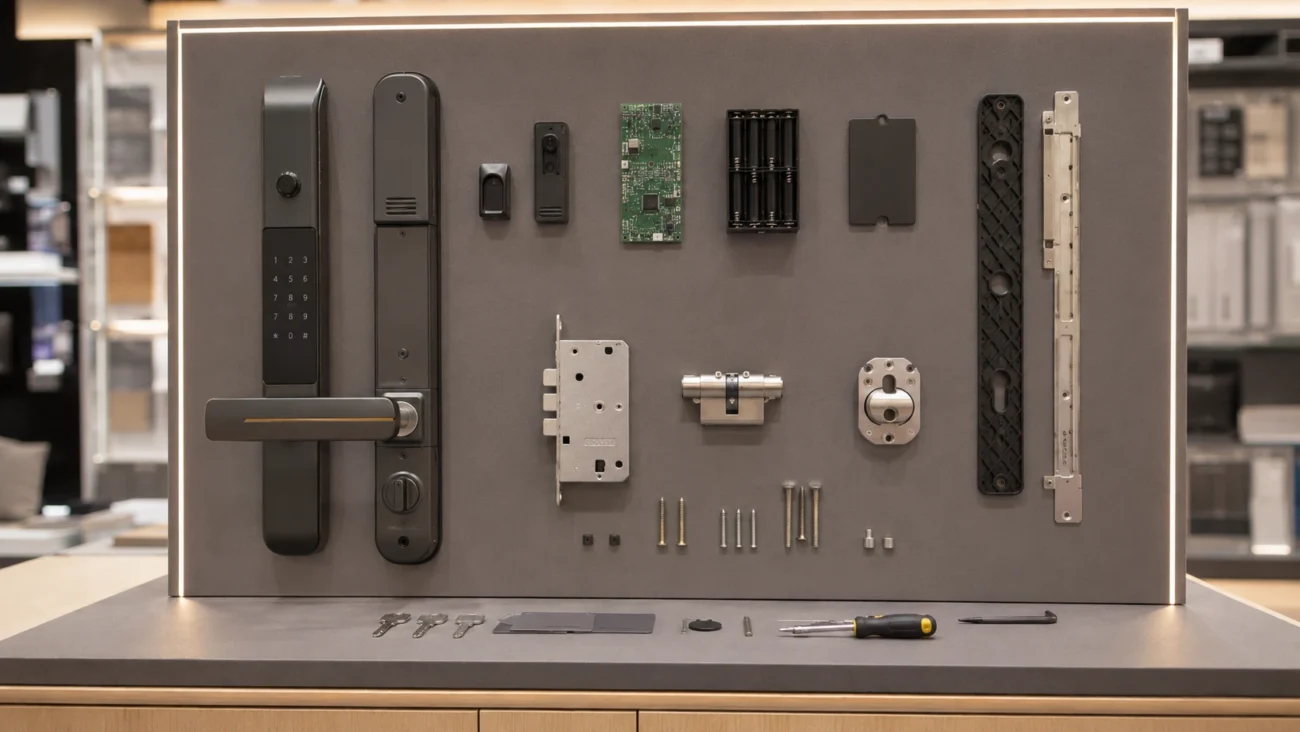
It still needs a reliable lock body, cylinder, handle, latch, deadbolt and strike plate. But it also includes a fingerprint module, keypad, PCB, battery system, wireless module, firmware, app platform, cloud server, user management function and sometimes camera, face recognition or palm-vein recognition.
This means the buyer is not only sourcing hardware.
The buyer is sourcing a connected security product.
A low-price smart lock may work during a factory demonstration, but problems can appear later when the app cannot be downloaded in the target country, the language is not suitable, the server is unstable, the battery drains quickly or the lock body does not match the local door preparation.
The real question is therefore not only:
How much is this smart lock?
A better question is:
Can this smart lock work reliably on the target door, in the target market, with the required app, security, certification and after-sales support?
What Buyers Should Prepare Before Requesting Smart Lock Quotations
A reliable smart lock quotation needs more than a product photo.
Before contacting Chinese suppliers, buyers should prepare basic project and product details. The supplier needs to know whether the smart lock is for retail sales, private-label distribution, hotel projects, apartments, short-term rentals, villas, offices or steel security doors.
Useful information includes:
- Target country and sales channel
- Door type and door material
- Door thickness
- Existing lock body or mortise size
- Backset requirement
- Opening direction
- Indoor or outdoor installation
- Required unlocking methods
- App requirement
- Language requirement
- Wi-Fi, Bluetooth, Zigbee, Thread or other connection
- Battery type and backup power requirement
- Mechanical key requirement
- Certification requirement
- OEM or ODM requirement
- Packaging and branding requirement
- Expected order quantity
Door compatibility is often underestimated.
A smart lock can have a good fingerprint module and attractive design, but it will still fail as a product if the lock body does not fit the door, the spindle length is wrong, the latch direction is incorrect or the strike plate does not match the frame.
For hotel, apartment and short-term rental projects, the buyer should also confirm whether the system needs remote password management, card access, master key logic, user permission groups, audit logs or property-management software integration.
Main Types of Smart Lock Manufacturers in China
Not every smart lock supplier controls the same part of the product.
Some factories focus on mechanical lock bodies and hardware. Some specialize in smart lock assembly. Some rely on third-party electronic modules or app platforms. Others mainly provide OEM branding, packaging and export coordination.
Understanding the supplier type helps buyers avoid comparing quotations that are not based on the same scope.
Mechanical Lock and Hardware Factories
Some suppliers have strong experience in lock bodies, cylinders, handles, panels and metal parts.
They may be suitable when the buyer needs stable mechanical quality, customized lock bodies or products matched with steel security doors and entrance doors.
However, they may not fully control the app, firmware or cloud service.
Smart Lock Assembly Factories
Smart lock assembly factories usually combine mechanical parts, electronic modules, fingerprint sensors, keypads, batteries, panels and packaging into finished products.
A strong factory should understand both hardware assembly and electronic testing.
Buyers should still confirm whether the app, firmware, PCB design and cloud service are controlled by the factory or provided by an outside solution provider.
Electronic Solution Providers
Some companies focus more on PCB, firmware, wireless modules, app integration and cloud platforms.
They may help brands develop more customized smart lock solutions, but they may not directly manufacture the full lock body or metal hardware.
For deeper OEM or ODM projects, cooperation between hardware factories and electronic solution providers is common.
Trading or Export Suppliers
Trading and export suppliers are not automatically unsuitable.
For overseas buyers, communication, documentation, packaging, certification coordination, inspection and after-sales spare parts can be as important as the factory itself.
The key question is not only whether the supplier is a factory.
The key question is which parts of the smart lock system the supplier actually controls and who is responsible when hardware, software or app-related problems appear.
OEM vs ODM Smart Locks: What Buyers Should Confirm
Many importers think OEM means adding a logo to the front panel.
In smart lock sourcing, OEM can involve much more. It may include the panel design, lock body, firmware, app interface, packaging, user manual, certification files, spare parts and after-sales responsibility.
Basic Private Label
Basic private label is suitable for buyers who want to test a market quickly.
The supplier may use an existing model, existing app platform and standard firmware. The buyer can add a logo, packaging design and user manual.
This approach is faster and usually requires a lower MOQ.
However, the risk is product similarity. The same lock may be sold by many other brands in the same market. The buyer may also have limited control over the app, server, firmware updates and long-term support.
Deeper OEM or ODM Development
Deeper OEM or ODM is more suitable for importers, building-material brands, hotel system suppliers and long-term distributors.
This may involve custom front-panel design, different lock body options, firmware changes, app interface customization, cloud service selection, packaging design, user manual localization and certification planning.
The buyer should ask who owns the mold, who controls the app, who maintains the firmware and what happens if the supplier changes platform provider.
A cheaper OEM quotation may not include software control, certification support, spare parts or future firmware maintenance.
This is why smart lock OEM should be evaluated as a long-term product program, not only as one hardware order.
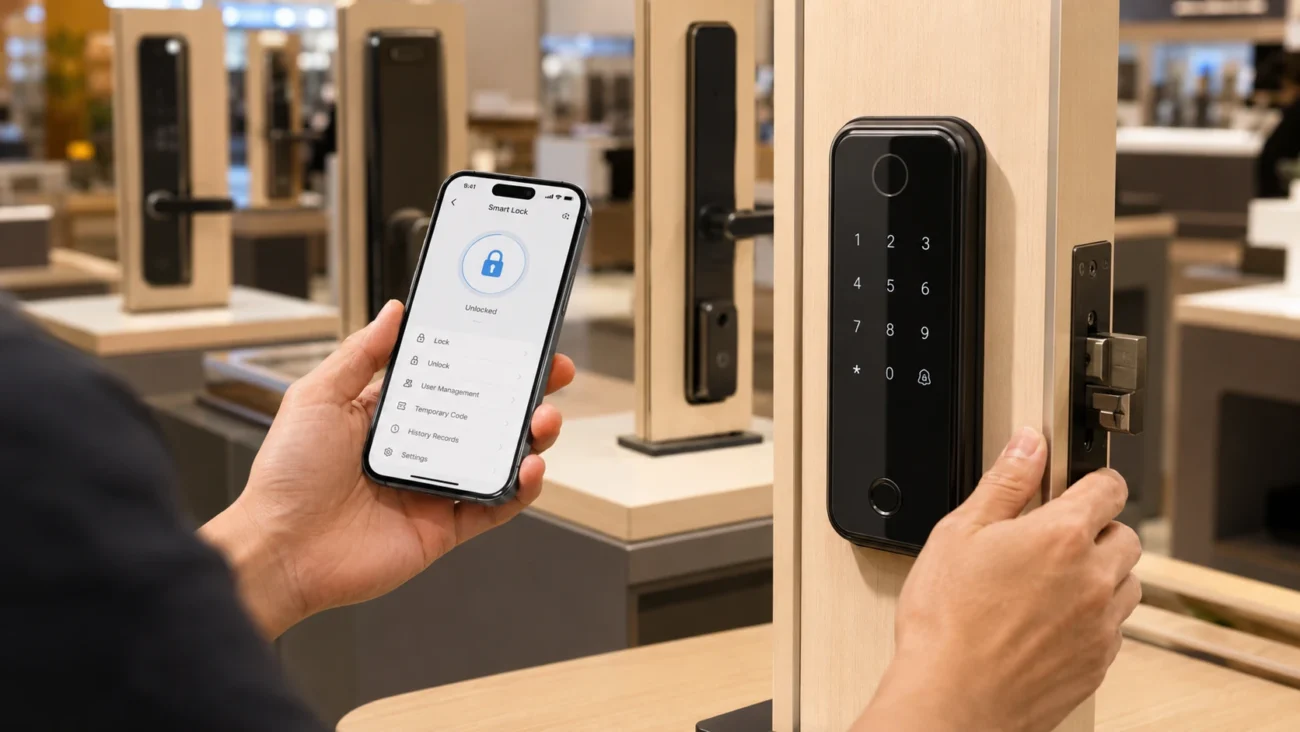
App Control, Cloud Service and User Management
App control is often the most attractive selling point, but it is also one of the highest-risk parts of smart lock sourcing.
Buyers should not assume that every app works globally.
Some apps may not be available in every country’s App Store or Google Play. Some may have limited language support. Some may depend on servers that are slow or unstable in the target market.
The buyer should confirm whether the app is developed by the factory, a third-party platform such as Tuya, or a custom solution provider.
Important questions include:
- Can users download the app in the target country?
- Which languages are supported?
- Who owns the app account and data?
- Can the buyer use its own brand name?
- Does the app support temporary passwords?
- Does it support multiple users and permission levels?
- Can it manage multiple locks?
- Does it support remote unlock?
- What happens if the cloud service is unavailable?
- Can the lock still work locally?
- Are firmware updates available?
- How long will software support continue?
For short-term rental buyers, temporary password stability is often more important than adding many advanced functions.
For hotels and apartments, user management, card access, master permissions and audit records may be more important than ordinary residential app functions.
App control should therefore be treated as part of the product specification, not as a free accessory.
Mechanical Security: Lock Body, Cylinder and Door Compatibility
A smart lock still needs a reliable mechanical base.
The lock body, cylinder, handle, deadbolt, latch, strike plate and emergency key system should match the door type and market requirement.
Buyers should check the door thickness range, backset, mortise size, handle direction, latch direction and installation template before placing an order.
A smart lock may be technically advanced but still unsuitable if it cannot fit the buyer’s existing door.
For steel security doors, the lock body and panel structure may be different from those used for wooden interior doors.
For aluminum doors, sliding doors or glass doors, the lock structure may need a completely different system.
For fire-rated doors, hardware cannot be selected only by appearance or size. The lock, latch and other components may need to match the approved fire-rated door assembly.
Physical security should include more than the words “fingerprint” or “smart.”
Buyers should ask about the cylinder type, anti-pry structure, panel material, deadbolt strength, emergency key, tamper alarm and failure mode.
A lock that is smart but mechanically weak is still a weak lock.
Electronic and Cybersecurity Risks
Smart lock security has three levels.
The first level is mechanical security: whether the lock body, cylinder, panel and deadbolt can resist physical attack.
The second level is electronic reliability: whether the fingerprint module, keypad, battery, wireless module and PCB can work consistently in the real environment.
The third level is cybersecurity and data security: whether user accounts, passwords, firmware, app communication and cloud service are properly protected.
Buyers should ask about encryption, password policy, anti-peeping password function, reset protection, firmware update method, app account security and vulnerability handling.
Default passwords and weak account settings are becoming more sensitive in many markets.
For the UK market, the Product Security and Telecommunications Infrastructure regime requires relevant consumer connectable products to meet baseline security requirements. For the EU, the Cyber Resilience Act is moving connected products toward stronger cybersecurity obligations during design, development and maintenance.
For smart lock buyers, this means software support, secure defaults, vulnerability response and product documentation are becoming part of export readiness.
A low-cost smart lock without long-term software support may be risky even if the hardware looks acceptable.
Aliro, Matter and Smart Home Compatibility
Smart access control is moving toward stronger interoperability.
The release of Aliro 1.0 by the Connectivity Standards Alliance shows that digital keys, smartphones, wearables and access-control systems are becoming more connected across residential, hospitality, office and multi-family building scenarios.
This does not mean every smart lock from China should immediately claim Aliro support.
Buyers should be careful with vague phrases such as “Matter ready,” “Aliro ready” or “future compatible.”
A serious supplier should be able to explain the exact chip module, firmware version, supported protocol, certification status, platform compatibility and production plan.
If a product only has hardware reserved for future support, that is different from a certified mass-production model.
For many importers, the practical question is not only whether the lock supports a popular ecosystem.
The question is whether the specific product can be sold, installed, supported and updated in the target market.
Export Requirements for the US, UK, EU and Project Markets
Export requirements depend on the destination market, wireless functions, product design, sales channel and project specification.
For the US market, buyers may need to consider FCC requirements for wireless functions, battery safety, product liability, user manuals, privacy policy and any project-specific ANSI/BHMA or building-hardware requirements.
For the EU market, buyers may need to review CE, RED, RoHS, REACH, privacy requirements and cybersecurity obligations for connected products.
For the UK market, buyers should pay attention to UKCA, PSTI-related product security requirements, support period statements and importer responsibility.
For hotel, apartment and rental projects, the required documents may be different from ordinary retail sales.
Project buyers may care more about management software, spare parts, offline mode, emergency keys, master permissions and local maintenance than general consumer packaging.
Chinese lock standards can help buyers understand the supplier’s domestic safety baseline. For example, GB 21556.2-2025 covers technical safety requirements for burglary-resistant locks.
However, compliance with a Chinese domestic standard does not automatically mean the same smart lock is accepted for a US, UK, EU, hotel or fire-rated door project.
The buyer should confirm the target-market requirements before production, not after the goods are ready to ship.
A Realistic Overseas Buyer Consultation Scenario
A common smart lock inquiry starts with a simple request:
We need a fingerprint smart lock with app control. Can you send your best price?
At first, the discussion seems to be about appearance, unlocking method and price.
But once the project details are reviewed, the real questions become more practical.
What door thickness does the lock fit? Is the lock body compatible with the selected door? Does the app work in the target country? Can the product support temporary passwords? Is remote access needed? What happens when the battery dies? Does the buyer need FCC, CE or UKCA files? Who will support the app after the sale?
For a short-term rental buyer, guest-code management and emergency access may be more important than a luxury front panel.
For an importer building a private-label product line, app ownership, firmware maintenance, certification files and spare parts planning may be more important than the lowest unit price.
For a UK residential door inquiry, the first discussion may be about the door itself, but the hardware and lock schedule can quickly become equally important because the lock body, hinges, closer and seals must match the door assembly and project requirements.
The real sourcing question becomes:
Can this smart lock work reliably as part of the complete door system and target-market sales plan?
Smart Lock Quality Inspection Before Shipping
Smart lock inspection should cover both mechanical and electronic functions.
Inspectors should check the panel finish, handle movement, lock body operation, latch direction, cylinder, emergency key, screws, strike plate and installation accessories.
They should also test fingerprint recognition, password entry, card access, mechanical key access, low-battery warning, emergency power and reset function.
If the lock uses an app, the app connection should be tested with the correct region, language and phone system whenever possible.
The inspection should confirm whether the lock can be paired, unlocked, reset and managed according to the buyer’s expected use.
Battery contact, wiring, PCB assembly and waterproofing details should also be checked for outdoor or semi-outdoor models.
For OEM orders, inspectors should check logo, packaging, user manual, QR code, app instructions and label information.
One sample test is not enough for a production order. Random units from the bulk batch should be tested before shipment.
A smart lock failure after arrival may be difficult to solve because the issue could come from hardware, firmware, app service, installation or user operation.
Packaging, Accessories and After-Sales Spare Parts
Smart lock packaging must protect the product and also prevent missing accessories.
A complete set may include the front panel, rear panel, lock body, cylinder, keys, strike plate, screws, spindle, cards, manual, installation template, battery notice and sometimes gateway or extra accessories.
If one small accessory is missing, the product may not be installable.
For project orders, each lock set should be labeled according to door number, room number, lock type and package number.
This is especially important for hotels, apartments and villas with different door thicknesses, opening directions or hardware configurations.
Spare parts should be planned before shipment.
Useful spare parts may include lock bodies, cylinders, handles, battery covers, key cards, screw packs, PCB parts, fingerprint modules or replacement panels depending on the project.
After-sales support is not only about warranty promises.
It also includes user manuals, installation videos, troubleshooting guides, app support, firmware updates and replacement part availability.
A buyer who plans to sell smart locks under a private label should ask the supplier how after-sales problems will be handled after six months, one year or three years.

Where to Source Smart Locks in China
China has several smart lock and door-hardware supply clusters.
Xiaolan, Zhongshan
Xiaolan in Zhongshan is especially relevant for smart locks, lock bodies, cylinders, mechanical locks, electronic lock components and OEM/ODM lock products.
The town is widely known for lock and hardware manufacturing, with a large number of smart lock manufacturers and supporting firms.
This makes Xiaolan useful for buyers comparing mechanical locks, smart locks and lock-related components in the same supply area.
Yongkang
Yongkang is useful when smart locks are sourced together with steel security doors, smart entrance doors and related door-hardware systems.
Its advantage is not only individual smart locks, but the connection between doors, locks, hardware and security-door manufacturing.
This is useful for buyers who need complete entrance-door and lock solutions.
Shenzhen, Dongguan and Other Pearl River Delta Areas
For electronic modules, PCB design, IoT solutions, app development and smart-home integration, Shenzhen, Dongguan and other Pearl River Delta areas can also be relevant.
Some smart lock projects require cooperation between a lock hardware factory and an electronic solution provider.
For deeper OEM or ODM development, buyers may need to evaluate both sides of the supply chain.
Foshan for Project Selection
Foshan is useful when smart locks are selected as part of a larger villa, hotel or renovation package.
Buyers may compare doors, aluminum windows, cabinets, bathroom products, lighting and door hardware during the same sourcing trip.
However, the final smart lock manufacturer may still be located in Zhongshan, Yongkang, Shenzhen or another specialist production area.
The best sourcing route depends on whether the buyer needs retail smart locks, hotel locks, apartment access systems, door-and-lock packages or a private-label product line.
How a China-Based Sourcing Team Helps
A China-based sourcing team should do more than send smart lock catalogues.
For smart lock projects, useful support begins with clarifying the buyer’s target market, door type, lock body requirement, app requirement, certification needs and after-sales expectations.
The team can compare mechanical quality, electronic functions, app platforms, packaging, OEM capability and supplier export experience.
It can also coordinate sample testing, factory visits, production inspection, packaging checks, spare parts planning and shipment.
Cody Sourcing works with door, hardware and building-material suppliers across South China and other industrial regions.
For smart locks, the value is not simply finding a low-price supplier. It is helping buyers connect product function, door compatibility, app support, security, documentation, inspection and long-term usability into one sourcing process.
Common Mistakes to Avoid
Common mistakes when sourcing smart locks from China include:
- Comparing only front-panel design
- Choosing a lock without checking door thickness
- Ignoring lock body and mortise compatibility
- Assuming every app works globally
- Not checking app language and region availability
- Ignoring firmware and software support
- Treating OEM as only logo printing
- Not confirming who owns the app and cloud service
- Selecting smart locks without backup keys or emergency power
- Ignoring battery life and low-battery warning
- Not checking certification for wireless functions
- Ignoring UK or EU connected-product security rules
- Using a smart lock on a fire-rated door without checking the full assembly
- Not testing bulk production units before shipment
- Shipping without spare parts or installation accessories
Most of these problems can be reduced before production when the buyer treats the smart lock as a complete product system instead of a simple electronic accessory.
Final Checklist Before Confirming a Smart Lock Order
Before paying the deposit, buyers should confirm:
- Target country and sales channel
- Door type and door thickness
- Lock body type
- Backset and mortise size
- Opening direction
- Indoor or outdoor use
- Unlocking methods
- Mechanical key backup
- Emergency power method
- Battery type and battery life
- App platform
- App language and region availability
- User management function
- Remote access requirement
- Temporary password function
- Cloud service and data responsibility
- Firmware update plan
- OEM or ODM scope
- Logo and packaging requirements
- Required certification
- User manual language
- Spare parts list
- Inspection method
- Packaging specification
- After-sales support period
- Shipment and customs documentation
The safest sourcing decision is not always the cheapest smart lock quotation.
It is the smart lock system that matches the door, target market, app environment, security expectations, certification requirements and long-term after-sales plan.
