


Door Hardware Manufacturers in China: Locks, Hinges and Door Closers

Door hardware manufacturers in China supply locks, hinges, door closers, handles, cylinders, latches, panic hardware, smart locks and other components for wooden doors, steel doors, aluminum doors, hotel doors and fire-rated door projects.
However, door hardware should not be sourced as separate accessories only.
In real projects, hardware problems often appear when the lock, hinge or closer does not match the door leaf, frame, door weight, opening direction, fire-rating requirement or installation environment.
A door may look correct in the factory, but if the lock body does not match the door thickness, the hinges cannot support the weight or the closer cannot shut the door properly, the final installation can still fail.
This guide explains how global buyers can compare door hardware manufacturers in China, select locks, hinges and door closers, check project requirements, understand standards and reduce inspection, packaging and installation risks.
For complete door sourcing, you may also read: 🔗Door Manufacturers in China: Wooden, Steel and Fire-Rated Door Sourcing Guide.

Why Door Hardware Should Be Sourced as a Complete System
Many buyers first ask for a door lock, hinge or closer as a separate product.
But in real residential, hotel, apartment and commercial projects, door hardware works as part of a complete door system.
The lock must match the door thickness, backset, lock body, cylinder, handle direction, strike plate and frame preparation. The hinge must match the door weight, door height, frame material and opening frequency. The closer must match the door width, door weight, opening angle, traffic frequency and fire-door requirement if applicable.
This is why two hardware sets with similar appearance may perform very differently after installation.
A cheaper lock may use a lighter lock body or weaker cylinder. A low-price hinge may not support a heavy solid wood door for long-term use. A basic door closer may shut a light interior door but fail to control a heavy fire-rated door in a busy corridor.
The real sourcing question is not only:
Which hardware supplier gives the lowest price?
It should be:
Which hardware set can match the door type, usage, standard, installation environment and project schedule?
This is the main difference between simple product sourcing and professional door hardware sourcing.
What Buyers Should Prepare Before Requesting Door Hardware Quotations
A reliable door hardware quotation needs more than product photos.
Before contacting Chinese suppliers, buyers should prepare Buyers Should Prepare Before Requesting Door Hardware Quotations
A reliable door hardware quotation information about the door type, door size, door material, opening direction, application, traffic frequency and target market.
For project orders, the most useful document is a door hardware schedule.
Useful information includes:
- Door type
- Door thickness
- Door width and height
- Door weight if available
- Door material
- Frame material
- Opening direction
- Interior or exterior use
- Residential, hotel or commercial application
- Fire-rated or non-fire-rated requirement
- Lock type
- Cylinder type
- Handle style
- Hinge type
- Door closer requirement
- Finish color
- Quantity
- Destination country
A photo of a handle or lock panel is helpful, but it does not define the complete hardware set.
For example, a buyer may select a black lever handle from a catalogue, but the actual installation still requires the correct latch, lock body, cylinder, strike plate, screws and door preparation.
When these details are not confirmed before production, the problem often appears at the project site.
Main Types of Door Hardware Manufacturers in China
China has many door hardware suppliers, but they do not all control the same product range or production process.
Some factories focus on mechanical locks. Some specialize in smart locks. Some produce hinges, handles or door closers. Some suppliers provide complete door hardware packages for hotel, apartment or fire-rated door projects.
Understanding the supplier type helps buyers avoid comparing quotations that are not based on the same scope.
Lock and Smart Lock Manufacturers
Lock manufacturers may produce lock bodies, cylinders, handles, mechanical locksets, hotel card locks, smart locks or related components.
Some are stronger in traditional mechanical locks, while others focus on electronic access, fingerprint, keypad, Bluetooth, Wi-Fi, app control or hotel management systems.
For smart locks, buyers should not check only the front panel design.
They should also review the lock body, cylinder, emergency key, battery system, app language, server dependency, access management, spare parts and after-sales support.
Hinge and Metal Hardware Factories
Hinge factories may produce stainless steel hinges, bearing hinges, concealed hinges, fire-rated hinges, pivot hinges or heavy-duty hinges.
The quality difference is often related to material thickness, bearing structure, screw fixing, finish quality, corrosion resistance and load capacity.
A hinge is a small component, but it carries the door every day.
For heavy wooden doors, steel doors or commercial doors, hinge selection should be based on door weight and usage frequency, not only appearance.
Door Closer and Door Control Manufacturers
Door closer manufacturers may produce surface-mounted closers, concealed closers, floor springs, pivots and other door-control products.
Door closers are common in hotels, apartments, offices, hospitals, schools and fire-rated door assemblies.
The closer should match the door width, weight, opening angle, traffic frequency and mounting condition.
For fire-rated doors, the closer is not just a convenience accessory. It helps the door return to the closed and latched position, which may be essential for the assembly to perform as intended.
Hardware Package Suppliers
Some suppliers do not manufacture every component themselves but can provide complete door hardware sets.
This can be useful for project buyers if the supplier can correctly match locks, hinges, closers, seals, handles and accessories to each door number.
The key question is not whether the supplier makes every part in-house.
The key question is whether the supplier can control product matching, documentation, inspection, packaging and after-sales responsibility.
Door Locks: Mechanical Locks, Smart Locks and Lock Bodies
Door locks from China may include interior locks, entrance locksets, mortise locks, cylinders, hotel card locks, smart locks, multipoint locks, sliding door locks and fire-rated latch or lock systems.
Buyers should not treat all locks as the same product.
A lock must match the door thickness, backset, lock body size, handle direction, cylinder type, strike plate, security requirement and local market expectation.
A common sourcing mistake is selecting the visible handle or smart lock panel first and checking the lock body later.
This can create problems when the lock body does not fit the door preparation or when the strike plate does not match the frame.
Mechanical Locks
Mechanical locks are still widely used for interior doors, entrance doors, hotel projects, apartments and commercial buildings.
Buyers should confirm the lock body size, cylinder type, latch direction, finish, handle material, screw quality, strike plate and packaging.
For export markets, buyers should also confirm whether the lock function matches the local installation habit.
A lock designed for one market may not match the door preparation, backset or cylinder system used in another market.
Smart Locks
Smart locks are growing quickly, but they require more careful checking.
A smart lock is not only an electronic panel. It includes the lock body, motor, cylinder, battery system, emergency unlocking method, software, access control logic and after-sales support.
Buyers should confirm:
- Unlocking methods
- Battery type
- Emergency key
- Emergency power supply
- App language
- User management
- Data storage
- Offline function
- Hotel or apartment system compatibility
- Replacement parts
- Target-market certification needs
For hotel, apartment and short-term rental projects, smart lock management is more important than one attractive sample.
The buyer should know who controls the app, server, software updates and password management.
Smart access is also becoming more standardized. The Connectivity Standards Alliance released Aliro 1.0 in 2026 as a communication protocol and credential standard for access control, covering use cases such as homes, offices, universities, hospitality and multi-family residential buildings.
This does not mean every Chinese smart lock is automatically compatible with Aliro. It simply shows that buyers should pay attention to interoperability, access management and long-term support when sourcing smart locks.

Hinges: Door Weight, Fire Rating and Long-Term Stability
Hinges are often treated as small accessories, but they are critical to door performance.
A heavy wooden door, steel door or fire-rated door depends on the hinges and frame fixing every time it opens and closes.
If the hinge load capacity, screw fixing or frame reinforcement is not suitable, the door can sag after installation.
This may create uneven gaps, rubbing, latch misalignment or difficulty closing the door.
Buyers should consider door weight, door height, door thickness, opening frequency, hinge material, screw type, corrosion resistance and whether the hinge must be fire-rated.
For residential interior doors, a simple hinge may be acceptable.
For hotel doors, apartment entrance doors, schools, offices and commercial doors, durability becomes more important.
For coastal or humid environments, stainless steel or corrosion-resistant finishes may be needed.
For hidden doors or premium interior design, concealed hinges may create a cleaner look, but they must still match the door weight and frame structure.
For fire-rated doors, hinges cannot be selected casually. They should match the door assembly, rating and hardware schedule required by the project.
Door Closers: Closing Control, Fire Doors and User Experience
Door closers control how a door closes.
This may sound simple, but the wrong closer can cause major project problems.
If the closer is too weak, the door may not close and latch properly. If it is too strong, the door may feel difficult to open. If the closing speed is too fast, users may feel unsafe or uncomfortable. If the latching speed is too slow, a fire-rated or security door may not close reliably.
Important closer details include:
- Door width
- Door weight
- Opening angle
- Spring power
- Closing speed adjustment
- Latching speed adjustment
- Backcheck function
- Hold-open function
- Mounting type
- Traffic frequency
- Fire-door suitability
For fire-rated doors, hold-open functions should be reviewed carefully because some applications may require the door to close automatically under specific conditions.
A door closer also depends on installation.
The same closer may perform differently if it is mounted incorrectly, if the frame is weak or if the door is affected by air pressure.
For commercial projects, buyers should not choose closers only by appearance. They should confirm door size, usage frequency, mounting method and project requirement before ordering.

Door Hardware Schedule for Different Door Types
For project buyers, the door hardware schedule is more useful than a simple product list.
It connects each door type with the correct hardware set, finish, function and room number.
| Door Type | Hardware to Confirm |
|---|---|
| Interior wooden door | Hinges, lever lock, latch, stopper and screws |
| Hotel room door | Card lock, mortise lock, hinges, closer, door viewer and seal |
| Apartment entrance door | Lockset, cylinder, hinges, closer, peephole, seal and threshold |
| Steel security door | Lock body, cylinder, handle, hinges, anti-pry parts and frame hardware |
| Fire-rated door | Listed hinges, lock or latch, closer, seals and panic hardware if required |
| Aluminum sliding door | Roller, track, handle, lock, gasket and stopper |
| Glass door | Floor spring, patch fitting, handle, lock and clamp |
This table should be adjusted according to the project drawing and local requirement.
The purpose is not only to buy hardware. It is to make sure every door leaf, frame and hardware set can work together after installation.
Standards and Certification: ANSI/BHMA, EN, UL and Chinese Standards
Door hardware standards are not universal.
The required standard depends on the destination market, building type, door function, fire rating, traffic frequency and project specification.
For the US market, ANSI/BHMA standards are commonly used for many architectural hardware categories. For example, ANSI/BHMA A156.4-2024 covers door closers and pivots, while ANSI/BHMA A156.39-2025 covers residential locksets and latches.
For European projects, buyers may see EN standards such as EN 1154 for controlled door closing devices, EN 1935 for single-axis hinges and EN 12209 for mechanically operated locks, latches and locking plates.
For China domestic lock safety, GB 21556.2-2025 covers technical safety requirements for burglary-resistant locks.
However, compliance with a Chinese domestic standard does not automatically mean that the same hardware is approved for a US, UK, EU, hotel or fire-rated door project.
For fire-rated doors, hardware must be reviewed as part of the complete door assembly.
A fire-rated door hinge, lock or closer cannot be selected only by appearance or size. It must match the door assembly, rating, hardware schedule and approved configuration.
UL’s fire-rated door guidance includes hinges, latches, locks, closers and fire exit hardware as part of complete assemblies. This means buyers should check whether the selected hardware is suitable for the exact rated door system and application.
For official reference, buyers can review:
- ANSI/BHMA A156.4-2024 Door Closers and Pivots
- ANSI/BHMA A156.39-2025 Residential Locksets and Latches
- UL Fire-Rated Doors Application Guide
- GB 21556.2-2025 Lock Safety Standard
This article is not legal, code or certification advice. Buyers should confirm requirements with their architect, code consultant, project inspector or certification specialist before production.
A Realistic Project Sourcing Scenario
In one residential door project, the buyer first focused on the door leaf style, color and surface finish.
But during quotation review, the real questions became hardware-related.
Would the lock body match the door thickness? Could the hinges support the selected door weight? Was the closer suitable for the opening width? Did the hardware finish match the door color? Would every hardware set be labeled to the correct room number?
For a UK residential fire-door inquiry, the buyer’s first concern was also the door itself.
However, before quotation, the hardware schedule became equally important because hinges, locks, closers and seals could affect whether the door assembly matched the required fire-rated configuration.
This type of project shows why door hardware sourcing should not begin with a random online catalogue.
It should begin with the door schedule, project requirement and hardware matching logic.
Quality Inspection Before Shipping
Door hardware inspection should cover appearance, function, dimensions, quantity and packaging.
For locks, inspectors should check the handle finish, lock body, cylinder, latch movement, screws, strike plate, keys, emergency function and product labeling.
For smart locks, the inspection should also include power-on testing, unlocking methods, app language, battery compartment, emergency power port and included accessories.
For hinges, inspectors should check material, finish, thickness, hole position, bearing structure, pin movement and screw quality.
For door closers, inspectors should check appearance, arm set, mounting accessories, adjustment valves, labels, function and packaging.
When possible, key hardware should be tested on a sample door or test frame.
A lock may work on the table but fail after installation if the lock body, strike plate or handle direction is wrong.
For project orders, inspectors should also compare the hardware sets with the door schedule.
A correct product can still create installation delays if it is packed under the wrong door number.
Packaging, Labeling and Matching Hardware Sets
Door hardware is small compared with doors, but packaging mistakes can stop the whole installation process.
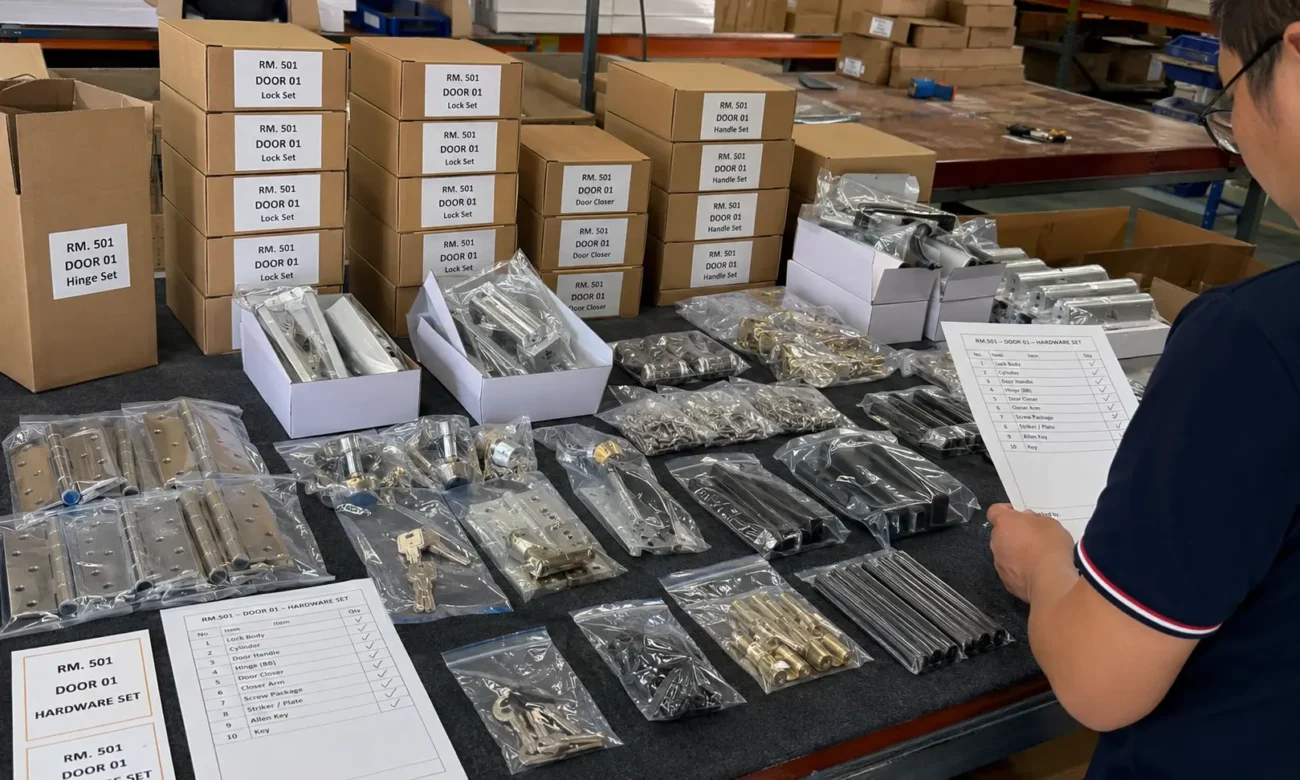
Locks, cylinders, handles, hinges, closers, screws, keys and accessories are often packed in different boxes. If the labels are unclear, workers may not know which hardware belongs to which door.
For project orders, each hardware package should clearly show:
- Door number
- Room number
- Floor
- Hardware set number
- Lock type
- Hinge type
- Closer model
- Finish color
- Key number if applicable
- Package number
Small parts such as screws, strike plates, spindle bars, keys, batteries and installation templates should be fixed inside the package.
A missing screw pack or wrong strike plate may seem minor in the warehouse, but it can delay installation on site.
For hotel, apartment and villa projects, hardware packaging should be coordinated with door packaging.
The door leaf, frame and hardware set should remain connected through the same door number or room number.
This is especially important when doors and hardware are sourced from different suppliers and consolidated in one warehouse before shipment.
Where to Source Door Hardware in China
China has several door hardware and lock manufacturing areas.
Xiaolan, Zhongshan for Locks and Smart Locks
Xiaolan in Zhongshan is especially relevant for locks, lock bodies, cylinders, smart locks and related door-hardware components.
The local hardware and lock industry has developed from traditional lock manufacturing toward smart lock products, with upstream and downstream hardware components supporting the supply chain.
This makes Xiaolan useful when buyers need mechanical locks, smart locks, lock-related OEM or ODM products and hardware matching.
Yongkang for Security Doors and Related Hardware
Yongkang is relevant when door hardware is sourced together with steel security doors, smart entrance doors, lock systems and metal components.
Its advantage is not only individual hardware production, but also the connection between security doors, smart doors, locks and related manufacturing.
For buyers sourcing steel entrance doors and matching hardware together, Yongkang can be a practical location to evaluate.
Foshan for Project Hardware Selection
Foshan is useful for villa, hotel and renovation buyers who are already comparing doors, aluminum windows, cabinets, bathroom products, tiles and furniture.
Door hardware may not always be manufactured in Foshan, but showrooms and suppliers can help buyers compare finishes, handles, hinges, locks and project matching together with doors and other building materials.
For project buyers, this can save time during product selection.
The final hardware manufacturer may still be located in Zhongshan, Yongkang or another specialist cluster.
How a China-Based Sourcing Team Helps
A China-based sourcing team should do more than send hardware catalogues.
For door hardware projects, useful support begins with reading the door schedule and identifying what information is missing.
The team can help compare lock bodies, hinges, closers, finishes, certifications, packaging methods and supplier capabilities.
It can also coordinate sample approval, factory communication, quality inspection, project labeling, warehouse consolidation and shipment.
Cody Sourcing works with door, window and building-material suppliers across South China and other industrial regions, helping overseas buyers compare products, inspect orders and coordinate export shipments.
For door hardware, the value is not simply finding a cheaper lock or hinge.
The value is helping buyers make sure the hardware matches the door, frame, project requirement, packaging plan and final installation.
Common Mistakes to Avoid
Common mistakes when sourcing door hardware from China include:
- Buying locks, hinges and closers as separate accessories
- Requesting a quotation from a photo only
- Not confirming door thickness
- Not checking lock body size
- Ignoring backset and strike plate requirements
- Choosing hinges without checking door weight
- Choosing closers without checking door width and traffic frequency
- Using ordinary hardware for fire-rated doors
- Assuming one certificate covers every door configuration
- Ignoring opening direction
- Not checking smart lock app language and server support
- Not confirming spare parts
- Mixing hardware sets without door numbers
- Packing screws and accessories loosely
- Not testing samples before bulk production
- Not inspecting hardware before shipment
Most of these problems can be reduced before production when buyers treat door hardware as part of the complete door system.
Final Checklist Before Confirming a Door Hardware Order
Before paying the deposit, buyers should confirm:
- Door type
- Door thickness
- Door size
- Door weight if available
- Frame material
- Opening direction
- Interior or exterior use
- Traffic frequency
- Lock type
- Lock body size
- Cylinder type
- Handle direction
- Hinge type
- Hinge load capacity
- Door closer power and mounting type
- Fire-rated requirement
- Target-market standard
- Finish color
- Hardware schedule
- Door number and room number
- Sample approval
- Inspection method
- Packaging label format
- Spare parts
- Production lead time
- Shipment and consolidation plan
The safest purchasing decision is not always the cheapest hardware quotation.
It is the hardware set that matches the door, frame, function, standard, installation environment and project schedule.
