


Hotel Door Manufacturers in China: Fire-Rated, Acoustic and Access Control Guide

Hotel door manufacturers in China can supply guest room doors, fire-rated doors, acoustic doors, bathroom doors, corridor doors and access-control door systems for hotels, serviced apartments, resorts and renovation projects.
Choosing the right hotel door is not only about price, because the door must match the guest room, corridor, fire requirement, lock system and installation plan.
But hotel doors should not be sourced as decorative wooden doors only.
A hotel guest room door must balance life safety, guest privacy and daily operational reliability. It may need to meet fire-rating requirements, reduce corridor noise, work with RFID card locks or mobile key systems, close properly with a door closer, and arrive on site with the correct room number, frame and hardware set.
This is why a hotel door order should be discussed as a complete door system, not only a door leaf.
This guide explains how global buyers can compare hotel door manufacturers in China, understand fire-rated and acoustic door requirements, review hotel locks and access control, inspect door quality before shipping, and reduce project mistakes caused by poor packaging or room-number matching.
For broader door sourcing topics, read: 🔗Door Manufacturers in China: Wooden, Steel and Fire-Rated Door Sourcing Guide.

Why Hotel Doors Are Different from Standard Interior Doors
A normal interior door is usually judged by appearance, size, material and price.
A hotel door has to do more.
It must support the guest experience, the building safety strategy and the hotel’s daily operation. A beautiful veneer is not enough if the door does not close properly, blocks too little corridor noise, uses the wrong lock system or cannot be matched to the correct room during installation.
Hotel buyers often begin by asking for a wooden guest room door. But once quotation starts, the real questions quickly move beyond color and size.
Does the door need a fire rating? What acoustic performance is expected? Is the door frame included? Does the lock work with the hotel management system? Does the closer match the door weight? Are the seals suitable? Will every door be labeled by room number before shipment?
These details may sound small during quotation, but they become serious problems on site.
A hotel project may include dozens or hundreds of doors. When one lock set, frame or package label is wrong, installation teams can lose time quickly.
This is why hotel doors from China should be sourced as project doors, not as loose decorative panels.
How to Compare Hotel Door Manufacturers in China
The best hotel door manufacturer is not always the factory with the most attractive showroom.
A reliable supplier should understand project drawings, door schedules, room numbering, fire-rated configurations, acoustic expectations, hardware matching, access-control locks and export packaging.
Some factories are strong in wooden door production. Some focus on fire-rated doors. Some are better at hotel room doors with veneer finishes. Others may rely on outside suppliers for locks, closers, seals or access-control systems.
This does not automatically make one supplier unsuitable.
The more important question is which parts of the hotel door system the supplier can actually control.
A buyer should know whether the factory produces the door leaf and frame in-house, whether hardware is supplied by a partner, whether fire-rated configurations are clearly documented, and whether hotel locks are tested with the actual door before shipment.
For large hotel projects, communication and project control may matter as much as manufacturing capacity.
A supplier who can produce doors but cannot manage door numbering, packaging labels and hardware matching may still create serious installation delays.
What Hotel Buyers Should Confirm Before Requesting Quotations
Before asking for prices, buyers should define the hotel door application.
A guest room entrance door is different from a bathroom door, a stairwell door, a corridor fire door, a service room door or a meeting room acoustic door.
Each type has a different priority.
A guest room door usually needs fire rating, acoustic comfort, hotel lock compatibility, closer control and guest-friendly operation. A bathroom door needs moisture resistance and suitable hardware. A stairwell or corridor door may focus more on fire and smoke control. A meeting room door may need stronger acoustic performance and durable hardware.
For hotel projects, a useful quotation normally depends on a door schedule.
| Hotel Door Area | Why It Matters |
|---|---|
| Door Type | Guest room, corridor, stairwell, bathroom or service area |
| Fire Rating | Affects door leaf, frame, hardware, seals and closer |
| Acoustic Target | Affects core, seals, drop seal and frame installation |
| Access Control | Affects lock model, card system, software and emergency access |
| Hardware | Hinges, closer, lock, peephole, stopper and threshold |
| Door Schedule | Controls room number, size, opening direction and package label |
| Packaging | Prevents damage and room-matching mistakes |
The table is only a starting point.
In a real hotel project, the buyer and supplier should connect each room to a door number, floor, opening size, wall thickness, opening direction, frame type, finish, hardware set, lock model and package number.
Without this information, the first quotation is often only a rough estimate.
Guest Room Doors: Fire, Acoustic and Daily Use
Guest room doors are the most important hotel doors from a guest-experience perspective.
They are the first product guests touch when entering the room, and they are also one of the most sensitive parts of the room for noise, privacy and safety.
A hotel guest room door may look like a normal wooden door from the outside, but the internal requirement is different.
The door core, thickness, frame, seals, closer, hinges, lock body, peephole and threshold can all affect how the door performs.
For a guest, the issue is not whether the door has an impressive product name. The issue is whether the room feels safe and quiet, whether the door closes smoothly, whether the lock works every time, and whether corridor noise stays outside.
For the hotel operator, the door must also be easy to maintain.
If a lock body fails, if the closer leaks oil, if the hinge loosens, or if the seal wears out, the hotel needs replacement parts and clear installation support.
A low-price door can become expensive if it creates repeated maintenance complaints after opening.

Fire-Rated Hotel Doors: Why the Complete Assembly Matters
Fire-rated hotel doors need extra attention because the door leaf alone is not enough.
A fire-rated hotel door may need a matching frame, hinges, lock or latch, closer, seals, threshold, glazing option, label and approved installation condition.
Changing one component can affect the complete door configuration.
For example, a buyer may choose a beautiful veneer guest room door, but if the door is part of a fire-rated corridor system, the final specification cannot be based on appearance only.
The buyer should ask whether the quoted product is a fire-rated door leaf only or a complete fire-rated door set.
A proper quotation should clarify the rating, door size range, frame type, hardware configuration, closer, seals and any label or documentation requirement.
The destination market also matters.
A Chinese domestic fire-door standard can help buyers understand the product category, but it does not automatically mean the door is accepted in the US, UK, EU, Middle East or another market.
Hotel buyers should confirm fire requirements with the project architect, local consultant, authority or inspector before production.
The safest question is not only:
Does your factory have a fire-door certificate?
A better question is:
Is this exact hotel door assembly, with this frame, hardware, closer and seal configuration, suitable for the project requirement?
That difference is critical.
Acoustic Hotel Doors: Guest Comfort Beyond the Door Leaf
Hotels do not receive guest complaints about technical acoustic terms.
They receive complaints about corridor conversations, housekeeping carts, elevator noise, neighboring rooms and doors closing late at night.
This is why acoustic hotel doors should be discussed from the guest’s experience, not only from a laboratory number.
STC can be useful when comparing acoustic performance, but buyers need to understand what the rating covers. A door leaf may have an acoustic rating, but real performance depends on the complete opening.
The door core, frame, perimeter seals, drop seal, threshold, lock cut-outs, peephole, wall condition and installation gaps all affect the final result.
A heavy door leaf alone does not guarantee a quiet hotel room.
If the bottom gap is too large, if the perimeter seal is weak, or if the frame is poorly installed, sound can pass around the door.
Connecting room doors need special attention.
A connecting door between two hotel rooms can become a weak acoustic point if the door pair, seals and wall detail are not properly designed.
For hotel buyers sourcing from China, the practical question should be:
Is the acoustic requirement based on the door leaf only or the complete installed opening?
That question helps avoid unrealistic expectations.
Access Control: Hotel Locks, Cards, Mobile Keys and Management Systems
Hotel access control is not only an electronic lock.
It is a daily operation system for guests, front desk staff, housekeeping, engineering teams and emergency access.
A hotel lock system may include RFID cards, mobile keys, lock bodies, cylinders, software, card encoders, gateways, emergency cards, master cards, cleaning staff access, maintenance access and mechanical override.
A supplier may show a modern hotel lock in a catalogue, but the buyer still needs to understand how it works in daily hotel operation.
Can the front desk issue cards quickly? What happens when a guest loses a card? Can the lock work offline? How are housekeeping cards controlled? What happens when batteries die? Are spare lock bodies and panels available after installation? Can the system support multiple buildings or floors?
For some projects, mobile key and digital credential systems may become more important. But buyers should not rely only on marketing words such as “smart access” or “mobile compatible.”
The exact lock model, software, card system, gateway and management platform should be checked before ordering.
For more detail on smart locks, read: 🔗Smart Lock Manufacturers in China: OEM, App Control, Security and Export Guide.
Hardware, Closers and Seals: Small Parts with Big Consequences
Hotel door hardware is not a small afterthought.
Hinges, closers, locks, seals, peepholes, stoppers, thresholds and drop seals all affect how the door performs after installation.
The door closer is especially important.
If the closer is too weak, the door may not close and latch properly. If it is too strong, guests may feel the door is difficult or uncomfortable to use. If the closing speed is not adjusted correctly, the door may slam and create noise complaints.
Hinges also matter because hotel doors are opened and closed many times every day.
A heavy guest room door needs hinges that can support the door weight without sagging. If the hinge and frame reinforcement are weak, the door may become misaligned over time.
Seals are equally important for both acoustic and fire-related performance.
A missing or weak seal may not be obvious during factory inspection, but guests and installers will notice it later.
For hotel projects, the hardware schedule should be reviewed together with the door schedule. Otherwise, a good door leaf may be paired with the wrong closer, lock or seal.
Door Schedule, Room Numbering and Package Matching
Hotel door projects are highly vulnerable to labeling mistakes.
A door can be manufactured correctly but still delay installation if the matching frame, lock, closer or hardware package is assigned to the wrong room.
This is why a door schedule is essential.
Each hotel door should be connected to a room number, floor, door type, size, opening direction, frame type, fire rating, acoustic requirement, lock model, closer, peephole, seal and package number.
The factory and sourcing team should use the same schedule during quotation, production, inspection, packaging and loading.
Room numbering should not be handled casually at the end.
If the project has different room types, connecting doors, suite doors, service doors and stairwell doors, the risk of mixing packages becomes much higher.
Good labeling does not make the door more beautiful, but it can save many hours during installation.
For hotel projects, correct matching is part of quality.
A Realistic Hotel Door Sourcing Scenario
A hotel buyer may ask for 120 guest room doors from China.
At first, the request seems simple: same veneer, same size and same lock.
But once the project is reviewed, the quotation becomes more detailed.
The buyer needs to confirm whether the doors require fire rating, what acoustic comfort is expected, which hotel lock system will be used, whether the closer is included, what type of seal is needed, whether the frame matches the wall thickness, and how each door will be labeled for each room.
If the hotel is a renovation project, there may be another layer of difficulty.
Existing wall openings may not be perfectly consistent. Some rooms may need different frame depths. Some doors may need to match old hardware or local installation habits. Some bathrooms may require moisture-resistant doors rather than standard room doors.
For a hotel-style apartment or short-term rental project, access control may become even more important. The buyer may care less about a traditional front desk card system and more about remote management, temporary passwords, maintenance access and emergency entry.
In real sourcing, the final door choice is rarely based on a single product photo.
It is based on how the door works inside the hotel operation.
Quality Inspection Before Shipping
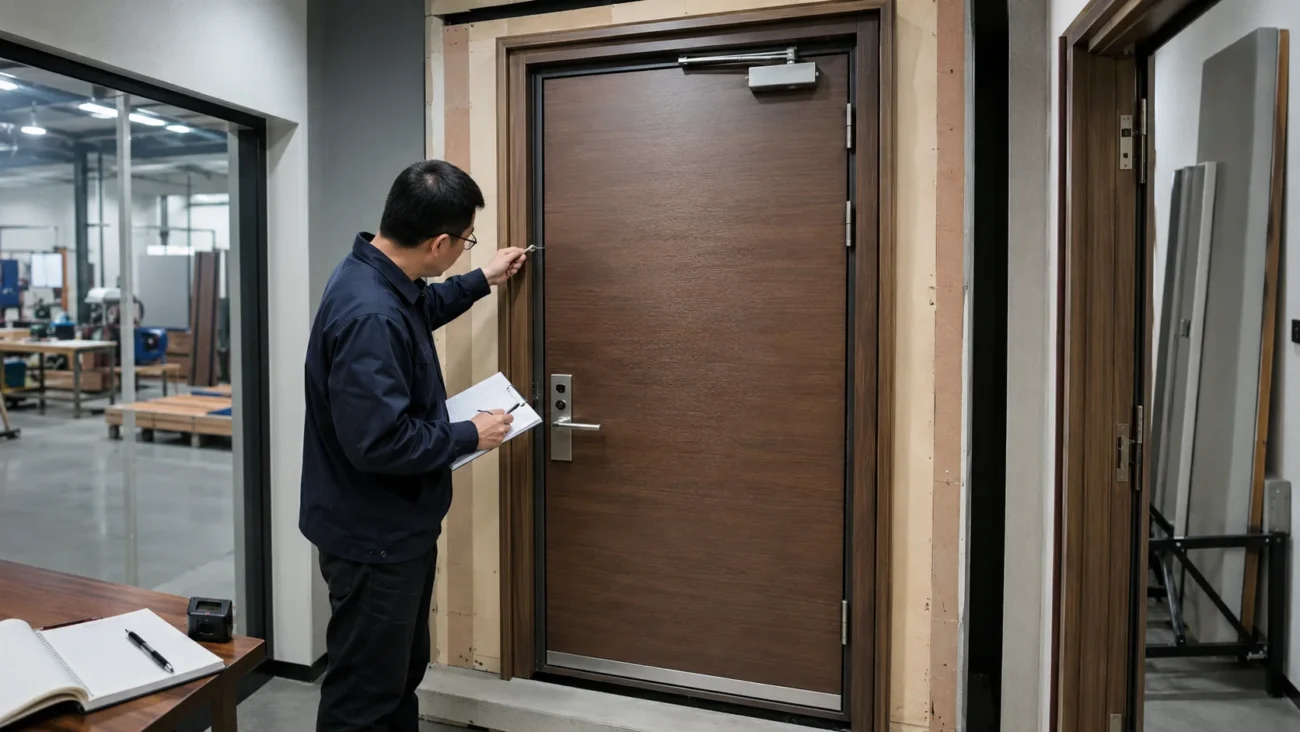
Hotel door inspection should cover appearance, dimensions, structure and operation.
The inspector should check whether the door leaf, frame, finish, hardware preparation, lock holes, closer position, seals and packaging labels match the approved specification.
For fire-rated hotel doors, labels, frame, hardware and closer configuration need extra attention.
For acoustic doors, seals, bottom gaps, drop seals and frame fit should be checked carefully.
For hotel locks, sample units should be tested with the actual door thickness and lock body. The card function, emergency access and mechanical key should also be checked when possible.
Surface finish is important because hotel doors are highly visible.
Veneer color, paint gloss, edge treatment, frame matching and hardware position should be consistent across the production batch.
A hotel door may pass a simple photo inspection but still create problems if the lock hole is wrong, the closer position is missing, the frame does not match the wall thickness or the package label is incorrect.
Inspection should happen before final packaging and loading, because correction becomes much harder after shipment.
Packaging and Container Loading for Hotel Door Projects
Hotel doors are large, finished products that can be damaged easily during international shipping.
Veneer can scratch. Painted surfaces can chip. Door corners can dent. Frames can bend. Hardware boxes can be misplaced.
For project orders, packaging must protect the product and preserve the room-matching system.
Each door leaf, frame and hardware set should be labeled clearly. If the lock, closer and seals are packed separately, the labels must still connect them to the correct room.
A hotel project may have many similar-looking doors. This makes package numbering even more important.
During container loading, heavy doors should be secured against movement. Finished surfaces need corner protection and separation. Long frames should be supported to reduce bending.
If hotel doors are shipped together with tiles, cabinets, lighting or bathroom products, the loading plan should protect the doors from heavy or sharp items.
Good packaging is not only about avoiding scratches.
It is about helping the hotel project install faster after the container arrives.

Where to Source Hotel Doors and Hardware in China
China’s hotel door supply chain is not concentrated in one single city.
Jiangshan in Zhejiang is highly relevant for wooden doors, engineered doors, painted doors, veneer doors and project door production. It is often considered one of China’s important wooden door manufacturing bases.
For hotel locks and access-control hardware, Xiaolan in Zhongshan is especially relevant. It has a strong lock and smart lock supply chain, including lock bodies, cylinders, hotel locks and supporting hardware companies.
For hotel renovation buyers, Foshan and the broader Guangdong building-material supply chain can also be useful because doors, windows, tiles, bathroom products, cabinets, lighting and furniture can be compared during the same sourcing trip.
However, the best sourcing route is not always one city.
A hotel project may need wooden door leaves from one production base, locks from another specialist supplier, and consolidation through a warehouse before container loading.
The right sourcing method depends on the hotel category, project standard, door schedule, access-control requirement and shipment plan.
How a China-Based Sourcing Team Helps
A China-based sourcing team should not only send hotel door catalogues.
Useful support starts with understanding the project: hotel type, destination market, drawings, door schedule, fire requirements, acoustic expectations, lock system, hardware standard, packaging method and shipping plan.
The team can help compare suppliers, clarify whether the quotation includes the full door system, coordinate samples, check hardware compatibility and follow production details.
For hotel projects, local coordination is especially valuable because the door leaf, frame, lock, closer, seal, package number and room number must remain connected from quotation to shipment.
Cody Sourcing works with door, window, hardware and building-material suppliers across China.
For hotel doors, the value is not simply finding a lower unit price. It is helping buyers connect product selection, supplier capability, fire and acoustic requirements, access-control systems, inspection, packaging and container loading into one controlled sourcing process.
Common Mistakes to Avoid
A common mistake is treating hotel doors like ordinary interior doors.
Another is asking only for a wooden door price without confirming fire rating, acoustic performance, lock system, closer, seals or frame depth.
Some buyers choose a hotel lock from one supplier and a door from another supplier without checking whether the lock body, door thickness and preparation holes match.
Others focus on STC numbers but ignore the door bottom gap, frame installation and seals.
Packaging is also often underestimated. A hotel door order can be delayed even when the doors are not damaged if the matching frame, lock or hardware box cannot be found at the site.
Most of these problems can be reduced when the buyer defines the hotel door as a complete room-entry system before production starts.
Final Thoughts
Hotel door manufacturers in China can offer strong options for guest room doors, fire-rated doors, acoustic doors and access-control systems.
But the safest sourcing decision is not simply choosing the lowest door-leaf price or the most attractive veneer sample.
A hotel door must work in the real hotel environment. It needs to close properly, reduce noise, support guest privacy, match fire requirements, work with the lock system and arrive with the correct room number, frame and hardware set.
For overseas buyers, real sourcing value appears when the hotel door is treated as a complete project system.
That is the difference between buying a door and sourcing a hotel door solution.
