


Bathtub Manufacturers in China: Acrylic vs Solid Surface Freestanding Tub Guide

Bathtub manufacturers in China should not be compared only by product shape, showroom photos or factory price.
Two freestanding bathtubs may look almost identical but have very different material structures, reinforcement methods, weights, installation requirements and shipping risks.
For global buyers, the first decision is usually not which shape looks best. It is whether an acrylic bathtub or a solid surface bathtub is more suitable for the target market, project budget and installation conditions.
Acrylic tubs are generally lighter and easier to ship, while solid surface tubs offer a heavier and more premium appearance. However, both materials can create quality problems when the factory uses weak reinforcement, unstable material formulas or unsuitable packaging.
This guide explains how buyers can compare bathtub manufacturers in China, evaluate acrylic and solid surface tubs, check US market requirements and reduce damage before shipment.

Latest Market Notes for Bathtub Buyers
Modern bathroom design continues to focus on wellness, comfort and spa-like experiences.
Freestanding tubs remain visually important in larger primary bathrooms, villas, hotel suites and luxury renovation projects, especially when the bathroom has enough space for both a separate shower and bathtub.
However, buyers should understand the market more carefully.
In many residential projects, larger showers are receiving more floor space than bathtubs. A freestanding tub therefore works best when it serves a clear design purpose instead of being added only because it looks attractive in a showroom.
Popular sourcing requests now commonly include:
- Oval freestanding tubs
- Soft rectangular tubs
- Thin-rim acrylic tubs
- Matte solid surface tubs
- Stone-look resin tubs
- Compact tubs for smaller bathrooms
- Deep soaking tubs
- Hotel and villa project bathtubs
The trend does not mean every buyer needs the most expensive tub.
It means buyers are becoming more selective about proportion, comfort, surface texture, cleaning, weight and installation.
Quick Comparison: Acrylic vs Solid Surface Bathtubs
| Area | Acrylic Bathtub | Solid Surface Bathtub |
|---|---|---|
| Typical Positioning | Mid-range to upper mid-range | Premium and luxury |
| Weight | Relatively light | Heavy |
| Surface | Usually glossy, sometimes matte | Commonly matte or satin |
| Production | Vacuum forming and reinforcement | Casting, curing and sanding |
| Design Options | Wide range of molded shapes | Strong sculptural appearance |
| Installation | Easier to carry and position | Requires more lifting and floor planning |
| Shipping Cost | Usually lower | Usually higher |
| Main Risks | Flexing, weak reinforcement and scratching | Pinholes, cracks, color variation and edge damage |
| Best For | Importers, projects, retail and volume orders | Villas, hotels and premium bathroom projects |
The decision should be based on target price, project positioning, installation access and freight cost—not appearance alone.
How to Compare Bathtub Manufacturers in China
Not every supplier displaying bathtubs is a real bathtub manufacturer.
Chinese bathtub suppliers may operate under several different business and production models.
Acrylic Forming Factory
An acrylic bathtub factory may control:
- Acrylic sheet heating
- Vacuum forming
- Trimming
- Fiberglass reinforcement
- Resin application
- Steel-frame assembly
- Drain installation
- Surface finishing
- Packaging
This supplier type is usually more suitable for volume acrylic bathtub orders.
Solid Surface Casting Factory
A specialist solid surface factory may control:
- Material mixing
- Mold casting
- Curing
- Demolding
- Sanding
- Surface finishing
- Color correction
- Product repair
- Reinforced packaging
This supplier type is usually better for premium solid surface or mineral-composite tubs.
Sanitary Ware Showroom Supplier
A large showroom may display bathtubs, toilets, vanities, faucets and shower enclosures from several factories.
This can be useful for project selection, but buyers should confirm:
- Who manufactures the selected model
- Which factory controls the material
- Where testing is completed
- Whether the certificate belongs to the actual manufacturer
- Whether the showroom can control bulk production
Trading or Export Company
A trading company may provide stronger communication and export documentation but may not directly control production.
This does not automatically make the supplier unsuitable. The buyer should understand who is responsible for material quality, inspection, packaging and after-sales service.
The best supplier is not always the company with the largest showroom. It is the supplier that can control the material, production process and packaging required for the order.
Acrylic Bathtubs from China: What Buyers Should Check
Acrylic bathtubs are widely selected for residential, hotel and commercial projects because they offer many shapes and are easier to move than heavy solid surface tubs.
However, the term “acrylic bathtub” does not describe the complete product structure.
Buyers should ask:
- Is the visible sheet PMMA acrylic?
- Is it pure acrylic or acrylic-capped ABS?
- What is the sheet thickness before forming?
- How much does the sheet thin during forming?
- How is the shell reinforced?
- Is there a steel support frame?
- How many adjustable feet are included?
- Is the bottom fully supported?
- Which drain and overflow parts are included?
Acrylic Sheet and Surface
Check:
- Surface gloss
- Color consistency
- Scratches
- Uneven polishing
- Thin corners
- Rim deformation
- Visible forming marks
The original sheet thickness is not the only important number. During vacuum forming, deeper areas can become thinner than flat areas.
Fiberglass and Resin Reinforcement
The underside should be inspected for:
- Fiberglass coverage
- Resin distribution
- Weak or exposed areas
- Strong odor
- Uneven reinforcement
- Cracks around drain openings
A low-price acrylic bathtub may use less reinforcement, creating movement or flexing after installation.
Frame and Bottom Support
The support structure should carry the filled bathtub and user weight without movement.
Check:
- Steel-frame thickness
- Welding quality
- Rust protection
- Adjustable feet
- Bottom board
- Connection between the shell and frame
The tub should also be tested after filling it with water. An empty bathtub may appear stable even when the bottom support is insufficient.

Solid Surface Bathtubs from China: What Buyers Should Check
Solid surface bathtubs are commonly selected for luxury villas, hotels, master bathrooms and premium bathroom brands.
They usually offer:
- A heavier appearance
- Matte or satin surfaces
- Sculptural shapes
- Smooth integrated walls
- Premium positioning
- Potential surface repairability
However, “solid surface” is not one fixed material formula.
Suppliers may use terms such as:
- Solid surface
- Stone resin
- Artificial stone
- Mineral composite
- Cast stone
- Resin stone
These names may describe different combinations of resin, mineral powder, pigment and other fillers.
Buyers should request a written material description instead of relying only on the product name.
Surface Quality
Check the tub under strong side lighting for:
- Pinholes
- Air bubbles
- Pores
- Sanding marks
- Color variation
- Uneven matte finish
- Repaired areas
- Edge chips
Small surface defects may become more visible after installation, especially on white or dark matte tubs.
Material and Structural Stability
Ask the supplier about:
- Resin type
- Mineral content
- Product weight
- Wall thickness
- Curing time
- Heat resistance
- Thermal-shock testing
- Stain testing
- Repair method
A heavy bathtub is not automatically a high-quality bathtub. The material formula and casting control are more important than weight alone.
Installation and Handling
Solid surface bathtubs are much heavier than many acrylic models.
Before ordering, confirm:
- Empty weight
- Filled weight
- Floor-loading considerations
- Door and elevator dimensions
- Stair access
- Number of workers required
- Lifting equipment
- Final placement method
A tub can be technically suitable for the bathroom but impossible to carry into the property.

Freestanding Tub Design, Size and Installation
Freestanding describes how the bathtub is positioned. It does not describe the material.
A freestanding bathtub may be manufactured from acrylic, solid surface, stone resin or another composite material.
Before confirming a model, buyers should check both the external size and the usable internal space.
Important dimensions include:
- Overall length
- Overall width
- Overall height
- Internal base length
- Shoulder width
- Soaking depth
- Rim width
- Drain position
- Overflow height
A large external dimension does not always mean a comfortable internal bathing space. Thick double walls or sculptural shapes may reduce usable space.
Installation Questions
Confirm:
- Is the drain centered or offset?
- Is an overflow included?
- Is the waste kit included?
- Is the outlet compatible with the project?
- Can the drain be accessed after installation?
- How far should the tub stand from the wall?
- Where will the floor-mounted faucet be installed?
- Can the tub be leveled?
- Is there enough space for cleaning around it?
Many project problems come from installation planning rather than manufacturing defects.
For example, the tub may arrive in good condition, but the drain position may not match the floor outlet. The freestanding faucet may also have insufficient clearance.
US Certification and Import Checks for Bathtubs
US buyers should separate product certification from general marketing claims.
For North American projects, buyers may need to check whether the selected bathtub model is included in a valid plumbing-product certification or product listing.
Instead of asking:
Do you have cUPC?
Ask:
Is this exact bathtub model included in the current listing under the same manufacturer and material?
Buyers should check:
- Manufacturer name
- Model number
- Product type
- Material
- Dimensions
- Applicable standard
- Listing status
- Whether the bulk product matches the listed design
WaterSense Is Not a Standard Bathtub Label
WaterSense may apply to related products such as toilets, bathroom faucets and showerheads.
However, buyers should not present WaterSense as a standard certification for the bathtub itself.
For a complete bathroom project, certification requirements should be checked product by product instead of assuming one certificate applies to the whole bathroom package.
HTS Classification and Tariffs
Exact US import classification depends on product material and construction.
An acrylic bathtub and a mineral-composite solid surface bathtub may not always be classified in exactly the same way.
US buyers should confirm with their customs broker:
- Exact product description
- Material composition
- HTS classification
- Base duty
- Additional tariff exposure
- Country-of-origin marking
- Required import documents
This article is not customs or legal advice. Product classification and current tariff exposure should be confirmed before placing a large order.
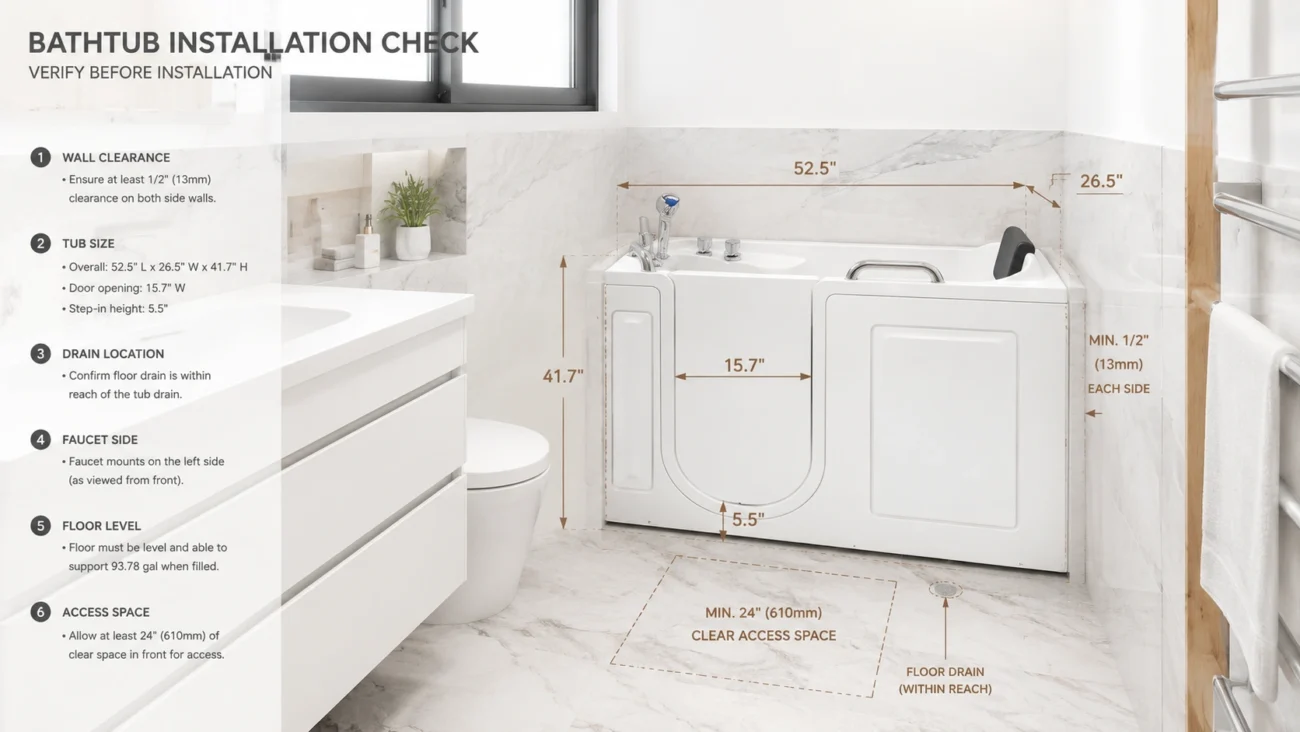
Bathtub Quality Checklist for Global Buyers
| Area | Acrylic Bathtub | Solid Surface Bathtub |
|---|---|---|
| Material | Acrylic/ABS structure and sheet details | Resin and mineral composition |
| Surface | Gloss, scratches and color consistency | Pinholes, pores and matte consistency |
| Structure | Fiberglass, resin, frame and bottom support | Wall thickness, casting density and flatness |
| Stability | Flexing, rim movement and filled-water test | Crack risk and heavy-load stability |
| Drainage | Drain opening, overflow and fittings | Drain opening, overflow and fittings |
| Installation | Feet, leveling and drain access | Floor strength, lifting and placement |
| Certification | Exact model and manufacturer listing | Exact model, material and manufacturer listing |
| Packaging | Foam, carton and internal support | Reinforced frame, corner and edge protection |
| Shipping | Scratching, flexing and shell impact | Edge chipping, cracking and handling risk |
For large orders, buyers should arrange random inspections instead of checking only one showroom sample.
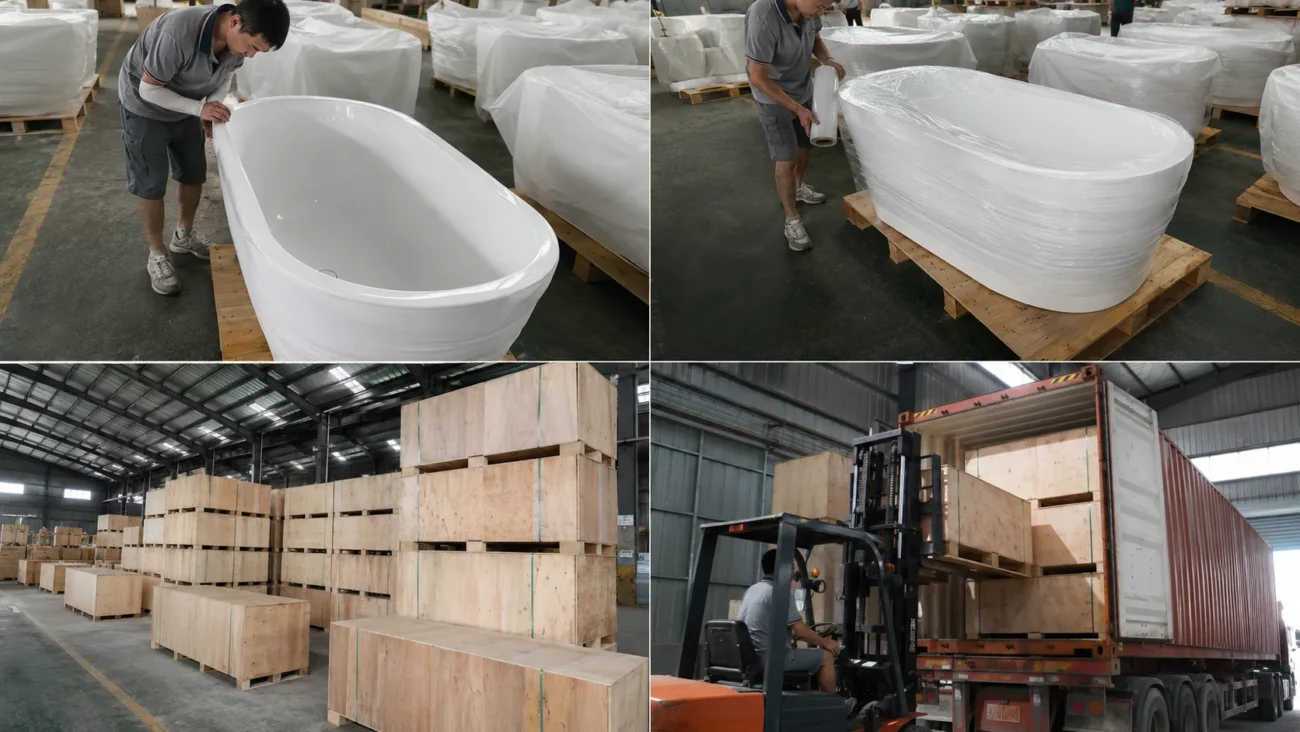
Packaging and Shipping Risks
Bathtubs look strong, but they are high-risk products in international shipping.
An acrylic tub has a large hollow body that can be damaged by impact or stacking pressure. A solid surface tub is heavier and may suffer cracks or edge chips during handling.
Common damage includes:
- Cracked rims
- Scratched surfaces
- Deformed acrylic shells
- Chipped solid surface edges
- Broken drains
- Damaged overflow parts
- Crushed cartons
- Forklift impact
- Missing accessories
- Incorrect stacking
Packaging should be treated as part of the product specification, not as a final warehouse decision.
Buyers should confirm:
- Protective bag
- Surface film
- Foam thickness
- Corner protectors
- Internal support
- Outer carton strength
- Wooden frame or crate
- Stack limit
- Forklift direction
- Accessory box
- Installation manual
- Carton marks
The tub should also be inspected after packaging. A strong product can still be damaged if it moves inside the carton.
For mixed-container shipments, bathtubs should not be placed under heavy tiles, stone, cabinets or other products that may create pressure.
For more information, read: 🔗 Bathroom Products Shipping from China: Packaging, Breakage and Container Loading Tips.
Common Mistakes When Buying Bathtubs from China
Common sourcing mistakes include:
- Selecting only by product photo
- Treating freestanding as a material type
- Comparing acrylic tubs without checking reinforcement
- Accepting “solid surface” without confirming material composition
- Not checking internal bathing dimensions
- Ignoring empty and filled weight
- Not confirming drain position
- Not checking installation access
- Assuming one certificate covers every model
- Not inspecting the bulk order
- Using standard cartons for heavy solid surface tubs
- Not planning container position and stacking
- Ignoring replacement and after-sales risks
Most problems can be reduced before production if the buyer provides clear technical and installation information.
A Realistic US Buyer Consultation Scenario
A common US buyer inquiry starts with a reference image and a simple question:
Can you find the same freestanding bathtub at a lower price in China?
But after discussing the project, several more important questions usually appear:
- Is the reference tub acrylic or solid surface?
- What is the required size?
- Is the bathtub going upstairs?
- What is the maximum acceptable weight?
- Does the project need a listed model?
- Where is the drain located?
- Will the faucet be wall-mounted or floor-mounted?
- Can the product be delivered without damage?
- How much will inland delivery cost after arrival?
The real sourcing question therefore becomes:
Can this bathtub match the bathroom layout, arrive safely and be installed correctly in the United States?
Buyers are often surprised that two visually similar tubs can have very different reinforcement, weights, usable space, packaging and final landed costs.
Where to Source Bathtubs in China
For project buyers, Foshan is a practical starting point because it allows comparison of bathtubs together with:
- Bathroom vanities
- Faucets
- Toilets
- Shower enclosures
- Tiles
- Mirrors
- Other renovation materials
However, a showroom visit should not replace factory verification.
After selecting the preferred material and models, buyers may need to visit or verify:
- Acrylic forming factories
- Solid surface casting factories
- Massage bathtub manufacturers
- Specialist export suppliers
- Certification-listed manufacturers
For remote sourcing, a practical process is:
Product brief → material confirmation → supplier shortlist → model and certification check → sample or video inspection → packaging confirmation → production inspection → container loading
The best sourcing route depends on whether the buyer is purchasing one bathtub model, developing an import product line or sourcing a full villa or hotel bathroom package.
How a Local Sourcing Team Adds Value
For bathtub sourcing, a local team should do more than send supplier catalogues.
Useful support includes:
- Confirming the buyer’s material and target price
- Comparing acrylic and solid surface structures
- Identifying the actual manufacturer
- Checking samples and dimensions
- Verifying model documentation
- Inspecting reinforcement and surface quality
- Reviewing packaging
- Coordinating multi-supplier consolidation
- Supervising container loading
- Following up on replacement parts or claims
Cody Sourcing works across South China furniture and building-material supply areas, helping overseas buyers compare bathroom suppliers, visit factories, inspect products and coordinate shipping.
The goal is not only to find bathtub manufacturers in China.
The goal is to select a bathtub that matches the project, installation conditions, import requirements and shipping plan.
Final Thoughts
Bathtub manufacturers in China should be compared by material structure, factory control, installation requirements and packaging—not only by design and price.
Acrylic bathtubs are generally more suitable for buyers who need lighter weight, wider model choices and more manageable shipping costs.
Solid surface tubs are suitable for premium projects that value matte texture, sculptural design and high-end positioning.
Freestanding tubs can be made from either material, so buyers should not treat “freestanding” as a separate material category.
Before ordering, confirm the exact material, reinforcement, internal dimensions, drain position, weight, model documentation and packaging method.
Successful bathtub sourcing is not about finding the cheapest tub with the right shape.
It is about finding a product that can be manufactured consistently, shipped safely and installed correctly in the target market.
