


Aluminum Door and Window Manufacturers in China: Factory Sourcing Guide

Many overseas buyers first send a photo of an aluminum sliding door, casement window or villa window system and ask for the factory price.
However, a product photo does not show the aluminum profile system, thermal break, glass thickness, hardware brand, drainage design, wind-load requirement, energy performance or installation opening.
Aluminum doors and windows should not be sourced as aluminum frames only. They are complete systems made from profiles, glass, spacers, gaskets, hardware, surface finishes, screens, drainage details, packaging and installation conditions.
Two aluminum windows may look almost the same in a showroom but perform very differently after installation.
This guide explains how global buyers can compare aluminum door and window manufacturers in China, understand factory types, prepare specifications, check glass and hardware, verify market requirements and reduce inspection and shipping risks.
For broader door and window sourcing topics, visit the Doors & Windows category.
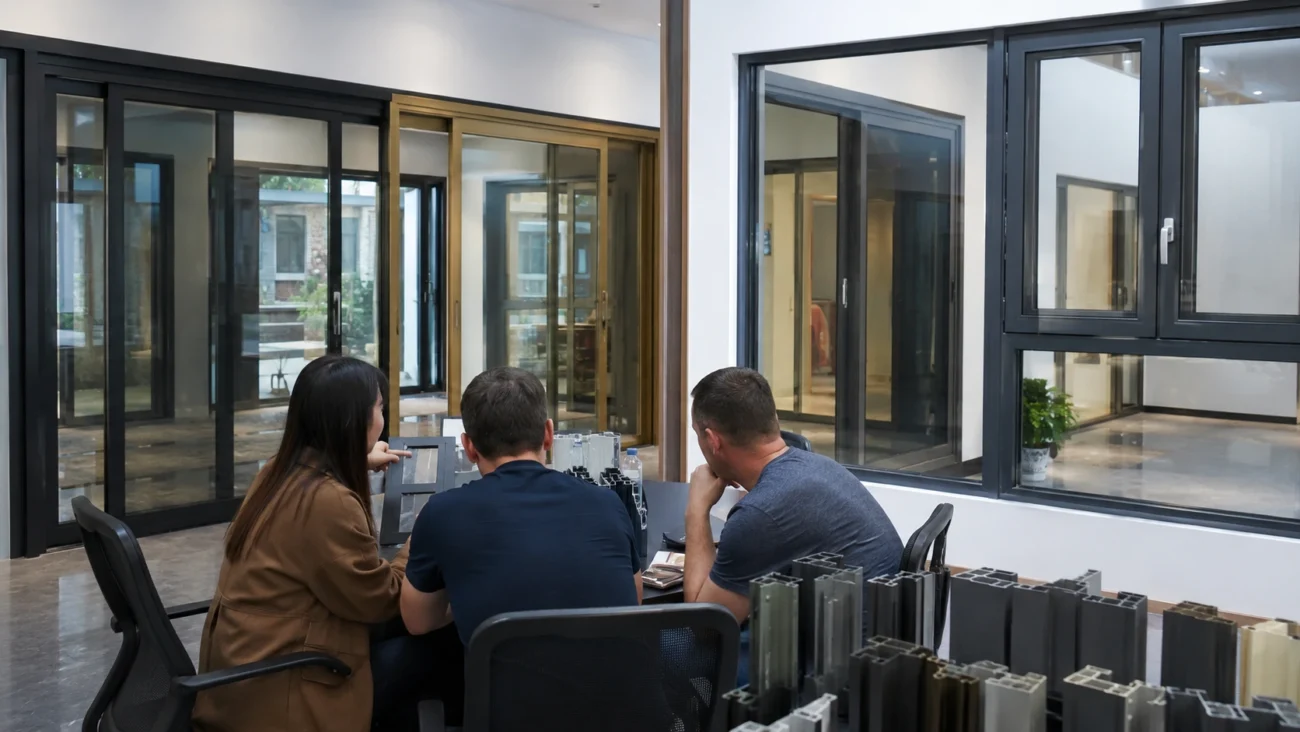
Why Aluminum Doors and Windows Should Be Sourced as Complete Systems
A common mistake is to compare aluminum doors and windows only by profile thickness.
Profile thickness is important, but it is only one part of the system. The final performance also depends on the profile design, aluminum alloy, thermal break strip, glass configuration, gasket pressure, drainage channel, corner joint, hardware quality and installation accuracy.
For example, a villa buyer may compare two black aluminum sliding doors with similar frame colors and glass panels. One quotation may use a basic sliding system with lighter rollers and ordinary double glass. Another may use a stronger profile system, better rollers, laminated safety glass, improved drainage and stronger packaging for international shipment.
The visible design may look similar, but the final product is not the same.
For project buyers, the real question is not only:
Which factory gives the lowest price?
A better question is:
Which complete window and door system can match the project opening, climate, performance needs, shipping route and installation conditions?
This is why buyers should define the system before comparing quotations.
What Buyers Should Prepare Before Requesting Quotations
A reliable quotation cannot usually be prepared from a photo alone.
Before contacting Chinese suppliers, buyers should prepare the project location, building type, opening sizes, product type, glass requirement, color, hardware expectations and destination market.
For residential, villa, hotel or apartment projects, drawings are more useful than screenshots from Pinterest or Instagram.
Useful information includes:
- Project country and city
- Residential, villa, hotel or commercial use
- Opening dimensions
- Window or door type
- Quantity and schedule
- Wall thickness
- Interior or exterior application
- Required color and surface finish
- Glass type and thickness
- Thermal break requirement
- Screen requirement
- Hardware preference
- Wind, rain or acoustic requirement
- Certification or energy-performance requirement
- Destination port or delivery address
Opening dimensions must be checked carefully.
A window can be manufactured according to the drawing but still create installation problems if the rough opening, finished wall, flooring level or waterproofing detail changes on site.
For large sliding doors and lift-and-slide systems, the buyer should also confirm the final floor height, threshold design, drainage method and unloading conditions at the destination.
Main Types of Aluminum Door and Window Manufacturers in China
Not every supplier displaying aluminum doors and windows controls the same part of the supply chain.
Some companies produce aluminum profiles. Some assemble complete window systems. Some mainly operate showrooms. Others provide export coordination and project management.
Understanding the supplier type helps buyers avoid comparing quotations that are not based on the same scope.
Aluminum Profile Factories
Aluminum profile factories focus on extrusion, surface treatment, anodizing, powder coating, wood-grain finishing and profile supply.
They may have strong control over aluminum profile production but may not be the best choice for a buyer who needs complete villa windows, glass, hardware, screens, packaging and export coordination.
A profile factory can be useful when the buyer already has a mature system design or needs long-term profile supply.
However, for project buyers, the profile is only the starting point.
System Door and Window Factories
System door and window factories are usually more suitable for villas, hotels, apartments and full renovation projects.
They can provide complete products such as sliding doors, casement windows, folding doors, lift-and-slide doors, fixed windows and curtain-wall-related systems.
A strong factory should be able to explain how the profile, glass, hardware, sealing and drainage work together.
It should also understand fabrication drawings, installation openings, packing methods and container loading.
Showroom Brands
In places such as Foshan, buyers may visit large showrooms displaying many aluminum door and window systems.
This is useful for comparing styles, opening methods, frame colors, hardware options and glass choices in one location.
However, a showroom visit should not replace factory verification.
Buyers should still confirm who manufactures the selected product, where the glass is processed, which profile system is used, whether export packaging is available and who is responsible for after-sales issues.
Trading or Export Suppliers
Trading or export suppliers are not automatically unsuitable.
For overseas buyers, communication, documentation, inspection, packaging and shipment coordination are often as important as the factory itself.
The key question is not whether the supplier calls itself a factory.
The key question is which part of the system it actually controls and how it handles problems before shipment.
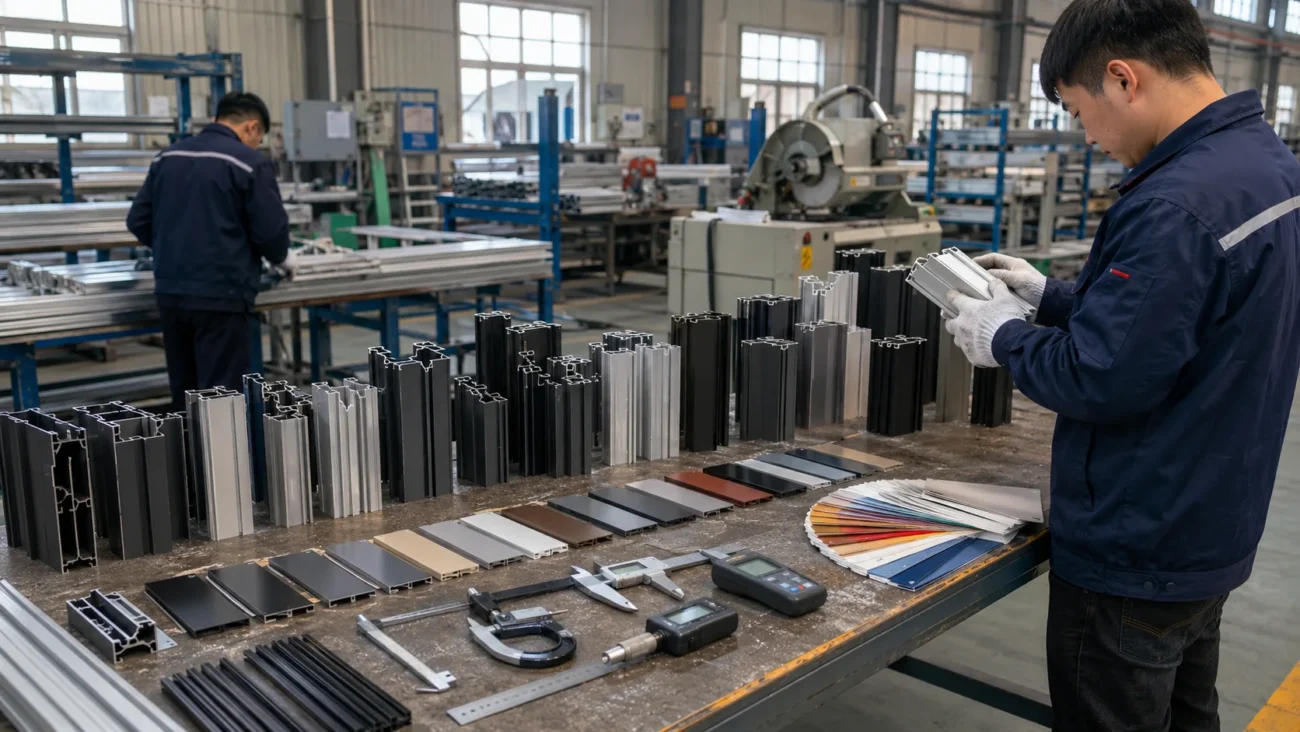
Aluminum Profiles, Thermal Breaks and Surface Finishes
Aluminum profile quality affects strength, durability, appearance and performance.
Buyers should not ask only for a general profile thickness. They should understand which parts of the frame and sash are being measured, what profile series is being used and whether the structure is suitable for the opening size.
For larger panels, stronger profiles and better reinforcement may be required.
Thermal break aluminum windows are especially important for buyers in colder climates, hot climates or higher-end projects.
A thermal break system uses an insulating strip between the interior and exterior aluminum sections. This helps reduce heat transfer, but the final performance still depends on the whole system, including glass, spacer, gasket, frame design and installation.
A thermal break profile with weak glass or poor sealing will not perform like a properly designed system.
Surface finish also matters.
Common options include powder coating, anodizing, fluorocarbon coating and wood-grain finishes. For coastal areas, strong sunlight, high humidity or heavy rain, buyers should discuss surface durability and corrosion resistance before placing an order.
A black powder-coated frame may look attractive in a showroom, but exterior exposure, salt air and cleaning chemicals can affect long-term performance if the finish is not suitable.
Glass, Hardware, Sealing and Drainage
Glass selection is one of the most important cost and performance factors.
Buyers may request double glazing, tempered glass, laminated glass, Low-E glass, tinted glass or acoustic glass. However, these terms alone are not enough for a complete specification.
A proper glass specification should include thickness, structure, spacer, air or gas gap, Low-E position, safety requirement and applicable local rules.
For large sliding doors, glass weight directly affects the roller system, frame strength, lifting method and final installation.
Hardware is another key difference between cheap and reliable systems.
Handles, hinges, rollers, locks, friction stays, multi-point locking systems and lift-and-slide mechanisms all affect daily use.
A high-quality profile system with weak hardware can still fail after repeated opening and closing.
Sealing and drainage should also be reviewed before production.
Water leakage problems often come from poor drainage design, weak gasket pressure, incorrect sill design or installation mistakes rather than the aluminum frame itself.
For rainy climates, balconies, terraces and exposed villa openings, the drainage structure should be discussed together with the site condition.
Sliding, Casement, Folding and Lift-and-Slide Systems
Different aluminum door and window systems serve different project needs.
A sliding door may be suitable for balconies, hotel terraces, restaurant patios or villa garden openings. Buyers should pay attention to track design, roller quality, drainage, panel weight, glass safety and locking structure.
A casement window usually provides stronger sealing than a basic sliding window. It may be preferred for bedrooms, villas, colder climates or projects requiring better air tightness. However, hinge quality, opening angle, wind pressure and hardware durability should be checked carefully.
A folding door can create a wide opening for villas, restaurants, cafés and terrace projects. The main risks are panel alignment, hinge durability, track accuracy, water drainage and installation precision. A small factory mistake may make the folding panels difficult to close smoothly.
Lift-and-slide doors are often used for high-end villas and large openings.
They can support heavier panels and larger glass areas, but they require better hardware, stronger tracks, accurate fabrication and careful installation.
Before ordering large systems, buyers should confirm glass weight, panel size, threshold design, drainage, site lifting method and whether the final destination can unload and move the product safely.
US and Overseas Compliance: NFRC, ENERGY STAR and Import Checks
For US buyers, aluminum doors and windows should not be evaluated only by the words “double glass” or “Low-E.”
The ENERGY STAR Version 7.0 specification for residential windows, doors and skylights took effect on October 23, 2023. For applicable residential projects, buyers should check whether the product must meet local energy-performance requirements before ordering.
NFRC is an important certification and rating organization for energy performance information related to windows, doors and skylights. Buyers may need to review performance values such as U-factor, Solar Heat Gain Coefficient, Visible Transmittance and air leakage, depending on the project and local requirements.
A Chinese supplier may say:
We can make Low-E double glass.
But the buyer may need to ask:
Is this exact window or door system suitable for the local permit, energy code or certification requirement?
Low-E glass alone does not prove whole-window performance.
The frame, thermal break, glass, spacer, gasket and assembly method all affect the final result.
For official information, buyers can review the 🔗ENERGY STAR residential windows, doors and skylights program and the 🔗NFRC website.
Import Classification and Tariffs
US buyers should also confirm import classification and duty exposure before placing a large order.
The USITC Harmonized Tariff Schedule includes aluminum doors, windows, frames and thresholds under HTS 7610.10.00, but importers should still confirm the correct classification, current duty rate, additional tariffs, product description and documentation with their customs broker.
Current classifications can be checked through the USITC Harmonized Tariff Schedule.
This article is not customs, legal or energy-code advice. Buyers should confirm requirements with their local architect, builder, inspector, certification consultant or customs broker before production.
A Realistic Overseas Buyer Consultation Scenario
A common inquiry starts with a photo of black aluminum sliding doors.
The buyer may ask whether a Chinese factory can make the same style at a lower price.
At first, the discussion seems to be about design and product price. However, after reviewing the project, the real questions become more specific.
What is the opening size? How large is each glass panel? Is the door exposed to rain? Does the project require thermal break profiles? Is the glass tempered, laminated or Low-E? Will the system need screens? Can the product meet local permit requirements? How will it be packed, unloaded and installed?
For villa renovation projects, aluminum doors and windows also need to be discussed together with flooring height, balcony drainage, wall openings, furniture layout and shipping sequence.
The real question is not only whether a factory can copy the appearance.
The real question is whether the complete system can be manufactured, shipped and installed correctly at the destination.
This is why a sourcing discussion often moves from “factory price” to “project control.”
Quality Inspection Before Shipping
Aluminum door and window inspection should cover more than color and surface appearance.
Inspectors should check dimensions, frame squareness, sash alignment, glass structure, rubber gaskets, locks, handles, rollers, hinges, drainage holes and opening operation.
For sliding doors, the panel should move smoothly without abnormal noise, shaking or resistance. The track, rollers and locking system should be tested before packing.
For casement windows, inspectors should check hinge operation, sealing pressure, handle movement, opening angle and frame alignment.
For folding doors, the panels should fold smoothly and align correctly when closed.
For thermal break systems, the profile structure and glass configuration should match the confirmed specification.
Surface finish should also be checked under proper lighting. Scratches, color differences, coating defects and damaged corners can become more visible after installation.
For project orders, random production units should be checked against the window schedule. The window number, opening size, glass specification, color, hardware and packing label must match the project documents.
One approved sample cannot prove that every production unit is correct.
Packaging, Numbering and Container Loading
Aluminum doors and windows are large, fragile and easy to damage during international transportation.
Glass can break, frames can bend, corners can dent and surface finishes can be scratched if packaging is too weak.
Large sliding doors and oversized glass panels require special protection because the product may be moved several times before final installation.
Packaging should include surface film, corner protection, foam, carton, wooden frame or crate when needed.
For project orders, numbering is as important as protection.
Each package should clearly show:
- Window or door number
- Room number
- Floor
- Opening size
- Glass type
- Color
- Hardware set
- Package number
Frames, sashes, screens, glass panels and accessories may be packed separately, but they must remain connected to the same project opening.
A window can arrive without damage but still delay installation if the matching screen, hardware pack or frame component is missing.
During container loading, heavy frames and glass units should be fixed securely to prevent movement. Products should not be pressed by heavy tiles, stone, cabinets or other building materials in a mixed container.
For multi-category villa or hotel shipments, loading sequence should be planned together with unloading and installation sequence.

Where to Source Aluminum Doors and Windows in China
China has several door and window manufacturing clusters, but buyers should choose the sourcing route according to product type and project needs.
Foshan Nanhai for Aluminum Profiles and System Windows
Foshan Nanhai, especially the Dali area, is highly relevant for aluminum profiles, system doors and windows, hardware matching, showrooms and project product selection.
The local aluminum profile industry association uses “Nanhai Aluminum” as a regional industry brand, and many companies in the area serve aluminum profile, window, door and building-material markets.
This makes Foshan useful for villa, hotel and renovation buyers who want to compare aluminum doors and windows together with tiles, bathroom products, cabinets, furniture and lighting.
However, buyers should still verify whether the supplier is a profile factory, a system window factory, a showroom brand or an export trading company.
Guangdong and Other Export-Oriented Factories
Beyond Foshan, buyers can also find aluminum door and window factories in other parts of Guangdong and other coastal manufacturing regions.
Some factories focus on domestic residential projects, while others are more experienced with overseas orders, export packaging and project documentation.
For overseas buyers, export experience matters.
The factory should understand drawings, labeling, glass safety, packaging, container loading and after-sales communication.
Compliance-Led Sourcing for Regulated Markets
For markets with strict energy, wind-load, hurricane, safety-glass or building-code requirements, sourcing should begin with the project standard rather than the factory location.
A practical sequence is:
Project location → performance requirement → profile system → glass specification → hardware → certification or rating check → factory verification → sample review → production inspection
The right sourcing route depends on whether the buyer needs a single house package, a hotel project, a retail window line or a long-term supplier.
How a China-Based Sourcing Team Helps
A China-based sourcing team should do more than send supplier catalogues.
For aluminum door and window projects, useful support begins with reading drawings, clarifying missing dimensions and turning the buyer’s openings into a supplier quotation sheet.
The team can help compare profile systems, glass configurations, hardware options, surface finishes, packaging methods and factory capabilities.
It can also coordinate samples, production follow-up, inspection, package numbering, warehouse consolidation and container loading.
Cody Sourcing works with door, window and building-material suppliers across South China, helping overseas buyers compare products, visit factories, inspect orders and coordinate shipment.
The goal is not only to find aluminum door and window manufacturers in China.
The goal is to help buyers connect project requirements, supplier capability, quality control, packaging and shipping into one manageable process.
Common Mistakes to Avoid
Common mistakes when sourcing aluminum doors and windows from China include:
- Comparing only profile thickness
- Requesting a quotation from a photo only
- Ignoring glass structure and safety requirements
- Treating Low-E glass as proof of whole-window performance
- Not confirming thermal break requirements
- Not checking hardware quality
- Ignoring drainage design
- Choosing sliding doors without checking roller capacity
- Choosing folding doors without checking alignment and track accuracy
- Not confirming wall opening and floor height
- Ignoring energy-code or permit requirements
- Assuming every supplier can provide export packaging
- Not matching window numbers with the project schedule
- Placing fragile glass products under heavy goods in a mixed container
- Not arranging inspection before shipment
Most of these problems can be reduced before production when the buyer provides complete project information and confirms the system instead of only the appearance.
Final Checklist Before Confirming an Order
Before paying the deposit, buyers should confirm:
- Project country and city
- Building type
- Product type
- Opening size
- Finished wall and floor conditions
- Profile system
- Profile thickness
- Thermal break requirement
- Surface finish and color
- Glass structure
- Glass safety requirement
- Hardware system
- Screen requirement
- Drainage design
- Wind, rain, acoustic or energy-performance needs
- Certification or rating requirements
- Window and door schedule
- Package numbering system
- Packaging specification
- Production lead time
- Inspection method
- Destination and unloading conditions
- Container-loading plan
The safest purchasing decision is not always the cheapest aluminum frame quotation.
It is the complete aluminum door and window system that matches the building opening, local climate, performance requirement, installation condition and shipping plan.
