


Smart Toilet Manufacturers in China: Ceramic Base, Electronics and Certifications

Smart toilet manufacturers in China should not be selected only by product appearance, function list or factory price.
A smart toilet is not just a ceramic toilet with electronic functions added. It is a ceramic product, an electrical product, a water system, an installation product and an after-sales product at the same time.
For global buyers, this makes smart toilet sourcing more complex than ordinary ceramic toilet sourcing.
A normal toilet mainly requires checks on ceramic body, glaze, flushing, seat cover and packaging. A smart toilet also requires checks on PCB, heating system, sensor, nozzle, remote control, voltage, water pressure, electrical safety, certification and spare parts.
This guide explains how buyers can evaluate smart toilet manufacturers in China more practically.

Latest Market Notes for Smart Toilet Buyers
Smart toilets are no longer only high-end bathroom products for a small market.
More buyers now ask for heated seats, automatic flushing, warm water washing, nozzle cleaning, drying, remote control, foot sensors and better hygiene functions.
In China, smart toilet products are also becoming more standardized. The national standard GB/T 34549-2024, Sanitary ware — Smart toilet, covers areas such as product classification, performance, electrical safety, inspection rules, marking, installation instructions, packaging, transportation and storage.
For overseas buyers, this means smart toilet sourcing should be handled more carefully.
The buyer should not only ask:
“Does this toilet have automatic flushing and heated seat?”
A better question is:
“Can this exact model meet my target market requirements, installation conditions, voltage, water pressure and after-sales needs?”
Why Smart Toilet Manufacturers Are Different from Ceramic Toilet Factories
A ceramic toilet factory may be strong at ceramic body production, glazing, kiln firing and flushing design.
But a smart toilet manufacturer needs more than ceramic production ability.
A smart toilet supplier should understand:
- Ceramic base production
- Smart seat matching
- Electronic control system
- Heating system
- Water system
- Sensor function
- Waterproof protection
- Electrical safety
- Certification requirements
- Spare parts supply
- After-sales support
This is why buyers should not treat smart toilet sourcing as a normal toilet order.
Some factories are strong in ceramic bases but weak in electronics. Some suppliers are strong in smart seat assembly but depend on outside ceramic factories. Some showroom suppliers may have attractive designs but limited control over production and testing.
Before placing an order, buyers should understand what the supplier actually controls.
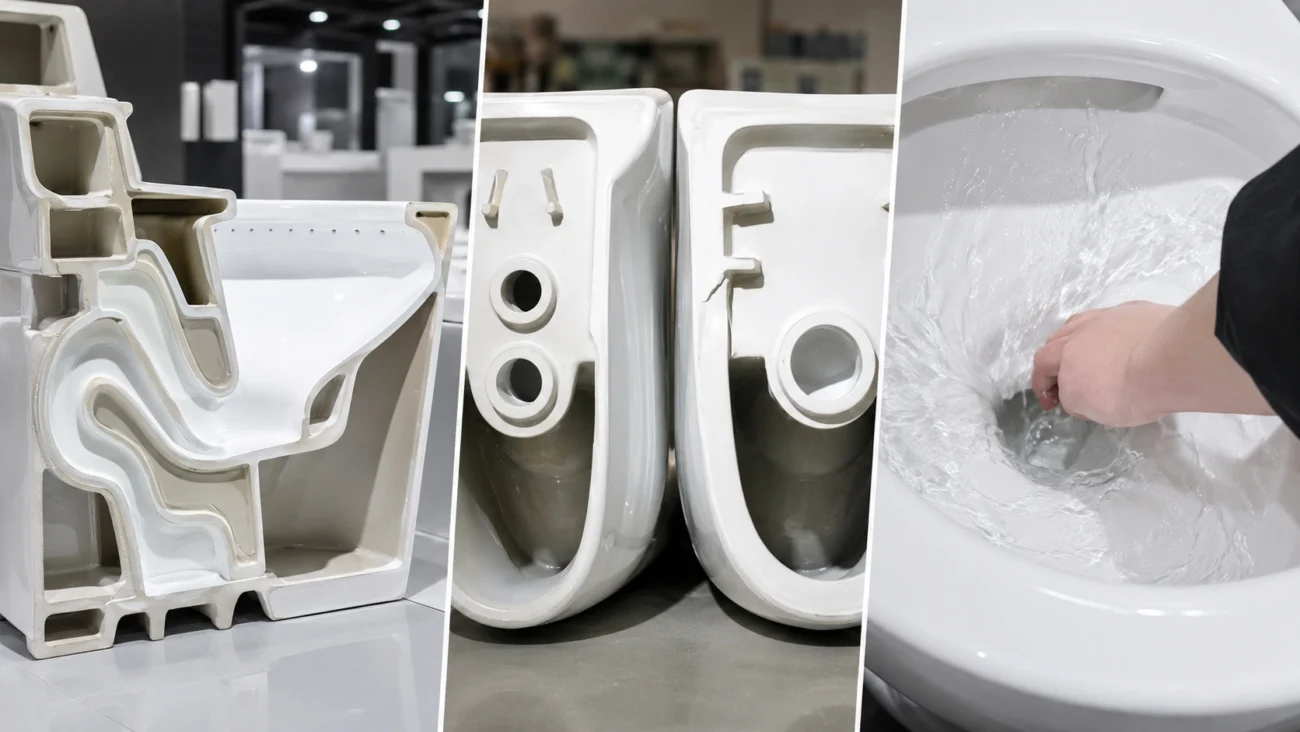
Ceramic Base: What Buyers Should Check
The ceramic base is the foundation of a smart toilet.
If the ceramic base is poor, the electronic functions cannot solve the problem.
Buyers should check:
- Ceramic body shape
- Glaze smoothness
- Surface defects
- Water absorption
- Ceramic deformation
- Bowl design
- Trapway quality
- Flushing performance
- Seat cover fit
- Smart module fit
- Packaging protection
Some smart toilet problems are not caused by electronics. They start from the ceramic base: poor glaze, unstable flushing, deformation, weak structure or poor matching between the ceramic body and the smart seat.
For smart toilets, the ceramic base must match the smart seat, nozzle position, water system and installation structure.
A buyer should not only look at the product photo. The buyer should check the ceramic body, flushing effect, seat alignment and packaging before confirming mass production.
Electronics: Why Function Lists Are Not Enough
Many smart toilet suppliers provide a long function list.
Common functions include:
- Heated seat
- Warm water washing
- Drying
- Automatic flushing
- Foot sensor
- Remote control
- Night light
- Deodorization
- Instant heating
- Nozzle cleaning
But a longer function list does not always mean a better product.
For smart toilet sourcing, stability, safety and after-sales parts are more important than adding every possible feature.
Buyers should ask deeper questions:
- Who supplies the PCB?
- Is the heating system stable?
- Is it instant heating or tank heating?
- What is the failure rate?
- Are spare parts available?
- Can the supplier provide testing reports?
- Is the control panel waterproof enough?
- What happens if the remote control fails?
- Can the same model be maintained after shipment?
A smart toilet may look modern in a showroom, but if the electronic system is unstable, the product can create serious after-sales problems.
This is especially important for importers, hotel projects, apartment projects and bathroom product brands.

Water System, Heating and Sensor Stability
The water system is another key part of smart toilet quality.
Buyers should check:
- Water pressure requirement
- Nozzle cleaning
- Leakage test
- Pipe connection
- Instant water heating
- Seat heating
- Temperature stability
- Sensor sensitivity
- Automatic flushing stability
- Water protection around electrical parts
Different markets may have different installation conditions.
A smart toilet that works well in one country may not work smoothly in another market if the water pressure, plug type, voltage or bathroom layout is different.
This is why buyers should confirm installation conditions before ordering.
For project buyers, the supplier should also provide clear installation instructions and technical support.
Certifications for Smart Toilets by Target Market
Certification is one of the most important parts of smart toilet sourcing.
Buyers should not only ask:
“Do you have certification?”
A better question is:
“Is this exact model certified for my target market?”
This is important because some suppliers may show certificates that do not match the exact model, function, component or market requirement.
Different markets may require different checks.
US and Canada
Buyers may need to check:
- cUPC / UPC
- ETL or UL-related electrical safety
- WaterSense if water efficiency is required
- ADA if accessibility is required for the project
- Local plumbing and electrical requirements
Europe
Buyers may need to check:
- CE
- RoHS
- REACH if applicable
- Electrical safety requirements
- Water and installation requirements
Australia
Buyers may need to check:
- WaterMark
- Electrical safety requirements
- Voltage and plug
- Local installation requirements
Middle East and GCC Markets
Buyers may need to check:
- SASO
- G-Mark
- Local water and electrical requirements
- Country-specific import requirements
This article is not legal or certification advice. Buyers should confirm exact requirements with their importer, testing partner, customs broker or local compliance consultant before placing large orders.

Smart Toilet Quality Checklist for Global Buyers
| Area | What Buyers Should Check |
|---|---|
| Ceramic Base | Glaze, deformation, flushing, water absorption, seat fit |
| الالكترونيات | PCB, control system, remote control, sensor, waterproof design |
| Heating | Instant heating, seat heating, water temperature stability |
| Water System | Nozzle cleaning, water pressure, leakage test, pipe connection |
| Safety | Voltage, plug, electrical safety, waterproof protection |
| Certification | cUPC, ETL/UL, CE, WaterMark, WaterSense or local requirements |
| Packaging | Foam protection, carton strength, spare parts, manuals |
| After-Sales | Spare parts list, warranty terms, failure rate, service support |
This checklist should be reviewed before placing the order, not after production has already started.
For smart toilet buyers, the risk is not only product damage during shipping. The bigger risk is receiving products that cannot be installed, certified, maintained or supported in the target market.
Common Mistakes When Buying Smart Toilets from China
Many smart toilet sourcing problems happen because buyers focus too much on price and functions.
Common mistakes include:
- Choosing suppliers only by appearance
- Comparing only function lists
- Not checking ceramic base quality
- Ignoring flushing performance
- Not confirming voltage and plug type
- Not checking water pressure requirement
- Assuming all certificates apply to the exact model
- Not asking for spare parts
- Not confirming after-sales support
- Not testing samples before bulk order
- Using weak packaging for fragile smart toilets
- Not checking installation manuals
- Not arranging inspection before shipment
A low-cost smart toilet may become expensive if the buyer faces complaints, installation problems, spare part shortage or certification issues after delivery.
Where to Source Smart Toilets in China
China has several supply chain areas related to smart toilets and bathroom products.
Chaozhou and Chao’an
Chaozhou and Chao’an are important for ceramic sanitary ware and smart bathroom industry development.
They are suitable for buyers who want to compare ceramic toilet bases, sanitary ceramic production and smart toilet suppliers connected with ceramic production.
فوشان
Foshan is useful for project bathroom sourcing.
Buyers can compare smart toilets together with bathroom vanities, tiles, faucets, shower enclosures and full bathroom solutions.
For hotel, villa, apartment and renovation projects, Foshan can be a practical first stop.
Other Smart Bathroom Supplier Areas
Some smart toilet suppliers may be stronger in electronics, assembly, testing or export certification experience.
For these suppliers, buyers should pay attention to R&D ability, testing process, electronic component control, spare parts and certification support.
The best supplier region depends on whether the buyer needs ceramic production strength, smart toilet electronics, project bathroom matching or export certification support.
Sample Testing Before Bulk Orders
For smart toilets, sample testing is highly recommended.
Buyers should test:
- Flushing performance
- Heated seat
- Water heating
- Nozzle cleaning
- Drying function
- Remote control
- Foot sensor
- Automatic flushing
- Leakage protection
- Installation accessories
- Manual clarity
- Spare parts availability
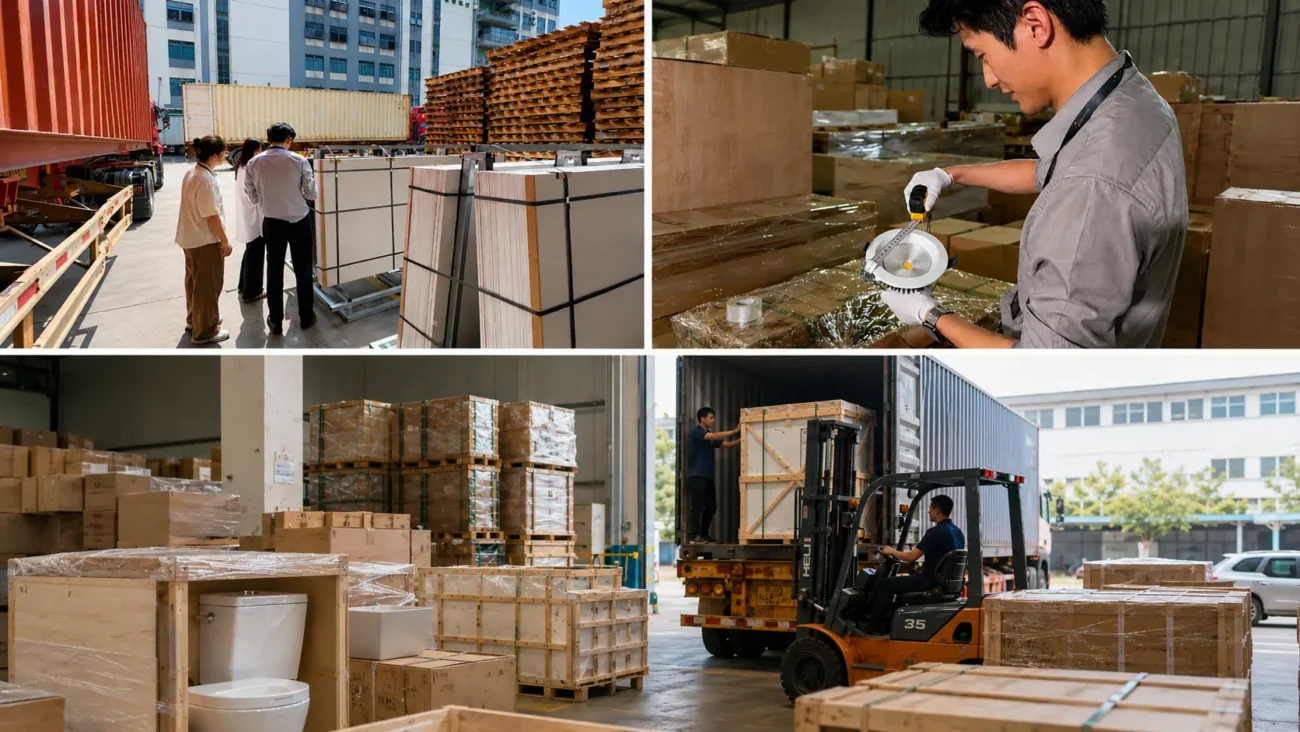
Sample testing should also include packaging review.
Smart toilets are fragile because they combine ceramic body and electronic components. If packaging is weak, damage during shipment can affect both ceramic structure and electronic function.
Packaging and Shipping Risks
Smart toilets need stronger packaging than many ordinary bathroom products.
Buyers should check:
- Foam protection
- Carton strength
- Wooden crate if needed
- Smart seat protection
- Remote control packaging
- Accessory box
- Manual and label
- Drop risk
- Container loading position
Smart toilets should not be loaded casually with heavy tiles, stone products or sharp-edged materials.
For mixed bathroom product shipments, warehouse consolidation and loading supervision are important.
For more shipping details, read: 🔗Bathroom Products Shipping from China: Packaging, Breakage and Container Loading Tips.
How a Local Sourcing Team Helps Smart Toilet Buyers
For smart toilet sourcing, the value of a local sourcing team is not only finding supplier names.
The real value is helping buyers check whether the supplier can control ceramic base quality, electronic stability, certification matching, packaging, inspection and shipping.
Cody Sourcing works across South China bathroom product supply areas, including Guangzhou, Foshan, Chaozhou and nearby regions, helping global buyers compare bathroom product suppliers, arrange factory visits, inspect goods and coordinate shipping.
For smart toilet buyers, local support can help with:
- Supplier shortlisting
- Factory or showroom visits
- Sample comparison
- Ceramic base checking
- Function testing
- Certification document review
- Packaging inspection
- Production follow-up
- Container loading coordination
The goal is not only to find smart toilet manufacturers in China.
The goal is to find a supplier whose products can work safely, reliably and legally in the buyer’s target market.
Final Thoughts
Smart toilet manufacturers in China should be evaluated more carefully than ordinary toilet suppliers.
A smart toilet is not only about appearance or functions. Buyers need to check ceramic base quality, electronic system stability, water heating, sensor performance, target market certification, spare parts, packaging and after-sales support.
For global buyers, the safest sourcing method is to define the target market first, then check the exact model, required certification, installation conditions and supplier control ability before placing an order.
Successful smart toilet sourcing is not about choosing the supplier with the longest function list.
It is about choosing a supplier that can deliver stable quality, clear certification, reliable spare parts and safe shipping.
