


Door Manufacturers in China: Wooden, Steel and Fire-Rated Door Sourcing Guide

Many overseas buyers first send a door photo and ask for a price.
However, a product photo does not show the wall thickness, frame depth, opening direction, internal core, hardware set, fire-rating requirement or installation conditions. These hidden details often create a larger cost difference than the visible door design.
A door is not only a door leaf. It is a complete system that may include the leaf, frame, hinges, lock, handle, closer, seals, threshold, glazing, finish and installation accessories.
Two doors with almost the same appearance may have very different internal structures, hardware preparation, certification coverage and long-term performance.
This guide explains how global buyers can compare door manufacturers in China, prepare useful specifications, understand wooden and steel door quality, verify fire-rated door systems and reduce installation and shipping risks.
For buyers sourcing a complete residential package, read: 🔗How to Buy Villa Building Materials from China.
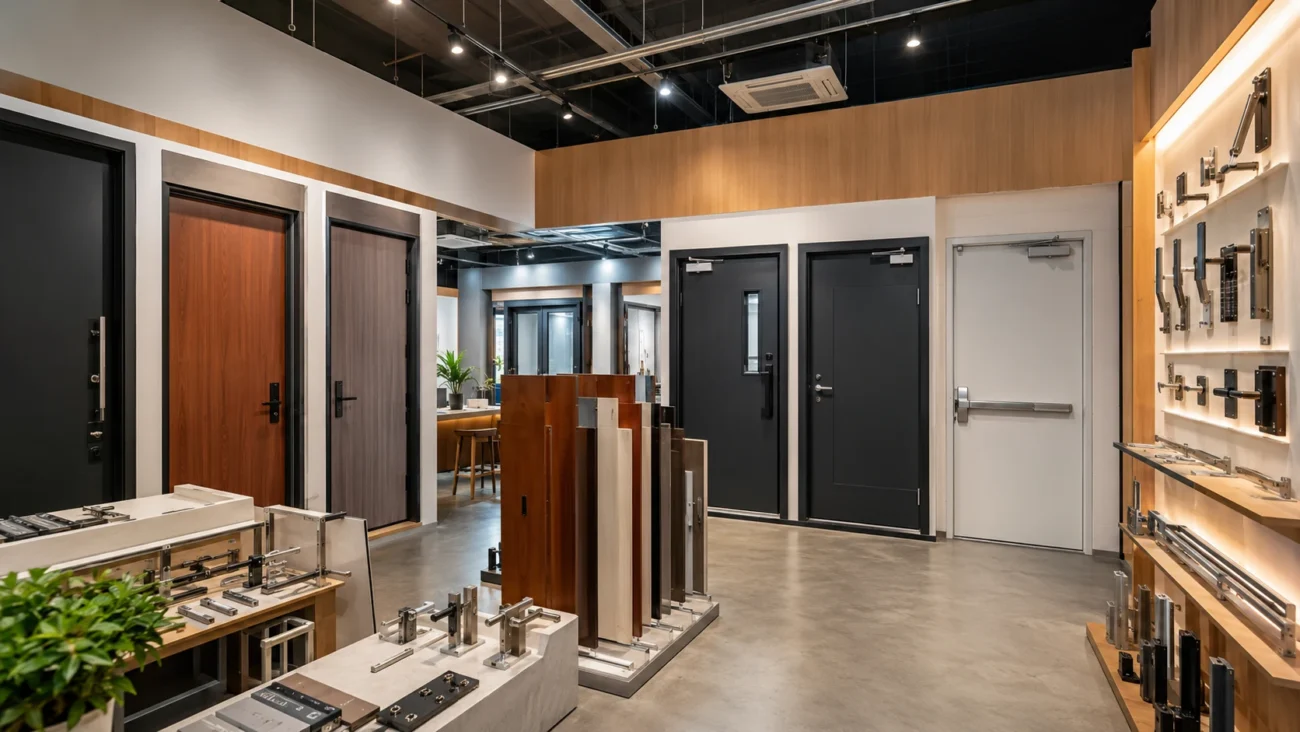
Why Door Buyers Need More Than a Supplier Catalogue
A supplier catalogue is useful for comparing styles, finishes and basic dimensions, but it rarely explains the complete door structure.
For example, two wooden doors may use the same veneer and color while having different cores, internal reinforcement and moisture stability. Two steel entrance doors may look almost identical from the front, but one may use a thinner frame, fewer reinforcement sections and a lower-grade locking system.
The quotation scope can also be different.
One supplier may quote only the door leaf. Another quotation may include the frame, architrave, hinges, lock, handle, closer, seals, threshold, installation accessories and export packaging.
The lowest quotation is therefore not always the lowest price for the same product.
Before comparing suppliers, buyers need to define whether they are purchasing a door leaf, a door set or a complete project opening system.
What Buyers Should Prepare Before Requesting Door Quotations
A reliable quotation normally requires more than a reference image.
Buyers should provide the project application, destination market and basic dimensions. They should also clarify whether the door is for a bedroom, hotel room, apartment entrance, villa entrance, fire compartment or commercial building.
For multi-door projects, a door schedule is especially important.
Useful information includes:
- Door number and room location
- Opening size and door-leaf size
- Wall thickness
- Single or double leaf
- Left-hand or right-hand opening
- Inward or outward opening
- Door material and finish
- Frame and architrave requirements
- Lock, hinge and handle requirements
- Fire, acoustic, security or weather requirements
- Required quantity
- Destination country
Wall thickness is often overlooked because buyers focus first on the visible door size.
However, the same door leaf may require a very different frame for a lightweight partition wall and a thick concrete wall. When the frame depth is wrong, the problem often appears only during installation, when local modification becomes expensive.
Opening direction is another common source of error. A door can be manufactured to the correct dimensions and finish but still be unusable because the handing or swing direction is wrong.
How to Compare Door Manufacturers in China
Not every company displaying doors is the actual manufacturer.
Some suppliers manufacture complete door sets. Others produce the door leaf but purchase frames, cores, decorative panels or hardware from different factories. Large building-material showrooms may display products from several manufacturers under one sales company.
This does not automatically make a showroom supplier or trading company unsuitable.
The more important question is which parts of the order the supplier controls.
A reliable supplier should be able to explain where the leaf and frame are produced, who supplies the core and hardware, how dimensions are checked, how finishes are matched between batches and who is responsible when a component does not fit.
For fire-rated products, buyers also need to know who owns the certification or listing and whether the selected configuration is actually covered.
The best supplier is not always the company with the largest showroom. It is the supplier that can control the specifications, production, documentation and packaging required for the project.
Wooden Door Manufacturers in China
China produces solid wood doors, engineered wooden doors, veneer doors, painted doors, laminate doors, hotel room doors and customized entrance doors.
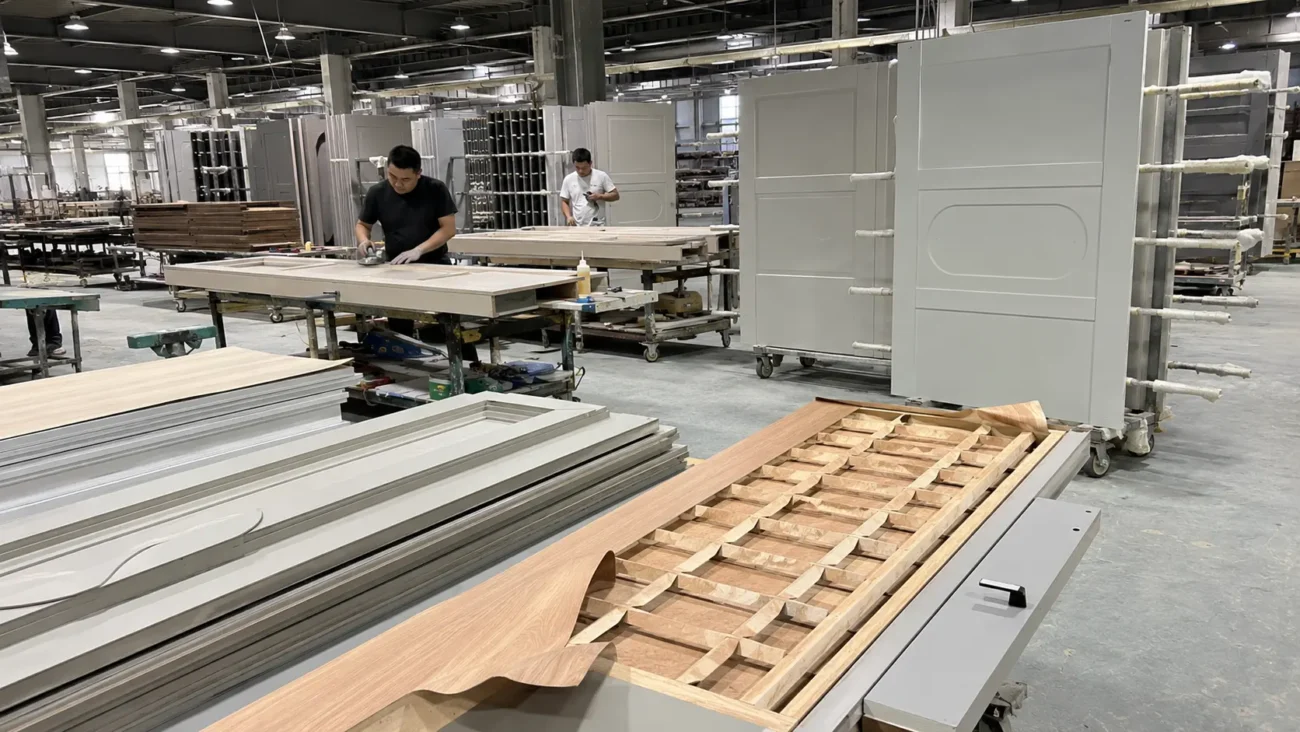
Buyers usually notice the surface finish first. However, the most important quality differences are often hidden inside the door.
A lower-priced wooden door may use a lighter core, weaker internal reinforcement or less stable frame materials. These differences may not be visible in showroom photos, but they can affect deformation, hardware strength, acoustic performance and long-term use.
What Buyers Should Check
The supplier should clearly describe the door core, leaf thickness, frame structure, edge treatment and finish system.
For a hotel entrance door or a heavy residential door, the lock, hinges and closer may need additional internal reinforcement. Without proper reinforcement, screws can loosen and hardware can move after repeated use.
Moisture control also matters.
A wooden door manufactured in a humid climate may later be installed in a dry, heated or air-conditioned building. Poor material moisture control, unbalanced veneer construction or weak edge sealing can lead to warping, cracking or movement.
The factory should be able to explain how timber and engineered materials are dried, pressed, cured and finished.
For project orders, the door leaf, frame and architrave should be checked together. A door leaf may match the approved sample while the frame has a different color, grain or gloss level.
Buyers should approve a physical finish sample and use it as the reference for production inspection.
Steel and Security Door Manufacturers in China
The term “steel door” can describe very different products.
It may refer to an apartment security door, villa entrance door, armored door, commercial hollow-metal door, insulated exterior door or steel fire-rated door.
These products should not be compared as if they have the same structure and purpose.
A steel-door quotation should describe the steel material, leaf construction, sheet thickness, frame thickness, internal reinforcement, core, locking system, hinge design, surface treatment and installation method.
Low-price steel doors can look similar to stronger products from the outside. The real difference may be hidden in thinner steel sheets, lighter frames, fewer reinforcement sections or simpler locks.
Buyers should ask exactly which component the quoted thickness refers to. The outer steel sheet, internal reinforcement and door frame should be reviewed separately.
A heavier door is not automatically safer. Buyers need to understand whether the weight comes from thicker steel, structural reinforcement, decorative panels, core material or unnecessary filler.
Locks, Hinges and Exterior Use
A security door should be evaluated as a complete system.
The lock body, locking points, cylinder, handles, anti-pry structure, hinges and frame anchoring all affect how the finished door performs.
For smart entrance doors, buyers should also confirm the emergency opening method, power supply, language, application compatibility and spare electronic parts.
Hardware decisions should be finalized before production. Changing a lock or hinge later may affect the internal reinforcement and pre-cut openings.
Exterior exposure also needs attention.
A steel door designed for an apartment corridor may not be suitable for an exposed villa entrance. Rain, sunlight, temperature changes and coastal conditions may affect the coating, seals, adhesives and decorative panels.

Fire-Rated Door Manufacturers: Certification and Assembly Risks
Fire-rated doors require more careful sourcing than ordinary interior or entrance doors.
China’s current mandatory fire-door standard is GB 12955-2024, which came into effect on May 1, 2026. However, compliance with a Chinese domestic standard does not automatically mean that the same product is accepted in the United States, United Kingdom, Europe, Australia or another target market.
The required standard and approval route must be confirmed according to the destination, building type, project specification and local authority requirements.
A Fire-Rated Door Is a Complete System
A fire-rated door is not only a fire-resistant door leaf.
The complete system may include the door leaf, frame, core, hinges, lock or latch, closer, smoke or intumescent seals, threshold, glazing, panic hardware, label and approved installation method.
Changing one component can affect the complete configuration.
For example, a supplier may have a tested door leaf, but the buyer’s requested frame, glass opening, hardware or dimensions may fall outside the tested or listed range.
The correct question is therefore not only:
Does your factory have a fire-door certificate?
A more useful question is:
Is this exact door assembly, size, frame, core, glazing option and hardware configuration covered by the certificate or listing?
The certificate or product listing should match the actual manufacturer, model, rating, dimensions and construction being ordered.
A certificate PDF sent by a salesperson is not enough when it belongs to another factory, another model or a different assembly.
Hardware and Installation Cannot Be Ignored
Fire-rated hinges, locks, closers, panic devices, seals and glazing systems are not ordinary accessories.
Changing the hardware, drilling new openings, enlarging the door or modifying the frame may affect the approved system.
The hardware schedule should be reviewed before production, especially for hotels, apartments, hospitals and commercial buildings.
Installation is equally important.
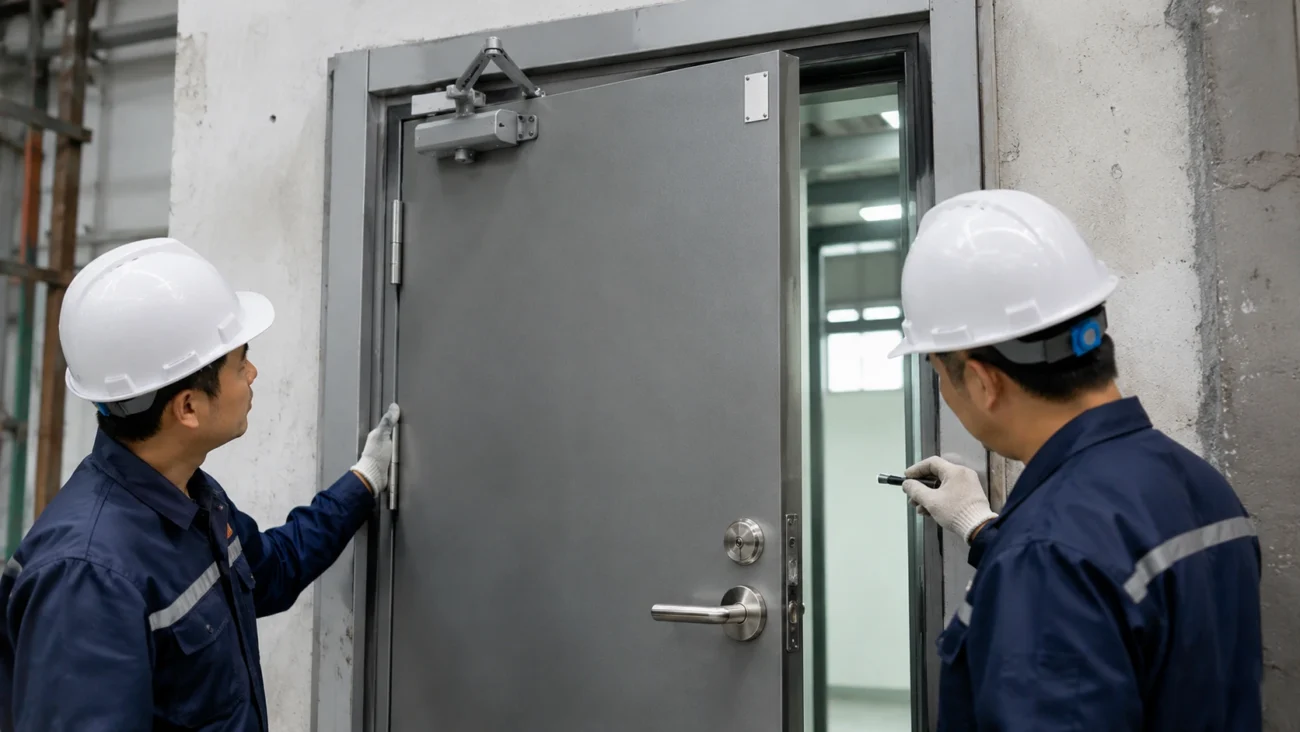
A correctly manufactured door can still perform poorly when the frame is anchored incorrectly, the clearances are unsuitable, the closer does not operate correctly or the door does not latch.
For US projects, fire doors also require inspection after installation and ongoing periodic inspection. This is why product documentation and installation instructions should be included in the sourcing process rather than treated as an afterthought.
Custom Doors: Size, Structure and Hardware Planning
Custom doors may include oversized entrance doors, pivot doors, double-leaf doors, hidden doors, custom veneers, special paint colors, decorative metal panels or glass inserts.
Custom manufacturing does not mean simply enlarging a standard product.
When a door becomes taller, wider or heavier, the leaf structure, frame, hinges, pivot system, locks and packaging may need to be redesigned.
An overseas villa buyer may first focus on the surface appearance of a large pivot door. However, the sourcing discussion usually moves quickly to the total weight, pivot-hardware capacity, frame anchoring, threshold, weather exposure and lifting method at the destination.
The real question is not whether a Chinese factory can copy the appearance.
It is whether the complete door system can be manufactured, transported and installed safely.
For custom wooden doors, buyers should pay special attention to deformation control and veneer matching. For custom steel doors, the frame and hinge structure must support the increased weight.
For custom fire-rated doors, buyers must confirm that the requested dimensions, hardware and glazing remain within the approved certification range.
A factory’s willingness to make a non-standard size does not prove that the result is structurally suitable or compliant.
How to Compare Complete Door Set Quotations
Door quotations should be compared using the same product scope.
| Area | What Buyers Should Confirm |
|---|---|
| Application | Interior, exterior, hotel, apartment, villa or commercial |
| Door Type | Wooden, steel, security, fire-rated or custom |
| Dimensions | Opening size, leaf size, frame size and wall thickness |
| Opening | Left/right hand, inward/outward and single/double leaf |
| Structure | Core, leaf thickness, reinforcement and frame construction |
| Finish | Veneer, paint, laminate, powder coating or metal panel |
| الأجهزة | Hinges, lock, handle, closer, seals and panic hardware |
| Performance | Fire, smoke, acoustic, security or weather requirements |
| Compliance | Exact model, listing, label, standard and target market |
| Packaging | Leaf, frame, hardware, numbering and accessory protection |
| Installation | Anchors, threshold, clearances and instructions |
One supplier may quote only the leaf, while another includes the frame and basic hardware.
The buyer should request a clear inclusion and exclusion list. Without this, a lower quotation may later require additional hardware, frames, local modification or packaging upgrades.
A Real UK Residential Door Project Lesson
In one high-end UK residential inquiry, the initial request was described simply as fire-rated doors.
However, preparing a meaningful quotation required much more than a door photo.
The project needed drawings, door schedules, opening dimensions, wall thicknesses, fire-rating requirements, finishes, frames, hardware sets and certification expectations.
Product consistency was also important because the doors were intended for a high-end residential environment rather than a basic commodity project.
Instead of moving directly to a full order, sample validation was the more practical approach.
The sample could be used to review the construction, finish, frame, hardware preparation, documentation and compatibility with the project requirements.
This type of project shows why door sourcing should begin with drawings and approval requirements rather than a supplier catalogue or a low unit price.
Quality Inspection Before Shipping
Door inspection should cover more than surface appearance.
For wooden doors, inspectors should review dimensions, flatness, finish, edge treatment, frame matching and hardware preparation.
For steel doors, the inspection should check frame alignment, welding, coating, locks, hinges and opening operation.
The door leaf should be tested with the correct frame whenever possible.
This is important because a leaf and frame can each meet their individual dimensions while still not fitting properly as a set.
Opening direction also needs careful verification. Left-hand, right-hand, inward and outward opening errors are expensive to correct after arrival.
For fire-rated doors, labels, documents and hardware configurations must match the approved door schedule. Inspectors should not rely only on a certificate stored in the supplier’s office.
For a large project, random units from the production batch should be checked. One approved sample cannot prove that every production door has the same dimensions, color, construction and hardware preparation.
Door Packaging, Numbering and Container Loading
Door packaging must protect more than the visible surface.
Wooden doors can suffer scratches, moisture damage and corner impact. Steel doors can develop dents, coating damage or deformation. Long door frames can bend when they are not supported correctly.
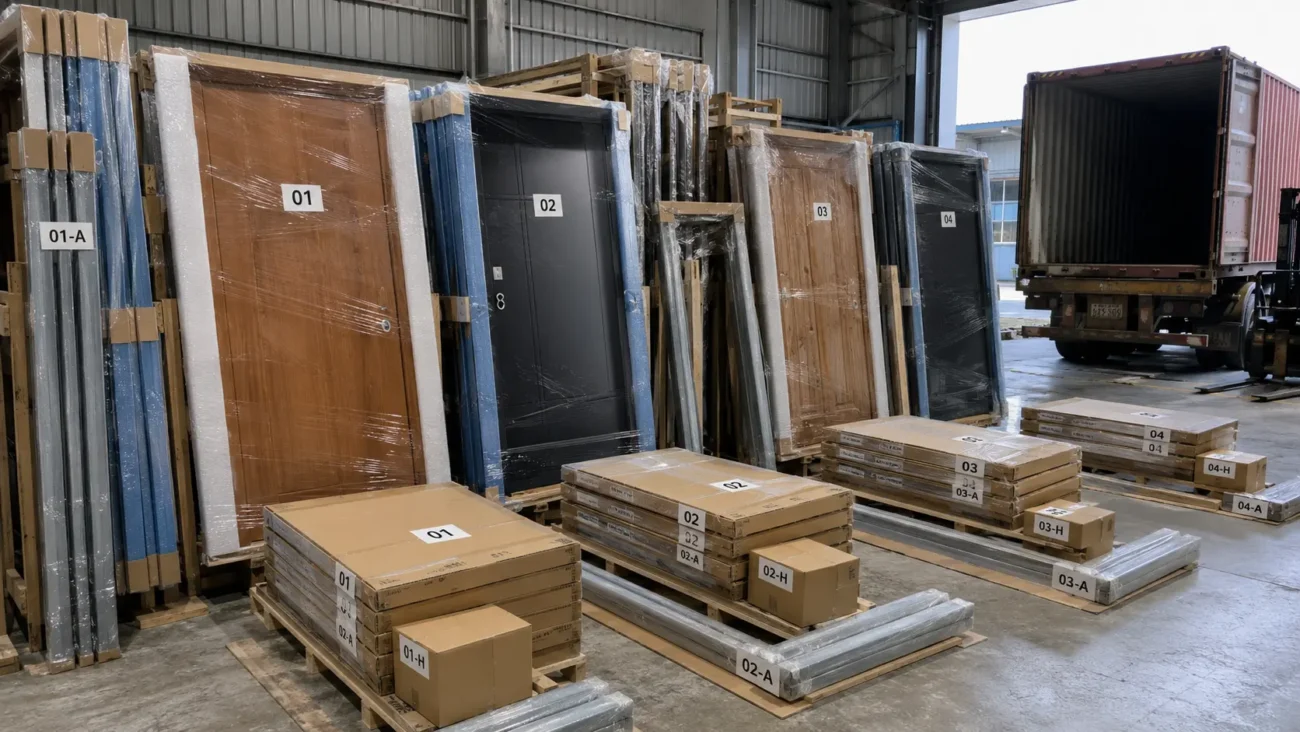
For project orders, packaging must also keep every component correctly matched.
Each package should clearly show:
- Door number
- Room number
- Floor
- Opening direction
- Frame type
- Hardware set
- Package number
Door leaves, frames, architraves and hardware may be packed separately, but their labels must remain connected to the same project opening.
This is especially important for hotels, apartment buildings and villas with many different door sizes.
A door leaf may arrive without damage but still delay installation if the matching frame or hardware box cannot be found.
During container loading, heavy steel doors should be secured against movement. Painted and veneered surfaces need separation and edge protection, while long frames should be supported to reduce bending.
Door packaging is therefore not only about preventing scratches. It must also preserve the relationship between each leaf, frame, hardware set and project door schedule.
Where to Source Different Doors in China
China’s door supply chain is spread across several specialized manufacturing areas.
Jiangshan for Wooden Doors
Jiangshan in Zhejiang is closely associated with wooden-door manufacturing and whole-home customization.
It is relevant for engineered wooden doors, veneer doors, painted doors, hotel room doors and project-based customized products.
However, location alone does not guarantee quality. Buyers should still compare core structure, moisture control, production capability and export experience.
Yongkang for Steel and Security Doors
Yongkang and its surrounding hardware supply chain are particularly relevant for steel entrance doors, security doors, armored doors, smart doors, locks and related hardware.
The local industry has continued moving toward smart functions, greener manufacturing and export-oriented products.
It is not necessarily the first sourcing location for every wooden or hotel project door.
Foshan for Project Product Selection
Foshan is useful for villa, hotel and renovation buyers who need to compare doors together with windows, cabinets, tiles, bathroom products, lighting and furniture.
Its strength is project selection and multi-category coordination.
The final wooden, steel or certified fire-door manufacturer may still be located in another industrial cluster.
For more information about the broader supply chain, visit the Doors & Windows category.
Fire-Rated Doors Should Be Sourced Compliance First
Fire-rated door sourcing should not begin by choosing a city.
A more reliable sequence is:
Target market → required standard → exact listing → door type → dimensions → hardware configuration → factory verification
Compliance requirements should determine the supplier shortlist.
How a China-Based Sourcing Team Helps Door Buyers
For a multi-door project, local coordination is most useful when drawings, supplier quotations, samples, production and package numbering must remain consistent.
A sourcing team can help turn the buyer’s door schedule into a supplier quotation sheet and identify where information is missing before production begins.
It can also coordinate sample approval, check whether frames and hardware match the door leaves, follow production changes and verify package numbers before container loading.
Cody Sourcing works with door and building-material suppliers across South China and other industrial regions.
For door projects, the value is not simply sending several supplier catalogues. It is helping connect the drawings, supplier capability, product documentation, inspection, package numbering and shipping into one controlled process.
Common Mistakes When Buying Doors from China
Common sourcing mistakes include:
- Requesting a quotation from a photo only
- Comparing a door-leaf price with a complete door-set price
- Confusing opening size with door-leaf size
- Not confirming wall thickness and frame depth
- Ordering the wrong opening direction
- Selecting wooden doors without confirming the core
- Selecting steel doors without checking the frame and reinforcement
- Treating a fire-rated door as only a fire-resistant leaf
- Assuming one certificate covers every size and hardware option
- Changing fire-door hardware after approval
- Ignoring installation and lifting conditions
- Failing to match leaves, frames and hardware by door number
- Using weak packaging for long frames or finished surfaces
- Not inspecting the production batch before shipment
Most of these problems can be reduced before production when the buyer provides complete project information.
Final Checklist Before Confirming a Door Order
Before paying the deposit, buyers should confirm:
- Project application and destination market
- Door type and material
- Opening dimensions
- Door-leaf dimensions
- Wall thickness
- Frame and architrave structure
- Opening direction
- Core or internal reinforcement
- Surface material and approved finish sample
- Hinges, lock and handle
- Closer, seals and panic hardware
- Threshold and glazing
- Fire, acoustic, security or weather requirements
- Exact certification model and approved configuration
- Door schedule and numbering system
- Packaging specification
- Installation accessories and instructions
- Production lead time
- Inspection method
- Destination and unloading conditions
- Container-loading plan
The safest purchasing decision is not always the door with the lowest unit price.
It is the complete door system that matches the opening, wall, hardware, performance requirements, certification and installation conditions—and can be produced consistently and delivered without damage.
