


Large Format Tiles from China: Sourcing Guide for Luxury Villas and Hotel Projects

Large format tiles from China are becoming popular in luxury villas, hotel lobbies, bathroom walls, feature walls, restaurants and high-end renovation projects.
They create a clean, continuous and premium surface that ordinary small tiles cannot always achieve. In Foshan showrooms, buyers can now see large marble-look tiles, porcelain slabs, sintered stone panels and full-height wall applications displayed together with furniture, bathroom products, cabinets and lighting.
But large format tiles are not simply bigger tiles.
They require more careful planning, stronger packaging, better handling and more experienced installation. A slab that looks beautiful in a showroom can still create problems if it breaks during shipping, cannot pass through the building entrance, does not match the production batch, or cannot be installed by the local team.
This guide explains how global buyers can source large format tiles from China for villas and hotel projects, compare products beyond appearance, and reduce risks in quality inspection, packaging, container loading and destination installation.
For broader tile sourcing in Foshan, read: 🔗Foshan Tile Market Guide: How Global Buyers Source Tiles from China.
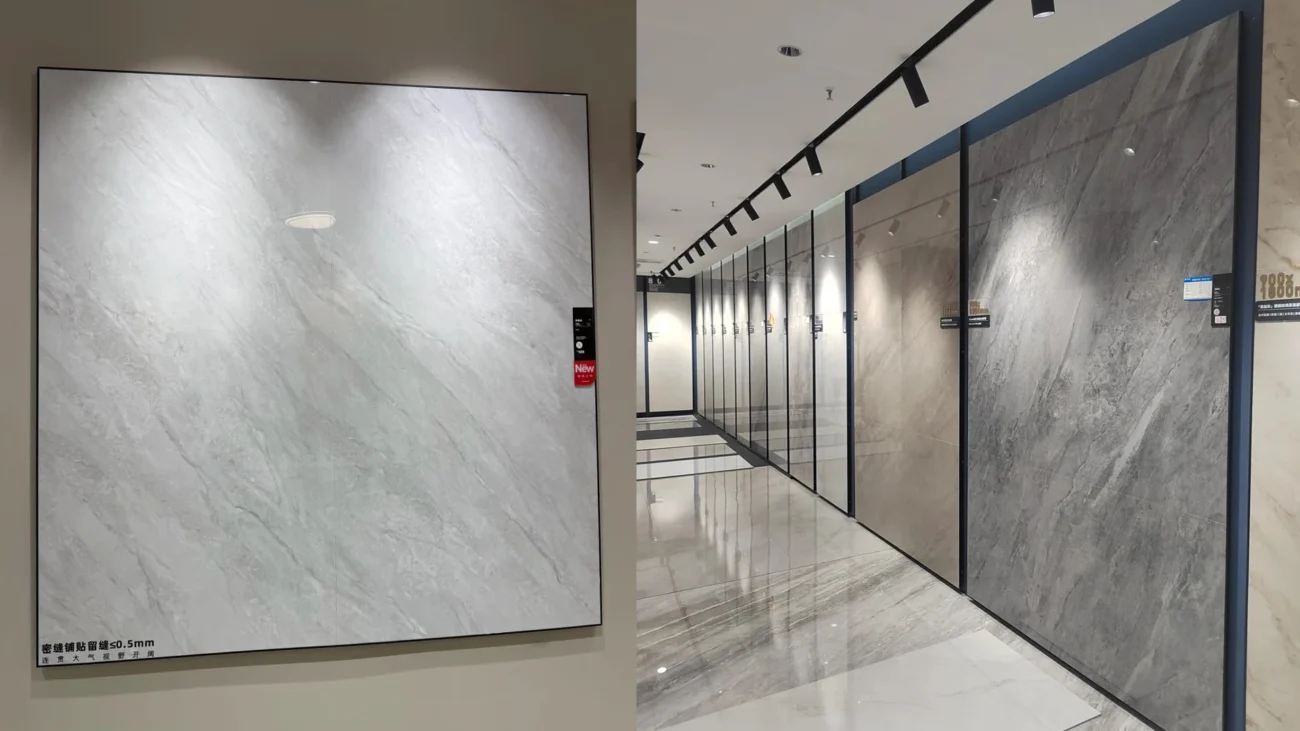
Why Large Format Tiles Are More Than Bigger Tiles
Many buyers first notice large format tiles because of their visual impact.
A single large slab can make a villa living room look more open, a hotel lobby more premium, or a bathroom wall cleaner because there are fewer grout lines. This is why designers and owners often choose large tiles for luxury projects.
However, the larger the tile becomes, the more sensitive the project becomes.
Small defects become more visible. Slight warping becomes easier to notice. Color differences across a large floor area become harder to hide. Transportation damage becomes more expensive. Installation mistakes become more difficult to correct.
A buyer may compare two marble-look slabs and think the only difference is pattern and price. In reality, the difference may come from body material, thickness, flatness, surface finish, production batch, packaging method, cutting suitability and supplier experience.
For normal tiles, a small breakage may be manageable.
For large format tiles, one broken piece can delay a feature wall, a bathroom installation or a hotel room delivery schedule.
This is why buyers should treat large format tiles as project materials, not only decorative products.
Large Format Tiles, Porcelain Slabs and Sintered Stone
In real sourcing conversations, buyers often use several terms at the same time: large format tiles, large slabs, porcelain slabs, sintered stone, marble-look panels and gauged porcelain panels.
These products can overlap in appearance, but their application and risks are not always the same.
Large format porcelain tiles are often used for floors and walls. They may come in sizes such as 600×1200 mm, 750×1500 mm, 900×1800 mm, 1200×2400 mm or larger.
Porcelain slabs and sintered stone panels are often used for feature walls, countertops, bathroom walls, dining tables, kitchen islands and commercial interior surfaces. Some are thin and wide, while others are thicker and more suitable for fabrication.
The name alone is not enough.
Buyers should understand the actual product structure, thickness, intended use, surface finish, edge quality, cutting method and packaging requirement.
For official installation references, buyers working in North America can review the 🔗TCNA Gauged Porcelain Tile Panels/Slabs installation publications when discussing large-format installation expectations with local installers.
A Chinese supplier can provide the product, but the final success also depends on the installer, substrate, handling equipment and site conditions at the destination.
Where Large Format Tiles Work Best in Villas and Hotels
Large format tiles are most valuable when the design needs fewer joints, a stronger visual effect or a more luxurious surface.
In luxury villas, they are often used for living room floors, TV background walls, bathrooms, stair areas, kitchen islands and outdoor covered spaces. The buyer may want a continuous marble-look effect, a cleaner bathroom wall or a large feature wall that feels closer to natural stone.
In hotel projects, large format tiles are often used in lobbies, elevator halls, guest bathrooms, restaurants, corridors and commercial public areas. They help create a premium first impression, especially when the tile pattern, lighting and furniture design are planned together.
But large format tiles should not be used everywhere only because they look premium.
A villa bathroom wall may benefit from large slabs, but the wall must be flat enough. A hotel lobby may look beautiful with large tiles, but wear resistance and replacement planning matter. A kitchen island may use sintered stone, but cutting, edge processing and fabrication risks must be checked.
| Project Area | Why Large Format Tiles Are Used | What Buyers Should Check |
|---|---|---|
| Villa Living Room | Seamless and premium floor effect | Flatness, batch color, slip feel and spare quantity |
| Hotel Lobby | Strong visual impact | Wear resistance, size consistency and replacement planning |
| Bathroom Walls | Fewer grout lines and cleaner look | Wall flatness, cutting, waterproofing and installer skill |
| Feature Walls | Marble-look or stone-look design | Pattern direction, bookmatch and crate protection |
| Kitchen Island | Stone-like luxury effect | Thickness, cutting, edge processing and fabrication risk |
| Outdoor Areas | Large modern surface | Anti-slip, drainage and weather resistance |
The table gives a quick comparison, but the real decision should always come back to the project.
A beautiful slab is only suitable when the site can receive it, move it, cut it and install it safely.
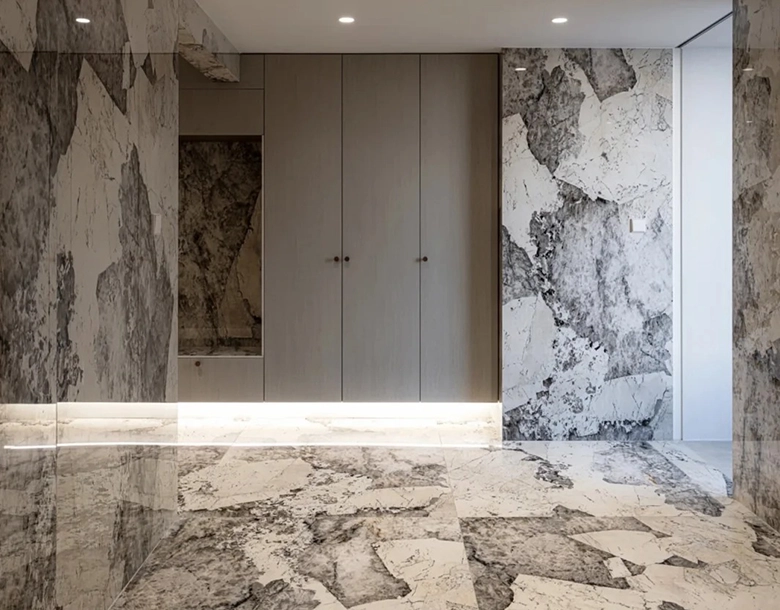
How to Choose Size, Thickness and Surface Finish
Many buyers start by asking for the largest size available.
That is not always the best approach.
Large size can create a premium effect, but it also increases transportation, handling and installation difficulty. Before confirming a size, buyers should check where the tile will be used, how it will enter the building, whether it can fit through elevators and staircases, and whether the local installer has experience with that format.
Thickness also matters.
Thin slabs may be lighter and suitable for wall applications, but they require careful handling and installation. Thicker slabs may be more suitable for certain furniture or countertop applications, but they are heavier and more difficult to move.
Surface finish should be selected by application, not only appearance.
A polished marble-look slab may look impressive on a showroom wall, but it may not be suitable for a wet bathroom floor or busy restaurant area. A matte surface may feel more practical in some spaces, while textured surfaces may be better for anti-slip requirements.
Color and pattern direction should also be discussed early.
For feature walls and hotel lobbies, pattern continuity can be important. Some buyers want bookmatch effects. Others prefer random natural variation. The supplier should explain how many patterns or faces are available and whether bulk production will match the approved sample.
The key is not choosing the largest tile.
The key is choosing a size and finish that the project can actually use well.
Why Factory Prices Can Be Very Different
Large format tile prices from China can vary widely, even when the products look similar in showroom photos.
The difference may come from material body, production process, thickness, surface finish, glaze quality, pattern technology, polishing, size tolerance, flatness, brand positioning, stock condition and packaging.
A low price is not always a bad sign, but buyers need to know what the price includes.
One supplier may quote a standard large porcelain tile with basic carton packaging. Another may quote a larger slab with wooden crate protection, stronger quality control and export support. A third supplier may quote sintered stone suitable for fabrication, which belongs to a different cost level.
These are not the same products.
For luxury villas and hotel projects, the lowest price can become expensive if the buyer later faces breakage, visible color differences, poor flatness, wrong batch, weak crates or installation delays.
Buyers should compare more than square meter price.
They should compare size, thickness, grade, batch, surface finish, packaging, spare quantity, loading method and whether the supplier understands export projects.
The real cost of large format tiles includes more than the factory invoice.
It includes the cost of safe delivery, installation success and future replacement planning.
Quality Checks Before Confirming Bulk Production
Quality checking should happen before the buyer commits to a large order.
The approved showroom sample should be kept as a reference. For bulk production, buyers should check color tone, surface texture, gloss, pattern variation, edge condition, flatness and size consistency.
Flatness is especially important for large tiles.
A slight curve may not be very noticeable on a small tile, but it can become obvious across a large wall or floor. If the substrate is also not flat, the problem becomes worse during installation.
Batch control is another key point.
For large villa floors, hotel lobbies or guest bathroom walls, different batches can create visible color changes. The buyer should ask whether the full order can be supplied from the same production batch or whether batch differences may appear.
Edge and corner condition should also be checked carefully.
Large slabs are vulnerable during handling. Small chips may become visible after installation, especially on feature walls or countertop edges.
For marble-look slabs, pattern direction and layout should be reviewed before production or cutting. A beautiful design can look messy if the panels are not arranged with the final installation in mind.
Inspection is not only about rejecting bad products.
It is about confirming that the selected material can support the design intention of the project.
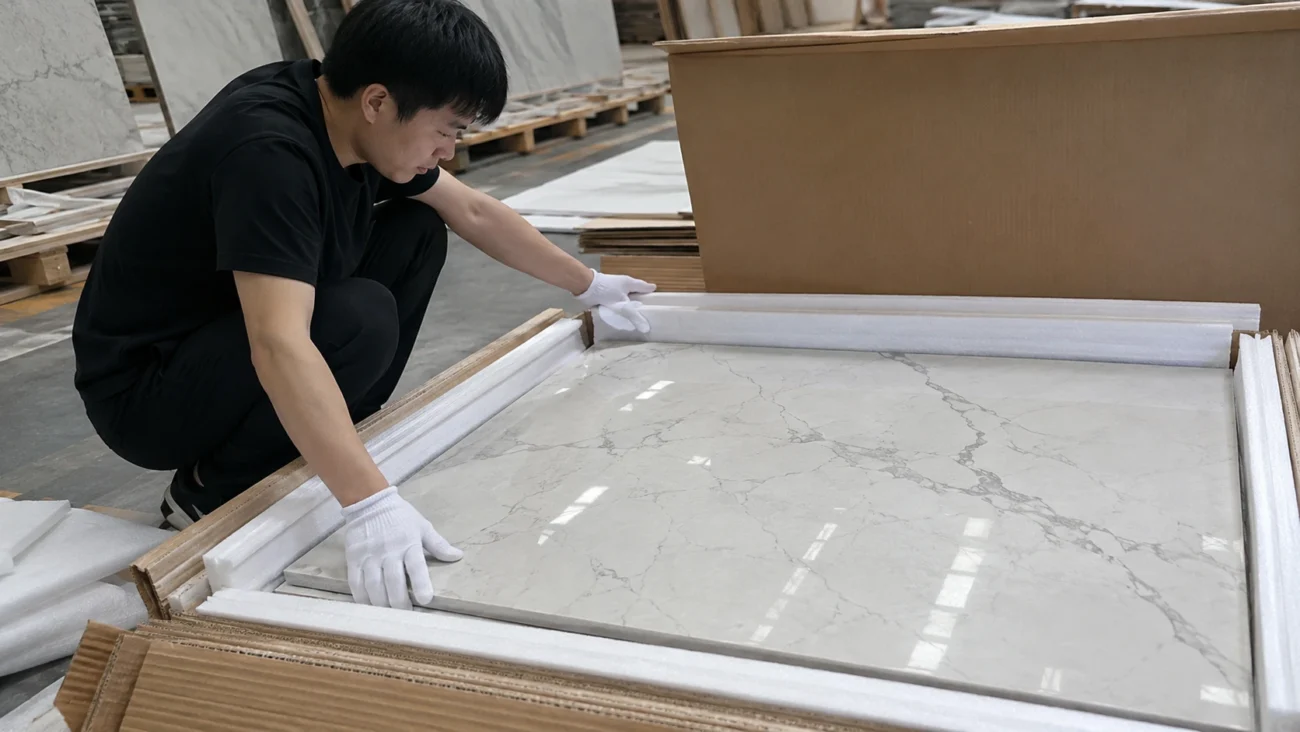
Packaging, Wooden Crates and Breakage Risks
Packaging is one of the most important parts of sourcing large format tiles from China.
Ordinary tile cartons are not enough for many large slabs or thin panels.
Large format products may need wooden crates, reinforced frames, A-frame support, foam protection, corner protection, straps and careful loading direction. The packaging method should match the size, thickness, quantity and shipping route.
Breakage does not only happen inside the container.
Tiles may be moved from factory to warehouse, from warehouse to container, from container to destination warehouse and from warehouse to project site. Every handling step increases risk.
This is why buyers should ask how the tiles will be packed before they confirm the order.
A low quotation without proper crate protection may look attractive at first. But once breakage happens, replacement can take weeks or months, especially if the same batch is no longer available.
For large slabs, the packaging plan should also consider unloading.
A crate that is safe for sea freight may still create problems if the destination does not have the right forklift, lifting tools, workers or space to unload it safely.
Good packaging is not just about avoiding cracks.
It is about protecting the project schedule.
Destination Handling and Installation: The Risk Buyers Often Forget
Many large format tile problems do not happen in China.
They happen after the goods arrive.
A villa buyer may choose a beautiful 1600×3200 mm slab for a living room feature wall. In the showroom, it looks perfect. But before ordering, the buyer needs to confirm whether the slab can pass through the gate, elevator, staircase, corridor and room entrance.
For hotel projects, the issue can be more complex.
A hotel may have many bathrooms, floors and corridors. If the tiles are large, the project team needs to plan where to store them, how to move them to each floor, and which installation team has the right equipment.
Local installation skill is critical.
Large format tiles may require suction cups, lifting frames, leveling systems, special adhesives, flat substrates and experienced installers. If the installer treats them like ordinary small tiles, the result can be poor even when the product itself is good.
This is why buyers should discuss installation before shipping.
The Chinese supplier may provide the material, but the destination team must be able to receive, move, cut and install it correctly.
For large format tiles, sourcing and installation are connected.
A Realistic Villa and Hotel Sourcing Scenario
A villa buyer may come to Foshan and fall in love with a marble-look slab displayed as a full-height wall.
The surface looks expensive, the pattern is elegant and the showroom lighting makes the material feel perfect.
But a careful sourcing discussion changes the question.
Where will the slab be installed? Is it for a living room wall, bathroom wall, floor or countertop? How many pieces are needed? Will the pattern need matching? Can the slab enter the house? Does the local installer have experience with this size? How will the slab be packed and unloaded?
For a hotel project, the situation is different.
The buyer may choose large format tiles for guest bathrooms and lobby walls. The design looks premium, but the sourcing team still needs to check batch consistency, spare quantity, room-area calculation, package numbering and replacement planning.
A hotel does not need only one beautiful sample.
It needs consistent delivery across many rooms and public areas.
For a restaurant project, large tiles can create a clean and high-end look, but the buyer should also consider cleaning, anti-slip performance, heavy traffic, breakage risk and whether the tiles can be shipped together with furniture, lighting and kitchen equipment.
In all three cases, the real sourcing question is not only whether the tile looks good.
It is whether the material can survive the full journey from showroom to installation.
How to Combine Large Format Tiles with Other Building Materials
Large format tiles are often sourced together with other building materials.
For villa and hotel projects, buyers may also need bathroom products, cabinets, doors, windows, lighting, furniture, stone, mirrors and hardware.
This creates a strong advantage in Foshan and nearby sourcing areas, because buyers can compare many project materials during the same trip.
But it also creates a logistics challenge.
Large slabs are heavy and fragile. Furniture is bulky. Lighting is fragile. Cabinets need moisture protection. Bathroom products need careful carton handling. If everything is loaded together without planning, one product can damage another.
Large format tiles should be positioned carefully in the loading plan.
Heavy crates should be secured. Fragile surfaces should be protected. Slabs should not be pressed by unsuitable cargo. Hardware and small accessories should be packed and labeled separately.
For mixed-container shipments, the sourcing team needs to think about unloading order as well as loading safety.
The container is not only a shipping space.
It is part of the project delivery plan.
Where to Source Large Format Tiles in China
Foshan is one of the most important sourcing areas for large format tiles, porcelain slabs, sintered stone and related building materials.
In Foshan showrooms, buyers can compare large slabs, marble-look tiles, wall panels, bathroom applications, furniture surfaces and project design displays in one area. This is useful for villa and hotel buyers who need to match tiles with bathrooms, cabinets, lighting and furniture.
However, buyers should still understand the supplier type.
Some suppliers focus on standard large format tiles. Some specialize in slabs and sintered stone. Some are better at showroom display than export packaging. Some can help with cutting and fabrication, while others only sell full slabs.
For large format tiles, the best supplier is not always the one with the most beautiful showroom.
It is the supplier that can match the project application, confirm batch consistency, protect the slabs properly and support inspection before shipment.
For official exhibition background, buyers can also review CeramBath Foshan, which covers ceramic tiles, slabs, mosaics, stone, sanitary ware and related building material categories.
How a China-Based Sourcing Team Helps
A China-based sourcing team should do more than bring buyers to tile showrooms.
For large format tiles, useful support begins with understanding the project: villa, hotel, restaurant, apartment or commercial space. The team should also understand where the tiles will be used, what sizes are realistic, whether slabs need pattern matching, and how the goods will be packed and shipped.
During supplier comparison, the team can help check whether quotations include the same grade, size, surface, thickness, packaging and export support.
Before shipment, the team can help inspect surface quality, flatness, color consistency, edge condition, packaging strength and loading method.
For mixed building material projects, local coordination becomes even more important because large slabs may be shipped together with cabinets, furniture, bathroom products, doors and lighting.
Cody Sourcing works with tile, slab, bathroom, cabinet, lighting, furniture and building-material suppliers across Foshan and other Chinese manufacturing regions.
For large format tile projects, the value is not simply finding a lower price. It is helping buyers connect design selection, supplier capability, quality control, packaging and shipment into one manageable sourcing process.
Common Mistakes to Avoid
Many buyers choose large format tiles too quickly from showroom displays.
They focus on the pattern and forget the project conditions.
One common mistake is choosing a size that looks beautiful in the showroom but cannot be moved easily at the destination. Another is confirming slabs without checking batch consistency or spare quantity.
Some buyers also underestimate packaging.
Large format tiles and slabs need stronger protection than ordinary tiles. Weak crates, poor corner protection or careless loading can cause breakage before the goods reach the project site.
Another mistake is assuming that any local tile installer can handle large slabs. Large format installation requires tools, experience and site preparation.
The most expensive mistake is not always choosing the wrong tile.
Sometimes it is choosing a good tile without planning the journey from factory to installation.
Final Thoughts
Large format tiles from China can be an excellent choice for luxury villas, hotels, restaurants and high-end renovation projects.
They can create a premium surface effect, reduce grout lines and make spaces feel more modern and continuous.
But buyers should not treat them as ordinary tiles in a larger size.
Large format tiles require careful decisions about size, thickness, surface finish, batch control, packaging, destination handling and installation capability.
For overseas buyers, the best sourcing result comes when the tile is selected not only for how it looks in the showroom, but for how it will perform through production, shipping, unloading and installation.
That is where real sourcing value appears.
