


Foshan Tile Market Guide: How Global Buyers Source Tiles from China

The Foshan tile market is one of the most important places for global buyers sourcing tiles, slabs and building materials from China.
But Foshan is not just one market or one building.
For overseas buyers, it is a sourcing ecosystem made of tile showrooms, factory display centers, export suppliers, wholesale dealers, slab suppliers, bathroom product showrooms and project-based building material suppliers.
Many buyers come to Foshan because they want better tile prices from China. However, the real value of Foshan is not only price. It is the ability to compare many styles, grades, sizes, finishes and supplier types in one area.
The challenge is that beautiful showroom samples do not always tell the full story.
A tile may look perfect on the display wall, but buyers still need to confirm batch consistency, grade, surface quality, packaging strength, stock availability, inspection method and shipping plan.
This guide explains how global buyers can use the Foshan tile market more effectively, compare showrooms and suppliers, avoid common sourcing mistakes and make better tile decisions for villas, hotels, restaurants, apartments and commercial projects.
For more building material sourcing ideas, read: 🔗How to Buy Villa Building Materials from China.
Why Foshan Tile Market Matters for Global Buyers
Foshan has a long connection with ceramic tiles, sanitary ware and building materials.
For global buyers, the city is useful because it allows them to compare many tile styles and supplier levels in a short period of time. A buyer can see porcelain tiles, ceramic wall tiles, marble-look tiles, large slabs, sintered stone, mosaics, outdoor tiles and bathroom products during the same sourcing trip.
This is especially valuable for renovation and construction projects.
A villa buyer may need living room floor tiles, bathroom wall tiles, outdoor tiles, stair tiles and feature wall slabs. A hotel buyer may need lobby tiles, guest room bathroom tiles, corridor tiles, restaurant tiles and extra spare quantity. A restaurant project may need anti-slip floor tiles, easy-clean wall tiles and durable kitchen-area materials.
These are not the same product decisions.
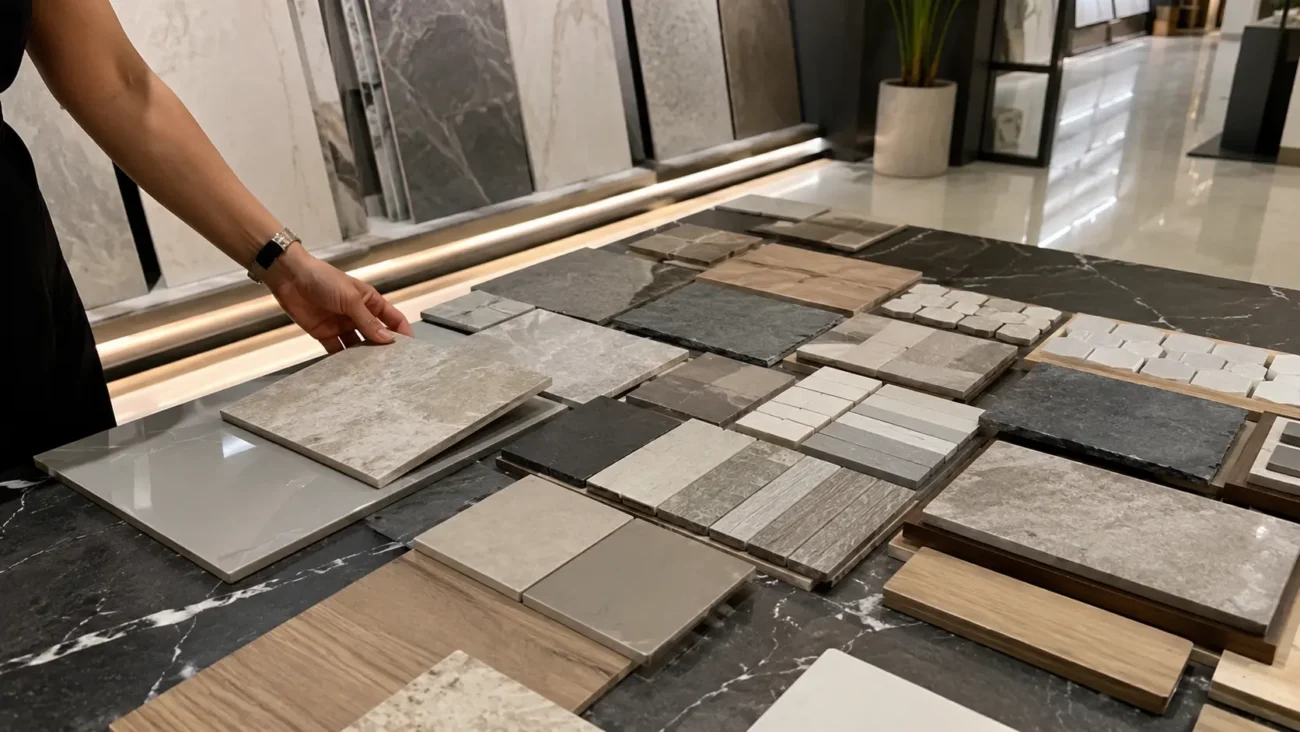
One of the biggest advantages of Foshan is that buyers can compare appearance, price and application together. Instead of choosing from a few online catalogues, buyers can touch the surface, compare colors under showroom lighting, check slab size, ask about stock and understand how different suppliers position their products.
However, the market can also be confusing.
A first-time buyer may not know whether a showroom represents a real factory, a trading company, a brand distributor or a warehouse supplier. This is why visiting Foshan without a sourcing plan can be tiring and inefficient.
Foshan Is Not One Market: Showrooms, Factories and Wholesale Suppliers
Many overseas buyers say they want to visit “the Foshan tile market,” but Foshan is not a single place.
It includes large showrooms, permanent exhibition centers, brand stores, factory display rooms, wholesale suppliers and export-focused trading offices. Some suppliers focus on high-end porcelain tiles. Some are strong in large slabs or sintered stone. Some sell stock tiles at lower prices. Others are better for hotel, villa or commercial project orders.
This difference matters.
A high-end showroom can help buyers understand design trends and product positioning. A factory showroom may be better for confirming production capability and project supply. A wholesale supplier may be useful for budget-sensitive orders or fast delivery, but product grade and batch consistency need more attention.
The supplier type also affects communication.
Some showrooms are good at presenting beautiful spaces but may not manage export packaging, container loading or after-sales issues well. Some factories can produce well but may not communicate clearly with overseas buyers. Some trading suppliers can coordinate export details, but buyers still need to understand where the actual product comes from.
For global buyers, the goal is not to visit as many showrooms as possible.
The goal is to identify which suppliers match the project type, quality expectation, budget and shipping plan.
What Types of Tiles Buyers Can Source in Foshan
Foshan is especially useful because buyers can compare different tile categories in one trip.
Porcelain tiles are one of the most common choices for overseas projects. They are widely used for floors, walls, villas, hotels and commercial spaces. Buyers usually compare surface finish, size, water absorption, flatness, wear resistance, batch color and packaging.
Ceramic wall tiles are often used for bathrooms, kitchens and indoor wall areas. Here, the key is not only strength. Buyers should care about glaze quality, edge condition, size consistency, color matching and installation effect.
Large slabs and sintered stone are popular for high-end projects. They can be used for feature walls, TV backgrounds, countertops, dining tables, bathroom walls and commercial design spaces. But large slabs bring higher shipping and handling risks. Cracking, edge damage, wooden crate quality and destination unloading conditions must be discussed before ordering.
Outdoor tiles need a different logic. Buyers should consider anti-slip performance, drainage, weather resistance, stain resistance and cleaning. A tile that looks beautiful indoors may not be suitable for a wet terrace, poolside or outdoor restaurant area.
Mosaic and decorative tiles are useful for bathrooms, pools, feature walls and smaller design areas. But they need careful checking of mesh backing, glue quality, color consistency and installation labor.
The real sourcing question is not simply:
Which tile looks best?
A better question is:
Which tile is suitable for this exact area of the project?
How to Choose Tiles by Project Area, Not Only by Style
Many buyers arrive in Foshan with photos from Pinterest, Instagram or hotel design references.
That is a good starting point, but it is not enough for final selection.
A villa buyer may want the same beige marble-look tile for the whole house. After visiting showrooms, the buyer may realize that the living room floor, bathroom wall, outdoor terrace, stair area and feature wall should not always use the same specification.
A living room floor may need a large-format porcelain tile with good flatness and consistent color. A bathroom floor may need better slip resistance. A bathroom wall may focus more on surface effect and easy cleaning. An outdoor area needs weather resistance and drainage. A stair area needs edge details and safe installation.
For hotel projects, the decision becomes even more detailed.
Lobby tiles need visual impact and durability. Guest bathrooms need batch consistency and waterproof installation support. Corridors need wear resistance and easy maintenance. Restaurants need cleaning performance and slip resistance. Spare quantity should also be planned because later replacement can be difficult if the same batch is no longer available.
This is where many buyers make mistakes.
They choose a tile because it looks beautiful in a showroom, but they do not check whether it fits the actual area where it will be installed.
Good tile sourcing starts from project use, not only from design style.

Why Tile Prices in Foshan Can Be Very Different
Buyers often receive very different prices for tiles that look similar.
This does not always mean one supplier is overcharging.
Tile prices may vary because of material body, production process, surface finish, size, thickness, grade, brand position, stock condition, packaging method and export service.
A polished porcelain tile, matte porcelain tile, textured outdoor tile and marble-look slab may all have very different cost structures. Even within the same appearance, one supplier may quote first-grade production tiles while another may quote stock tiles, lower-grade tiles or a different factory source.
Packaging also changes the final cost.
A tile price may look low, but if the quotation does not include strong cartons, pallets, wooden crates for slabs or container-loading support, the risk may move from the supplier to the buyer.
Global buyers should be careful with the idea that “Foshan tiles are cheap.”
Foshan can offer strong supply-chain advantages, but a low price only makes sense when the grade, batch, packaging and shipping plan are clear.
The better question is not:
Why is this tile more expensive?
A more useful question is:
Are these tiles really the same grade, same size, same surface, same batch condition and same export packaging?
Only then does price comparison become meaningful.
Tile Quality Checks: Size, Flatness, Surface, Grade and Batch
Tile quality should be checked before the buyer confirms a large order.
The first thing buyers usually notice is the surface. They compare color, texture, gloss and pattern. But quality control goes deeper than appearance.
Size consistency matters because small dimensional differences can affect installation lines. Flatness matters because warped tiles can create uneven flooring, especially with larger formats. Edge condition matters because chipped corners and uneven sides become visible after installation.
Batch consistency is another major issue.
A showroom sample may look perfect, but the bulk order may come from a different production batch. Slight color differences may not be obvious in the carton, but they can become very visible after installation across a large floor.
For marble-look tiles and slabs, pattern variation should also be reviewed. Some buyers prefer natural variation, while others want a more consistent look. The supplier should explain how many faces or pattern variations are available.
Grade should be confirmed clearly.
Buyers should know whether they are purchasing first-grade tiles, commercial grade, stock tiles or discounted inventory. There is nothing wrong with stock tiles when the buyer understands the condition and quantity, but they should not be compared directly with fresh first-grade production.
For large projects, buyers should keep approved samples and compare them with the actual production batch before shipment.

Packaging, Pallets and Container Loading Risks
Tiles are heavy and fragile. Packaging is not a small detail.
A tile order can be damaged by weak cartons, poor palletizing, loose loading, bad corner protection or careless mixing with other building materials.
Porcelain tiles usually need strong cartons and pallet protection. Large slabs and sintered stone often need wooden crates or stronger support because cracks and edge damage are expensive. Outdoor tiles, mosaics and mixed sizes need clear labeling so the installation team can identify products quickly after arrival.
The container-loading plan also matters.
Tiles are heavy, so weight distribution must be considered. If tiles are shipped with furniture, cabinets, lighting or bathroom products, the loading sequence must protect both heavy and fragile goods.
A common mistake is treating tile packaging as a supplier’s final detail.
For overseas buyers, packaging should be discussed before the order is confirmed. The buyer should understand whether the quotation includes pallets, wooden crates, protective corners, labels and export-ready packaging.
A low tile price with weak packaging can become expensive after breakage, delays or replacement difficulty.

A Realistic Foshan Tile Sourcing Scenario
A villa buyer may come to Foshan with design photos and ask for marble-look tiles for the whole house.
At first, the request seems simple.
The buyer wants a warm beige tile, large size and modern style. After visiting showrooms, the decision becomes more practical.
The living room floor may need a large porcelain tile with good flatness. The bathrooms may need different wall and floor tiles. The outdoor terrace may need anti-slip tiles. The staircase may need edge processing. The TV background may use a slab instead of normal floor tile.
The buyer also needs to check stock, batch, packaging, spare quantity and whether all materials can be shipped together with other building materials.
The same thing happens in restaurant and hotel projects.
For a restaurant project, the tile choice is not only about appearance. The buyer must consider cleaning, anti-slip performance, kitchen area, bathroom walls, delivery timing and whether the tiles can be shipped together with furniture, lighting and kitchen equipment.
For a hotel project, batch consistency and room-area calculation may be more important than choosing one beautiful showroom sample. If a bathroom tile cannot be supplied in the same batch later, maintenance and replacement become difficult.
This is why real Foshan tile sourcing is not just a market visit.
It is a project decision process.
How to Combine Tiles with Other Building Materials in Foshan
Many overseas buyers do not source tiles alone.
They come to Foshan and nearby areas because they also need bathroom products, cabinets, doors, windows, lighting, furniture, stone, slabs and other renovation materials.
This creates an advantage, but also a risk.
The advantage is that buyers can compare many project products in one sourcing trip. They can match tile colors with cabinets, check bathroom products with wall tiles, compare slabs with countertops and plan how the full renovation package will look.
The risk is that different product categories have different production times, packaging methods and loading requirements.
Tiles are heavy. Furniture is bulky. Glass and lighting are fragile. Cabinets need moisture protection. Bathroom products need careful carton and pallet handling. If everything is loaded together without planning, one product can damage another.
For mixed-container building material shipments, tiles should be managed carefully. Heavy cartons should not crush fragile goods. Slabs need support. Cartons should be labeled clearly. Spare tiles should be packed and recorded properly.
Foshan is useful because many categories can be sourced together, but that also means the sourcing plan must be organized from the beginning.
Where a China-Based Sourcing Team Adds Value
A China-based sourcing team should do more than bring buyers to tile showrooms.
Useful support starts before the visit.
The team should understand the project type, room areas, style direction, budget range, quantity estimate, destination country, shipping plan and whether the tiles will be shipped alone or with other building materials.
During the visit, the team can help buyers compare supplier types, check whether a showroom has real factory support, confirm grade and stock, collect samples, record item numbers and avoid choosing products only by appearance.
After selection, the work becomes more important.
The team should help confirm quotations, batch availability, packaging, inspection, warehouse consolidation and container loading. For large projects, sample approval and production-batch checking can reduce costly mistakes.
Cody Sourcing works with tile, bathroom, cabinet, door, lighting and furniture suppliers across Foshan and other Chinese manufacturing regions.
For tile sourcing, the value is not simply finding a lower price. It is helping buyers connect product selection, supplier verification, quality control, packaging and shipping into one manageable process.
Common Mistakes to Avoid
Many tile sourcing mistakes happen because buyers confirm too quickly from showroom samples.
A beautiful sample does not guarantee bulk batch consistency. A low price does not guarantee first-grade quality. A supplier with a large showroom does not always provide the best export packaging.
Another common mistake is choosing one tile style for too many project areas. Bathrooms, living rooms, outdoor terraces, stairs and commercial kitchens may need different specifications.
Some buyers also forget spare quantity. This can become a problem when a tile breaks during installation or when the same batch is no longer available months later.
Packaging is another common blind spot.
Tiles are heavy and fragile, and replacement from China can take time. It is better to discuss cartons, pallets, crates and loading before shipment instead of after damage occurs.
Most problems can be reduced when buyers treat Foshan tile sourcing as a project process, not a simple shopping trip.
Final Thoughts
The Foshan tile market is valuable for global buyers because it brings many tile styles, supplier types and building-material options into one sourcing area.
But the best result does not come from visiting the most showrooms or choosing the lowest price.
It comes from matching the right tile to the right project area, confirming grade and batch, checking quality before shipment, using suitable packaging and planning container loading carefully.
For villas, hotels, restaurants and renovation projects, tiles affect both design and long-term use.
That is why sourcing tiles from China should be handled as part of the full project plan, not only as a product purchase.
