


Tile Factory vs Trading Company in China: How Global Buyers Choose the Right Supplier

Many global buyers sourcing tiles from China believe that buying directly from a tile factory is always cheaper and safer.
In some cases, that is true.
If a buyer needs a large quantity of one tile model, already understands the product, and can manage inspection, export a buyer needs a large quantity of one tile model, already understands the product, and can manage inspection, export documents, loading and shipping, factory-direct sourcing can be a good choice.
But in real tile sourcing, the situation is often more complicated.
A villa project may need living room floor tiles, bathroom wall tiles, outdoor anti-slip tiles, stair tiles and a marble-look slab for a feature wall. A hotel project may need bathroom tiles, corridor tiles, lobby slabs, mosaics, spare quantity, room-area labels and mixed-container loading. A restaurant project may need floor tiles, wall tiles, lighting, furniture and kitchen equipment together.
In these cases, the real question is not simply factory or trading company.
The better question is:
Which supplier structure can control quality, price, batch, packaging, timing and shipping risk for this project?
This guide explains how global buyers can compare a tile factory vs trading company in China, understand when each option makes sense, and avoid judging suppliers only by unit price.
For broader tile sourcing background, read 🔗Foshan Tile Market Guide: How Global Buyers Source Tiles from China.

Why This Choice Matters When Sourcing Tiles from China
China has many ceramic tile factories, showrooms, brand distributors, export trading companies, warehouse suppliers and sourcing teams.
In Foshan, this is especially obvious.
A buyer may visit a beautiful tile showroom and assume it is a factory. Another supplier may call itself a manufacturer but actually works with several production partners. A trading company may look small but have strong access to different factories, stock tiles, slabs, mosaics and export packaging resources.
This is why supplier identity is not always obvious from a showroom visit or website.
For global buyers, choosing the right supplier affects more than price. It affects batch consistency, product grade, packaging, spare quantity, delivery time, inspection, export documents and container loading.
This has become more important as China’s tile export market becomes more competitive. When suppliers compete heavily on price, buyers may receive attractive quotations, but they also need to check whether the quotation is based on first-grade tiles, stock tiles, mixed batches, basic packaging or export-ready packaging.
A cheaper quotation can be useful.
But it is only useful when the buyer understands what is included.
What a China Tile Factory Can Do Well
A real tile factory can be a strong choice when the order is clear, simple and large enough.
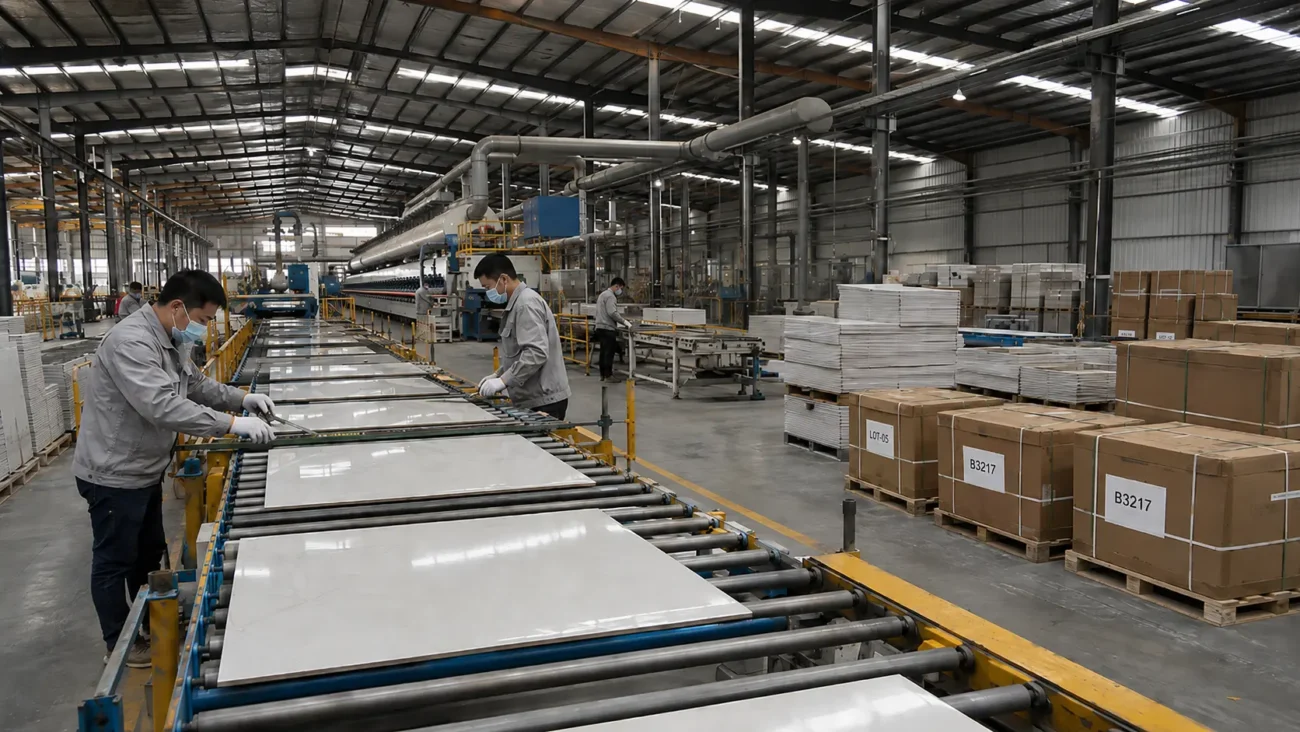
Factories usually understand their own production lines, tile body, surface finish, kiln schedule, available sizes and production capacity. If a buyer needs one stable porcelain tile model in a large quantity, a factory may offer better control and a more direct production conversation.
Factory-direct sourcing can also be useful for long-term importers.
A distributor or wholesaler that imports containers regularly may prefer to work directly with one factory, build a stable relationship, negotiate repeat pricing and control product development over time.
In these cases, the factory’s advantage is not only price.
It is production visibility.
The buyer can ask about production schedule, batch, shade, cartons, pallet plan and future repeat orders. If the same model is ordered again, the factory may be able to manage supply more consistently.
However, this advantage is strongest when the buyer knows exactly what they need.
A factory is usually best when the product range is narrow, the quantity is meaningful and the buyer can manage the rest of the sourcing process.
Where Factory-Direct Sourcing Can Become Difficult
Factory-direct sourcing does not automatically mean lower total project cost.
A factory may quote a good tile price, but the quotation may only include the product at the factory gate. The buyer still needs to arrange sample checking, quality inspection, packaging confirmation, domestic transportation, warehouse receiving, export customs, container loading and shipping.
Some factories are strong in production but not strong in overseas project coordination.
They may not want to handle small quantities across many tile styles. They may not help source matching mosaics, slabs, outdoor tiles or bathroom products. They may not have the patience to coordinate many changes from a villa owner, hotel designer or restaurant contractor.
This becomes a problem for project buyers.
A hotel buyer may need several tile types and room-area labeling. A villa buyer may need tiles, slabs, cabinets, bathroom products and lighting together. A restaurant buyer may need tiles with furniture and kitchen equipment in the same shipment.
A single tile factory can solve one part of the project, but not always the full project.
This is why factory-direct can be suitable for product purchasing, but not always suitable for project sourcing.
What a Tile Trading Company Actually Does
Many buyers hear “trading company” and immediately think of a middleman adding margin.
Sometimes that is true.
A weak trading company may simply collect factory photos, add a markup, forward messages and avoid responsibility when problems happen.
But a good trading company or sourcing company can provide real value when the buyer’s order involves different products, small quantities, multiple factories, tight timing or export coordination.
A useful trading company should help compare suppliers, check tile grades, arrange samples, confirm packaging, coordinate inspection, receive goods in a warehouse, manage labels, consolidate suppliers and prepare shipment.
The value is not that it hides the factory.
The value is that it makes a complicated sourcing process easier to manage.
For example, if a buyer needs porcelain tiles, large slabs, mosaics, bathroom products and lighting in one container, a trading company may be more practical than asking one tile factory to manage everything.
For related large slab sourcing, read 🔗Large Format Tiles from China: Sourcing Guide for Luxury Villas and Hotel Projects.
When a Trading Company Can Be Better Than a Factory
A trading company can be more useful when the project is not simple.
This often happens with villas, hotels, apartments, restaurants and commercial renovation projects.
The buyer may need different tile types in small or medium quantities. One factory may be strong in porcelain floor tiles, another in mosaics, another in outdoor tiles, and another in large slabs. If the buyer works with every factory directly, communication and coordination become heavy.
A trading company or sourcing team can help connect these pieces.
It can collect samples from different suppliers, compare grades, check whether the colors work together, receive products in one warehouse and arrange a mixed container.
This does not mean the trading company is always better.
It means the buyer should compare the supplier structure with the project structure.
If the project has many products, many suppliers and one final shipment, a sourcing team may reduce risk. If the order is one product in large quantity, a factory may be enough.
| Buyer Situation | Factory May Be Better | Trading Company May Be Better |
|---|---|---|
| Large quantity of one tile model | Strong option | Not always necessary |
| Many tile types in one project | Limited | More useful |
| Need tiles, slabs and bathroom products together | Usually limited | More practical |
| Need lowest unit price | Often possible | Depends on service scope |
| Need mixed container loading | Usually limited | More useful |
| Need inspection and packaging control | Buyer must arrange | Can be included |
| Need flexible small quantities | Sometimes difficult | Often easier |
| Need long-term OEM supply | Stronger | Depends on supplier network |
The table is only a quick comparison.
In real sourcing, the best choice depends on the buyer’s product knowledge, order quantity, project complexity and ability to manage risk in China.

Factory Price vs Total Project Cost
The biggest mistake buyers make is comparing only square-meter price.
A buyer may receive two quotations:
Factory A: lower unit price
Trading Company B: slightly higher unit price
At first, Factory A looks better.
But the buyer still needs to ask what each quotation includes.
Does the price include pallets? Does it include reinforced cartons? Does it include export labels? Does it include delivery to a consolidation warehouse? Does it include inspection? Does it include mixed-container coordination? Does it include spare quantity planning?
A factory price can be lower because it only covers the tile itself.
A trading company price can be higher because it includes communication, packaging control, warehouse handling, supplier coordination and loading supervision.
Neither structure is automatically right or wrong.
The buyer needs to compare the full scope.
A villa buyer may receive a cheaper factory quotation for living room tiles, but the quote does not include pallets, spare quantity, inspection or delivery to the consolidation warehouse. A sourcing supplier’s price may look higher, but it may already include packaging control, sample comparison and shipment coordination with bathroom products and furniture.
The lowest unit price is not always the lowest project cost.
Tile Grade, Batch Consistency and Packaging: The Real Comparison
When comparing tile suppliers in China, buyers should look beyond the company type.
A factory can supply good tiles or poor tiles. A trading company can be responsible or careless. The real comparison should focus on product grade, batch consistency and packaging scope.
Tile grade matters because two similar-looking tiles may not be the same quality. One quotation may be based on first-grade production tiles. Another may be based on stock tiles, project tiles or mixed inventory.
Batch consistency matters because different batches can create visible color differences after installation. This is especially important for large villa floors, hotel bathrooms, lobby areas and restaurant walls.
Packaging matters because tiles are heavy and fragile. Weak cartons, missing pallets, poor corner protection or careless container loading can create damage before the product reaches the project site.
A supplier should be able to explain how tiles will be packed, labeled and loaded.
If the buyer needs other building materials in the same shipment, the loading plan becomes even more important. Tiles should not damage cabinets, lighting, furniture, bathroom products or fragile slabs.
The real supplier test is not the business license type.
It is whether the supplier can deliver the correct tiles safely and consistently.

Foshan Tile Market: Why Supplier Type Is Not Always Obvious
Foshan is one of the most important tile sourcing areas in China.
Buyers can see ceramic tiles, porcelain tiles, mosaics, large slabs, sintered stone, bathroom products and other building materials in one sourcing trip. Public exhibition information from CeramBath also shows how broad the Foshan ceramic and bathroom supply chain has become, with categories such as ceramic tile, slab, mosaic, green surfacing material, stone and sanitary ware.
Buyers can also review the official exhibition information here: 🔗CeramBath Foshan Introduction and 🔗China Ceramics City Venue.
But this variety can also create confusion.
A showroom may represent a brand, a factory, a distributor or a trading supplier. Some suppliers have strong displays but limited export service. Some factories produce well but are not flexible with small project orders. Some trading companies can coordinate export, but buyers still need to know whether they inspect products properly.
This is why buyers should not judge only by whether the supplier says “factory” or “trading company.”
They should ask:
Who controls the product?
Who controls the quality?
Who controls the packaging?
Who takes responsibility before shipment?
These questions are more useful than the label on the business card.
A Realistic Villa, Hotel and Restaurant Sourcing Scenario
A villa buyer may visit Foshan and choose five different tile types: living room floor tiles, bathroom wall tiles, outdoor anti-slip tiles, stair tiles and a marble-look slab for the TV wall.
One factory may not supply all of them at the right style, grade and price.
In this case, a sourcing company can help compare several suppliers and consolidate everything into one shipment.
A hotel buyer may have a different problem.
The buyer may need consistent tiles for many bathrooms and public areas. Factory-direct sourcing may look safer at first, but if the factory cannot manage room-area labeling, spare quantity, batch control and mixed-container coordination, the hotel project may still face delays during installation.
For a restaurant project, the order may include anti-slip floor tiles, wall tiles, lighting, chairs, tables and kitchen equipment.
A tile factory can only solve one part of that project.
The bigger challenge is whether all suppliers can deliver on time and whether the container can be loaded without damaging heavy or fragile goods.
These are the real situations where the factory vs trading company question becomes more practical.
It is not about which supplier type sounds better.
It is about which one can manage the project better.
How to Check Whether a Supplier Is Reliable
A reliable supplier should answer clearly, not only quickly.
When discussing tile sourcing, buyers should ask about product grade, factory source, stock condition, production batch, sample approval, packaging, pallet plan, lead time, inspection and shipment responsibility.
If the supplier avoids these questions and only talks about low price, the buyer should be careful.
A reliable factory should be able to explain what it produces, what it does not produce, what grades are available, what packaging is used and what the MOQ is.
A reliable trading company should be able to explain where products come from, how suppliers are compared, how inspection is handled, how warehouse consolidation works and what is included in the quotation.
Buyers should also compare samples with bulk production before shipment.
This is especially important for large format tiles, marble-look tiles, outdoor tiles and hotel project tiles.
A supplier does not need to be perfect, but it should be transparent about what it can control and what it cannot control.
How a China-Based Sourcing Team Helps
A China-based sourcing team should not simply replace the factory.
Its value comes from helping the buyer manage the full sourcing process.
For tile projects, this may include supplier comparison, sample collection, quotation review, product grade checking, production follow-up, inspection, packaging review, warehouse consolidation and loading supervision.
For multi-category projects, the value becomes bigger.
Tiles may need to be shipped with bathroom products, cabinets, doors, lighting, furniture, hardware or kitchen equipment. In that case, the challenge is not only buying tiles. The challenge is making different suppliers work together as one shipment.
Cody Sourcing works with tile, slab, bathroom, cabinet, lighting, furniture and building-material suppliers across Foshan and other Chinese manufacturing regions.
For global buyers, the goal is not always to avoid factories or avoid trading companies.
The goal is to build the right supplier structure for the project.
Sometimes that means buying directly from a tile factory. Sometimes it means using a trading company. Sometimes it means using a sourcing team to compare factories, manage quality and consolidate shipment.
The right answer depends on the project.
Common Mistakes to Avoid
Many buyers believe factory-direct always means cheaper.
It can be cheaper, but only when the quotation scope is the same.
Another mistake is rejecting every trading company without checking whether the project actually needs coordination. For simple repeat orders, a trading company may not add much value. For villa, hotel or restaurant projects, coordination may be exactly what the buyer needs.
Some buyers also compare quotations without checking tile grade, batch, packaging and shipping terms.
A low price for stock tiles should not be compared directly with a price for first-grade fresh production. A price without pallets should not be compared with a price including export-ready packaging. EXW price should not be compared with FOB or delivered warehouse price.
The most serious mistake is confirming a supplier before understanding who takes responsibility for quality before shipment.
A supplier should not only sell the tile.
It should help the buyer reduce project risk.
Final Thoughts
The choice between a tile factory vs trading company in China is not a simple question of who is cheaper.
A factory can be the right choice for large, stable and repeat tile orders. A trading company or sourcing team can be more practical for project orders that involve multiple tile types, mixed quantities, supplier coordination, inspection, warehouse consolidation and container loading.
For global buyers, the best supplier is not always the one with the lowest unit price or the biggest showroom.
The best supplier is the one that can support the real project: correct tile grade, consistent batch, clear quotation scope, safe packaging, reliable inspection and organized shipment.
That is how buyers should choose the right supplier when sourcing tiles from China.
