


Sintered Stone Manufacturers in China: Countertop and Interior Project Guide

Sintered stone manufacturers in China can supply large slabs, porcelain slabs, countertop materials, kitchen island surfaces, vanity tops, dining table panels and interior wall applications for villas, hotels, apartments, restaurants and commercial projects.
But sintered stone should not be sourced only as a decorative slab.
For overseas buyers, the real question is not only whether the surface looks like marble, stone or cement. The more important question is whether the material can be cut, packed, shipped, unloaded, fabricated and installed safely in the final project.
A slab may look perfect in a Foshan showroom. But if the edge chips during cutting, the sink opening cracks, the crate is too weak, or the destination fabricator cannot handle the material, the project can still face delays and extra cost.
This guide explains how global buyers can compare sintered stone manufacturers in China, understand countertop and interior applications, check fabrication risks, inspect quality before shipment, and plan packaging and loading for international projects.
For related large slab sourcing topics, read:🔗 Large Format Tiles from China: Sourcing Guide for Luxury Villas and Hotel Projects.

Why Sintered Stone Is More Than a Decorative Slab
Many buyers first notice sintered stone because of the surface.
A Calacatta-look slab, dark stone texture, cement effect or soft matte finish can make a kitchen island, bathroom vanity or hotel lobby wall look premium. In Chinese showrooms, sintered stone is often displayed as a full interior solution, not only as a single slab on a rack.
But the buying decision should not stop at appearance.
Sintered stone is often used in places where ordinary wall tiles are not enough. It may become a countertop, island top, dining table, bathroom vanity, feature wall, cabinet surface or hotel interior panel.
Once the material is used this way, the sourcing logic changes.
The buyer needs to think about slab thickness, edge processing, cutting, drilling, support structure, breakage risk, packaging, unloading and local installation. A beautiful slab is only useful when it can survive the full process from factory to final installation.
That is why sourcing sintered stone from China is different from choosing a normal tile.
It is closer to sourcing a fabricated surface material.
Sintered Stone, Porcelain Slabs and Ceramic Slabs: What Buyers Should Know
In real China sourcing conversations, buyers often use several terms together: sintered stone, porcelain slab, ceramic slab, large slab, rock slab and large format panel.
These terms can overlap in the market, but they are not always used in the same way by every supplier.
Some products are mainly designed for wall panels and decorative surfaces. Some are suitable for countertops and furniture surfaces. Some can be cut and fabricated into vanity tops or kitchen islands. Others may look similar but are not ideal for complex cut-outs, exposed edges or heavy-use countertops.
This is why buyers should not rely only on the product name.
A more practical approach is to ask what the material is intended for.
Can it be used as a countertop? What thickness is available? Can it handle sink or cooktop cut-outs? Can the edge be polished cleanly? Is it suitable for a dining table top? Does the supplier only sell full slabs, or can it also support fabrication?
For North American projects involving large porcelain panels or slabs, buyers may also discuss installation expectations with local installers using references such as the 🔗TCNA Gauged Porcelain Tile Panels/Slabs installation publications.
The Chinese supplier can provide the slab, but the project result also depends on the fabricator, installer, tools and site conditions at the destination.
Countertops, Kitchen Islands and Vanity Tops: Different Uses, Different Risks
Countertops, kitchen islands and vanity tops may all use sintered stone, but they do not have the same risk.
A kitchen countertop needs practical performance. The buyer should think about edge finishing, sink cut-out, cooktop opening, stain resistance, cleaning, heat exposure, support structure and whether the material is suitable for the intended kitchen use.
A kitchen island is often more design-focused. Buyers may want a waterfall edge, bookmatched pattern or large continuous surface. The visual result can be impressive, but the slab size, weight, support and lifting method must be planned carefully.
A bathroom vanity top has another logic. It may need a basin opening, polished edge, water resistance, matching wall slabs and room-number labeling for hotel projects.
For dining tables and furniture surfaces, the slab may look strong, but the buyer should still check backing support, impact risk, edge safety and how the stone surface will be fixed to the frame.
| Application | Why Buyers Use Sintered Stone | What Buyers Should Confirm |
|---|---|---|
| Kitchen Countertops | Stone-look surface with lower maintenance | Thickness, edge detail, sink cut-out and food-contact requirement |
| Kitchen Islands | Large continuous design and waterfall edges | Slab size, pattern direction, support structure and lifting method |
| Bathroom Vanity Tops | Clean surface and matching wall design | Basin opening, edge finish, water exposure and room numbering |
| Dining Tables | Premium furniture surface | Backing support, impact risk, edge safety and packaging |
| Feature Walls | Large marble-look or stone-look effect | Bookmatch, wall flatness, crate protection and installation path |
| Hotel Projects | Consistent design across many rooms | Batch consistency, spare pieces, labeling and replacement plan |
The table is useful for comparison, but the real decision should always come back to the project.
The same slab may be suitable for a wall, but not ideal for a kitchen island. Another slab may work well as a dining table, but require better packaging and support than a normal wall panel.
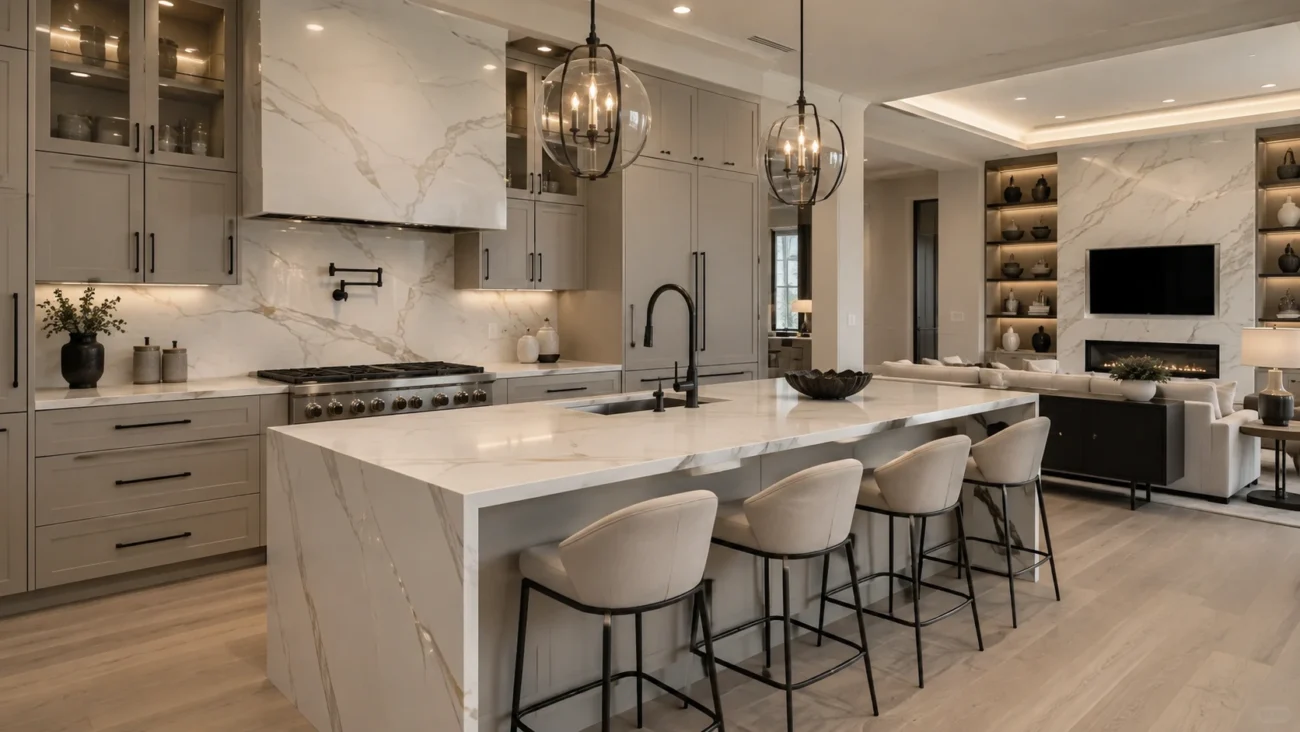
Interior Walls, Furniture Surfaces and Hotel Projects
Sintered stone is often attractive for interior projects because it creates a large, clean surface with fewer joints.
For villas, it is commonly used for TV feature walls, bathroom walls, kitchen islands, dining tables, cabinet surfaces and entry areas. The owner may want a natural stone look without using natural marble in every area.
For hotels, the logic is more project-based.
A hotel may use sintered stone in lobby walls, bathroom vanities, elevator halls, restaurant surfaces and guest bathroom panels. In this case, the buyer is not only choosing one beautiful slab. The buyer needs consistent delivery across many rooms and public areas.
Batch consistency becomes important. Spare pieces matter. Package labels must match floors and room numbers. Replacement planning should be discussed early, because the same surface may be difficult to match later if the production batch changes.
For restaurant projects, sintered stone dining tables and wall surfaces can look premium and be easier to clean than some decorative materials. But the buyer should also think about edge safety, impact risk, frame support, traffic level and how replacement pieces would be handled.
A surface material that looks beautiful in one showroom photo may behave very differently when used across an entire project.
That is why project application should guide the supplier selection.
How to Compare Sintered Stone Manufacturers in China
Not every supplier selling sintered stone controls the same part of the supply chain.
Some companies are slab manufacturers. They focus on production, surface design, size, thickness and slab quality. They may be strong in materials but may not handle cutting, fabrication or export packaging for finished countertops.
Some are showroom brands or distributors. They are useful for comparing design, color, texture and application scenes. However, buyers still need to confirm the actual production source and whether bulk delivery will match the sample.
Some are fabrication workshops. They may not produce the slab, but they can cut, drill, polish and process countertops, vanity tops, tabletops and interior panels.
Some cabinet, furniture or bathroom suppliers use sintered stone as part of a finished product. In that case, buyers should still check where the slab comes from and who is responsible for edge quality, cut-outs and packaging.
For overseas buyers, the best supplier may not be one single factory.
A countertop project may require a slab supplier, a fabrication partner, a cabinet supplier and an export warehouse working together.
This is why sintered stone manufacturers in China should be compared by project capability, not only by slab price.
Why Factory Prices Can Be Very Different
Sintered stone quotations can vary widely.
At first, two slabs may look very similar. Both may have a marble pattern, matte finish and large size. But the price difference may come from body quality, thickness, surface technology, flatness, pattern detail, stock condition, brand level, packaging and whether fabrication is included.
A full slab price is not the same as a finished countertop price.
If the buyer needs sink openings, cooktop cut-outs, polished edges, waterfall island pieces, dining table tops or vanity tops, the supplier must include fabrication cost and processing risk.
Packaging also affects the quotation.
A slab sold for local pickup may not include the wooden crate, A-frame support, foam, corner protection or export loading required for international shipping.
This is where many buyers misunderstand Chinese factory prices.
A lower quotation may still be usable if the buyer clearly understands the scope. But it should not be compared directly with a quotation that includes fabrication, stronger packaging, inspection and export handling.
The better question is not:
Why is this slab cheaper?
The better question is:
Are these suppliers quoting the same material, thickness, surface, processing scope, packaging and shipping responsibility?
Only then does price comparison become meaningful.
Fabrication: Cutting, Edge Processing and Sink Openings
Fabrication is where many sintered stone projects become more complex.
A slab can be beautiful, but the final countertop depends on cutting accuracy, edge polishing, opening positions, corner details and support structure.
For kitchen countertops, the sink and cooktop cut-outs should be discussed before production. Poor cutting can create chips, cracks or weak corners. For waterfall islands, pattern direction and edge matching should be planned carefully.
For vanity tops, basin openings and faucet holes need accurate drawings. For dining tables, edge safety and backing support should be checked. For wall panels, the buyer should know whether panels need to be pre-cut before shipping or cut at the destination.
Fabrication also raises a safety issue.
Cutting, grinding or drilling stone and ceramic surface materials can generate respirable crystalline silica dust. OSHA and NIOSH have updated their hazard alert for countertop manufacturing, finishing and installation, so buyers should work with qualified fabricators that use proper wet cutting, dust control and worker-safety practices.
This does not mean buyers should avoid sintered stone.
It means countertop projects should be handled by suppliers and fabricators who understand the material and process.

Quality Checks Before Confirming Bulk Production
Quality checking should happen before the buyer confirms a large order or allows shipment.
For sintered stone, surface inspection is important, but it is only one part of the process.
The buyer should compare the bulk material with the approved sample. Color tone, pattern, gloss, texture and body consistency should be checked. For marble-look slabs, pattern direction and matching should be reviewed before cutting.
Flatness matters, especially for large panels and countertop pieces.
A slight curve can become more visible after installation. Edge condition also matters because chips are difficult to hide on countertops, tabletops and feature walls.
If the order includes fabricated pieces, the inspection should include cut-outs, edge polishing, dimensions, corner radius, hole positions and package labels.
For hotel or apartment projects, room matching becomes important. Vanity tops, wall panels or tabletop pieces may look similar, but each piece may belong to a different room or floor.
A good inspection process does not only look for defects.
It confirms that the material can support the final design, fabrication and installation plan.
Packaging, Wooden Crates and Container Loading Risks
Sintered stone is large, heavy and fragile during international shipping.
Good packaging is essential.
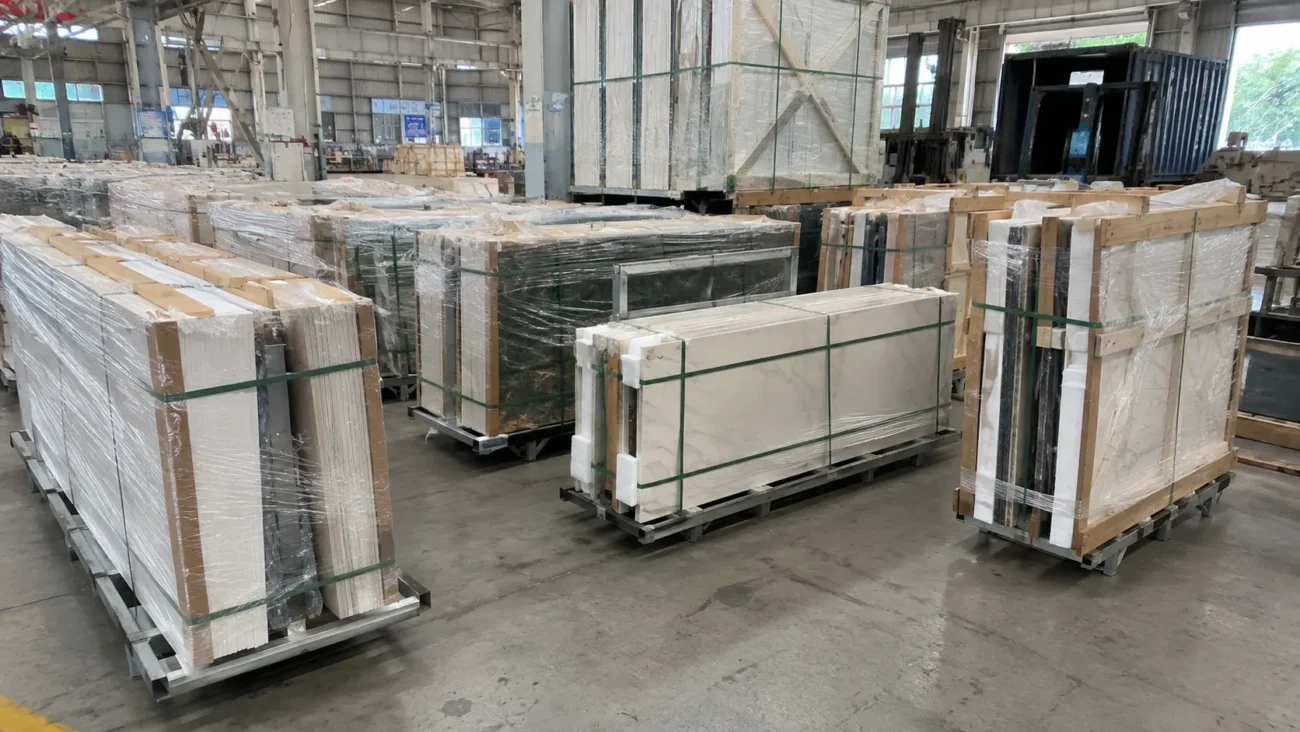
Large slabs, fabricated countertops, dining table tops and vanity tops usually need stronger protection than ordinary tiles. Wooden crates, A-frame support, foam, corner protection, straps and clear labels may be necessary depending on the size and shipment method.
Finished countertops may be even more sensitive than full slabs.
Once a piece has sink openings, cooktop openings or polished edges, weak areas can break if the crate is not designed properly. The packaging should support the piece without putting pressure on cut-out corners.
Container loading should also be planned carefully.
Heavy slabs should be secured to prevent movement. Fragile edges should be protected. Crates should not be squeezed by heavy or sharp goods. If sintered stone is shipped together with cabinets, lighting, bathroom products or furniture, the loading sequence must protect every product type.
A good slab can fail before reaching the site if packaging is treated as an afterthought.
For international buyers, packaging should be part of the quotation review, not a final detail after production.
Destination Handling and Installation
Many sintered stone problems happen after the goods arrive.
The project site may not have enough space to unload large crates. A slab may not fit through a doorway, elevator, staircase or narrow corridor. A finished countertop may be too heavy for the available workers or lifting tools.
Before ordering large slabs, buyers should check the destination path.
For a villa kitchen island, the buyer should confirm the entrance, hallway, turning space and installation access. For a hotel project, the buyer should think about floor-by-floor movement, temporary storage, room sequence and replacement pieces.
Local fabricator capability is also critical.
Some buyers plan to import full slabs and cut them locally. Others prefer to complete fabrication in China and ship finished pieces. Both options can work, but each has risks.
Fabrication in China may reduce local cutting work, but it requires accurate drawings and stronger packaging. Fabrication at the destination may allow better site adjustment, but the local team must understand sintered stone and have the correct tools.
The best approach depends on the project, installer, cost structure and risk tolerance.
For sintered stone, the sourcing plan should not end at the factory gate.
It should continue to the final installation.
A Realistic Sintered Stone Sourcing Scenario
A villa buyer may choose a Calacatta-look sintered stone slab for a kitchen island.
In the showroom, the slab looks perfect. The pattern feels luxurious, the size looks impressive, and the surface matches the cabinet design.
But after the first excitement, the real sourcing questions begin.
What thickness is suitable? Will the island have a waterfall edge? Where will the sink and cooktop openings be? Can the edge be polished cleanly? Does the local installer prefer full slab delivery or finished pieces? Can the crate fit into the container and be unloaded safely at the destination?
For a hotel project, the questions are different.
The buyer may need vanity tops for many bathrooms. One sample may look good, but the project needs consistent color, accurate basin openings, clean edge finishing, room-number labels, spare pieces and replacement planning.
For a restaurant project, sintered stone dining tables may look premium and practical. But the sourcing team should still check edge safety, table-frame support, impact risk, packaging and whether replacement tops can be produced later.
In each case, the product decision is connected to fabrication, packaging, shipping and daily use.
That is why sintered stone sourcing is not only a material selection task.
It is a project coordination task.
Where to Source Sintered Stone in China
Foshan is one of the most important places for buyers comparing sintered stone, porcelain slabs, ceramic slabs and related interior surface materials.
In Foshan showrooms, buyers can see sintered stone displayed as countertops, kitchen islands, vanity tops, dining tables, cabinet surfaces and hotel wall panels. This helps buyers understand how the material works inside real project spaces.
CeramBath in Foshan also covers ceramic tiles, slabs, mosaics, stone, green surfacing materials, sanitary ware and related categories, which makes the city useful for buyers who want to compare surface materials together with bathroom products and other building materials.
However, a beautiful showroom is not enough.
Buyers still need to confirm whether the supplier is a slab manufacturer, showroom distributor, fabrication workshop, furniture supplier or export trading company.
For countertop and interior projects, the right sourcing route may involve more than one supplier.
The slab source, fabrication partner, packaging method and export coordination should all be connected before the order is confirmed.
How a China-Based Sourcing Team Helps
A China-based sourcing team should do more than send slab catalogues.
Useful support starts with understanding the project: countertop, kitchen island, vanity top, feature wall, dining table, hotel bathroom or villa interior application.
The team can help compare sintered stone manufacturers in China based on slab quality, thickness, surface finish, fabrication capability, packaging method and export experience.
For countertop and furniture projects, the team can also help communicate drawings, confirm cutting details, check edge samples, review sink and cooktop openings, and inspect finished pieces before shipment.
For mixed building-material projects, local coordination becomes even more important. Sintered stone may be shipped together with cabinets, bathroom products, furniture, lighting, doors or tiles. The loading plan must protect fragile slabs while keeping the project organized.
Cody Sourcing works with tile, slab, cabinet, bathroom, furniture and building-material suppliers across Foshan and other Chinese manufacturing regions.
For sintered stone projects, the value is not simply finding a lower slab price. It is helping buyers connect material selection, fabrication, quality control, packaging and shipping into one manageable process.
Common Mistakes to Avoid
One common mistake is choosing sintered stone only by surface pattern.
The pattern matters, but it does not answer whether the material is suitable for a countertop, island, vanity top, dining table or wall panel.
Another mistake is comparing full slab prices with finished countertop prices. A full slab quotation may not include cutting, edge finishing, sink openings, wooden crates or export handling.
Some buyers also forget destination handling. A slab can be produced correctly and packed well, but still create problems if it cannot be unloaded, moved or installed safely at the project site.
For hotel and villa projects, batch and replacement planning are often underestimated. If the project needs additional pieces later, matching the same pattern and color may be difficult.
Most problems can be reduced when buyers treat sintered stone as a fabricated project material, not just a showroom slab.
Final Thoughts
Sintered stone manufacturers in China can offer strong options for countertops, kitchen islands, vanity tops, dining tables, feature walls and hotel interior projects.
But the best sourcing decision is not simply choosing the most beautiful slab or the lowest square-meter price.
A successful sintered stone project depends on material selection, thickness, surface finish, fabrication, cutting, edge detail, packaging, unloading and installation.
For overseas buyers, the safest approach is to think through the full journey: showroom sample, factory production, fabrication, inspection, wooden crate packaging, container loading, destination handling and final installation.
That is where real sourcing value appears.
