


Decorative Wall Panels from China: Hotel and Villa Sourcing Guide

Decorative wall panels from China are widely used in hotel renovations, villa interiors, restaurant projects, apartments, offices and commercial spaces.
They can make a wall look finished faster than traditional paint or stone. They can create a warm wood-look feature wall, a fluted hotel headboard, a stone-look lobby surface, an acoustic restaurant wall or a quick-renovation corridor system.
But decorative wall panels should not be sourced only by surface design.
For overseas buyers, the real question is not only whether the panel looks good in a showroom. The more important question is whether the material is suitable for the project area, safe for the destination market, stable in the local climate, easy to install, durable enough for daily use and protected well during international shipping.
A villa owner may care more about texture, lighting effect and custom design. A hotel buyer may care more about fire performance, batch consistency, acoustic comfort, maintenance and room-number matching. A restaurant buyer may care about cleaning, odor, scratch resistance and replacement.
This guide explains how global buyers can source decorative wall panels from China, compare materials and finishes, avoid common project mistakes, and manage inspection, packaging and shipment more clearly.
For broader surface material sourcing, read 🔗Foshan Tile Market Guide: How Global Buyers Source Tiles from China and 🔗Sintered Stone Manufacturers in China: Countertop and Interior Project Guide.

Why Decorative Wall Panels Are More Than Surface Design
Many buyers first choose decorative wall panels because of appearance.
A wood veneer panel may look warm. A fluted panel may make a villa wall feel more architectural. A stone-look panel may create a hotel lobby effect at a lower weight than natural stone. An acoustic panel may make a restaurant or meeting room feel more comfortable.
Appearance matters, but it is only the first layer.
The same wall panel can perform very differently depending on substrate, surface film, panel thickness, installation method, fire performance, moisture resistance and packaging.
A hotel corridor wall is not used the same way as a villa TV feature wall. A bathroom wall is not the same as a dry bedroom wall. A restaurant wall needs to handle cleaning and impact in a way that a private living room wall may not.
This is why buyers should avoid choosing decorative wall panels only from one showroom sample.
A sample can show color and texture, but it cannot show how the panel will behave after shipping, cutting, installation, cleaning and daily use.
The better sourcing question is:
Will this wall panel still work well after it is installed in the actual hotel, villa or commercial project?
How to Compare Decorative Wall Panels from China by Project Use
Decorative wall panels are not one single material.
In China, buyers may see wood veneer panels, fluted panels, WPC panels, PVC panels, PS panels, bamboo charcoal panels, acoustic slat panels, fabric panels, stone-look panels, sintered stone wall panels, HPL panels and metal decorative panels.
This can be confusing because many products look similar after installation.
A wood-look PVC panel and a real wood veneer panel may both create a warm surface in photos. But the substrate, surface feel, scratch resistance, odor, fire behavior, edge finishing and price can be very different.
A stone-look PVC marble sheet and a sintered stone wall panel may both be used for feature walls, but the weight, installation method, surface realism, breakage risk and packaging are not the same.
For buyers, the first step is not asking which material is the best.
The first step is deciding where the wall panel will be used.
| Panel Type | Common Use | What Buyers Should Check |
|---|---|---|
| Wood Veneer Panels | Hotel rooms, villa feature walls, luxury interiors | Substrate, veneer quality, color batch, formaldehyde and warping risk |
| WPC / PVC Panels | Quick decoration, commercial spaces, budget projects | Surface film, odor, fire behavior, trims and scratch resistance |
| Bamboo Charcoal Panels | Fast interior wall renovation and decorative surfaces | Board structure, smell, surface film, bending and installation system |
| Acoustic Panels | Hotel rooms, meeting rooms, restaurants and offices | Acoustic report, felt backing, fire performance and mounting method |
| Stone-Look Panels | Lobby walls, bathrooms and feature walls | Surface realism, water exposure, weight and edge protection |
| Fabric Panels | Hotel headboards, bedrooms and lounges | Fabric quality, fire treatment, cleaning, padding and installation |
This table can help buyers compare basic categories, but the final decision should still come from the project.
A panel that works well for a villa bedroom may not be suitable for a hotel corridor. A material that looks premium on a feature wall may not be durable enough for a restaurant with heavy traffic.
Hotel Wall Panels: Fire, Durability, Acoustic Comfort and Maintenance
Hotel wall panels should be selected with daily operation in mind.
A hotel guest may not know what material is installed on the wall, but they will notice if the corridor looks damaged, if the room feels noisy, if the wall has odor, or if the surface looks cheap after a few months of use.
For hotel projects, decorative wall panels often appear in corridors, guest room headboards, lobby walls, elevator halls, restaurants, meeting rooms and public areas.
Each area has a different requirement.
Hotel corridors need stronger durability because luggage, cleaning carts and guests may hit the walls every day. Guest room headboard walls may need a warmer texture, better acoustic comfort and a clean installation detail. Lobby walls need a premium visual effect and good batch consistency. Restaurants need surfaces that can handle cleaning and traffic.
Fire performance should also be discussed early.
For hotel and commercial projects, wall panels may be treated as interior finish materials in the destination market. Buyers should confirm whether fire-performance reports are required for the exact material, thickness, surface and installation method.
The practical point is simple: a hotel wall panel should look good, install clearly, meet project requirements and remain maintainable after opening.
A cheap panel that cannot be replaced later or does not match the next batch may become expensive for hotel operations.

Villa Wall Panels: Feature Walls, Warm Textures and Custom Design
Villa buyers often choose decorative wall panels for a different reason.
They want the interior to feel more complete, more designed and more personal.
A villa owner may want a fluted wall behind the sofa, a warm wood-look bedroom wall, a stone-look TV background, a soft fabric headboard panel or a decorative panel that matches cabinets, lighting and furniture.
This is where China sourcing can be useful because buyers can compare wall panels together with tiles, cabinets, furniture, lighting, doors and bathroom products during one sourcing process.
For villa projects, the main challenge is not only the material itself.
The wall panel must match the full interior design.
Lighting position, corner finishing, panel joints, cabinet lines, skirting, door frames and ceiling details can all affect the final result.
A panel that looks good as one sample may not look good across a full wall if the joint layout is not planned. A fluted panel may look premium, but corners and end caps must be solved cleanly. A wood-look panel may feel warm, but the buyer still needs to check color consistency and climate stability.
For villa interiors, custom design and installation details are often more important than choosing the cheapest panel.
For related high-end interior surface ideas, read🔗 Large Format Tiles from China: Sourcing Guide for Luxury Villas and Hotel Projects.
Wood Veneer, WPC, PVC, Bamboo Charcoal and Acoustic Panels
Different wall panel materials solve different problems.
Wood veneer and wood-based panels can create a natural, high-end interior feel. They are common in hotel rooms, villa feature walls, offices and luxury residential spaces. But buyers should check substrate, veneer quality, formaldehyde-related documents, moisture behavior, paint finish, edge banding and color matching.
WPC, PVC and PS panels are often used for fast decoration, budget-sensitive projects and commercial interiors. They are popular because they can be lightweight, easy to cut and quick to install. But buyers should not judge them only by surface pattern. Odor, surface film quality, scratch resistance, fire behavior, bending and installation accessories should all be reviewed.
Bamboo charcoal composite panels are common in China’s quick-renovation market. They may be promoted for interior wall decoration, but buyers should still check the actual board structure, surface film, smell, bending strength, fire behavior and accessory system.
Acoustic panels are another category.
They are often used in hotel rooms, meeting rooms, restaurants, offices and entertainment spaces. But buyers should not only look at the wooden slat surface. Felt backing, panel thickness, mounting method, acoustic report, fire performance and edge finishing can all change the result.
Stone-look panels and sintered stone wall panels are useful when buyers want a large marble-look or stone-look effect. If the project uses real slabs or sintered stone panels, packaging, weight, breakage and installation path become more important.
For slab-based wall materials, read 🔗Sintered Stone Manufacturers in China: Countertop and Interior Project Guide.
Fire Performance, Formaldehyde and Indoor Air Quality Concerns
For hotels, restaurants, offices and public commercial spaces, wall panels cannot be selected only by appearance.
Buyers should confirm whether the material needs fire-performance documentation in the destination market.
For example, the 2024 International Fire Code Chapter 8 treats certain paneling, wall pads and similar materials used for decoration or acoustic correction as interior finish materials. Buyers can review the official reference here: 2024 International Fire Code Chapter 8.
For wood-based panels and products containing composite wood, formaldehyde documentation can also matter.
For US-related projects, buyers should understand EPA requirements for composite wood products under TSCA Title VI. EPA provides guidance for importers, distributors and retailers here: EPA Formaldehyde Emission Standards for Composite Wood Products.
China also has relevant product standards for wall panel categories. The national standard information platform lists GB/T 46106-2025 Interior decorative wood-based wallboard 和 GB/T 43212-2023 Bamboo charcoal composite board. These references can help buyers discuss product categories more clearly with suppliers, but they do not replace destination-market compliance.
The safest approach is to ask for documents that match the exact product model, material, thickness and surface finish.
A generic test report from another product should not be treated as proof for the wall panel being ordered.
Installation Accessories: Trims, Corners, Clips and Adhesives
Wall panel sourcing often fails because buyers only order the panel itself.
The installation system is just as important.
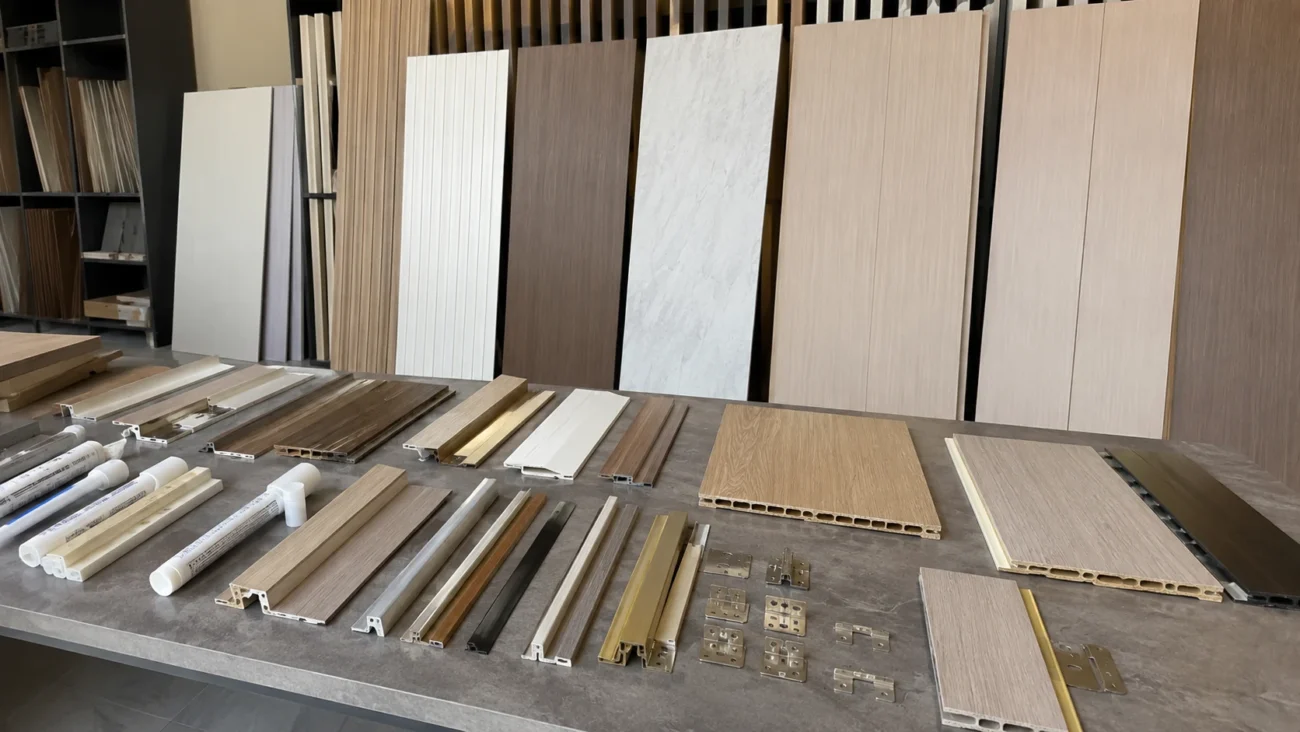
Most decorative wall panels need matching accessories such as corner trims, edge strips, joint profiles, skirting lines, clips, adhesives, backer strips or special fixing parts. Without these accessories, the installer may need to improvise at the destination.
That can ruin the final appearance.
For fluted panels, corner treatment is very visible. For wood veneer panels, edge finishing and color matching matter. For PVC or WPC panels, clips and trims may decide whether the installation looks clean or cheap. For acoustic panels, mounting method affects both appearance and sound absorption.
The wall condition also matters.
If the substrate wall is uneven, panel joints can become obvious. If the project needs hidden lighting, the panel layout should be coordinated with LED strips and electrical positions before production.
In villa and hotel projects, buyers should ask how the panels will meet ceilings, floors, door frames, cabinet edges and corners.
A good wall panel supplier should be able to explain not only the panel, but also how the system is installed.
Why Factory Prices Can Be Very Different
Decorative wall panel prices from China can vary widely.
Two panels may look similar in photos but use different substrates, surface films, thicknesses, densities, backing materials, fire treatments, edge details and accessory systems.
A low-price PVC wall panel may use a thinner board, weaker surface film or simpler print layer. A higher-price acoustic panel may include better felt, stronger slats, cleaner edge treatment or a more complete mounting system. A wood veneer panel may cost more because of veneer quality, substrate, paint finish and color control.
Quotation scope also matters.
Some suppliers quote only panels. Others include trims, corners, clips, adhesive, packaging and project labeling. For hotel projects, package labels by floor or room number may also be included in a more complete quotation.
These are not the same quotation.
A buyer should not ask only:
Why is this wall panel cheaper?
A better question is:
Are these suppliers quoting the same material, thickness, surface finish, fire requirement, accessories, packaging and delivery scope?
Once the scope is clear, price comparison becomes much more useful.
Quality Checks Before Shipping
Wall panel inspection should focus on whether the product will look consistent after installation.
The surface should be checked for scratches, color differences, pattern consistency, film adhesion, dents, warping, odor and edge quality. For fluted panels, the groove shape and alignment should be reviewed. For wood veneer panels, color batch and veneer matching are important. For acoustic panels, slat spacing, backing and panel flatness should be checked.
Accessory inspection is also important.
A shipment may include perfect panels but still fail during installation if trims, clips, corner pieces or adhesive are missing.
For hotel and villa projects, packaging labels should match the room, floor or wall area whenever needed. This helps installers find the correct material quickly after arrival.
Buyers should also keep approved samples and compare them with the bulk batch before shipping.
Many wall panel problems are not obvious from one photo. They become visible when many panels are installed side by side across a long wall.
Inspection should happen before the products are packed deeply into cartons or loaded into a container.
Packaging, Edge Protection and Container Loading Risks
Wall panels are often long, thin and vulnerable at the edges.
Even if the surface is strong, corners and edges can be damaged during handling. Fluted panels can dent. Wood veneer panels can scratch. PVC or WPC panels can bend. Acoustic panels can deform if stacked incorrectly.
Good packaging should protect the face, edges and accessories.
Long panels may need strong cartons, corner protection, foam separation, straps or pallets. High-value veneer panels may need extra surface protection. Stone-look panels or slab panels may need wooden frames or stronger support.
Packaging should also keep the project organized.
For hotels, panels may be packed by floor, room number or wall area. For villas, panels may be packed by living room, bedroom, stair area or feature wall.
If all panels are mixed together without clear labels, installation becomes slower and more stressful.
Container loading should consider weight, length and surface protection. Wall panels should not be crushed by heavy tiles, stone, cabinets or equipment. Accessories should not be separated from the main panels.
A wall panel can be manufactured correctly and still arrive unusable if packaging is weak.

A Realistic Hotel and Villa Wall Panel Sourcing Scenario
A hotel buyer may choose wood-look wall panels for corridors because the sample feels warm and premium.
At first, the discussion seems to be about color and price. But after reviewing the project, the sourcing conversation changes.
The buyer needs to confirm fire performance, impact resistance, acoustic comfort, batch consistency, corner trims, replacement panels and package labeling by floor.
For a villa owner, the starting point may be different.
The owner may show a design reference for a fluted TV wall or stone-look feature wall. The sourcing team then needs to check wall size, lighting position, panel joint layout, corner finishing, material thickness, color consistency and whether the local installer can create the same effect.
For a restaurant project, decorative wall panels can make the space look finished quickly. But the buyer should also consider cleaning, odor, scratch resistance, fire requirements, customer traffic and whether damaged panels can be replaced later.
In all three cases, the wall panel is not only a decoration product.
It is part of the project’s daily use, maintenance and long-term appearance.
Where to Source Decorative Wall Panels in China
Decorative wall panel supply chains in China are not limited to one city.
Foshan and the broader Guangdong building-material market are useful for hotel and villa project selection. Buyers can compare wall panels together with tiles, slabs, cabinets, lighting, doors, bathroom products and furniture. This is helpful when the wall panel needs to match the full interior style.
For wood-based panels, decorative boards and veneered panels, buyers may also look at regions with strong wood panel and furniture material supply chains, such as Linyi in Shandong and other board-production areas.
For WPC, PVC, bamboo charcoal panels, acoustic panels and metal decorative panels, the right supplier may be located in different regions depending on material type and factory specialization.
The best sourcing route should not begin with the city name.
It should begin with the project requirement.
A practical route is:
Project area → material type → fire and indoor-air requirement → surface finish → installation system → supplier verification → sample approval → inspection → packaging and shipment
For hotel and villa buyers, Foshan is often useful as a project showroom and sourcing starting point, but the final manufacturer may be in another city.
That is normal in China sourcing.
How a China-Based Sourcing Team Helps
A China-based sourcing team should not only send wall panel catalogues.
Useful support begins with understanding the project: hotel corridor, guest room, villa feature wall, restaurant interior, bathroom wall, meeting room, office or commercial space.
The team can help compare decorative wall panels by material, substrate, surface finish, fire-performance documents, formaldehyde concerns, installation accessories, packaging and supplier reliability.
During supplier selection, the team can check whether the factory understands export packaging, whether accessories are complete, whether samples match bulk production, and whether documents belong to the actual product being ordered.
For multi-category projects, local coordination becomes more important.
Wall panels may be shipped together with tiles, sintered stone, cabinets, doors, bathroom products, lighting and furniture. The packaging and loading plan must protect panels from heavy goods while keeping accessories matched to the right area.
Cody Sourcing works with tile, panel, furniture, cabinet, lighting and building-material suppliers across Foshan and other Chinese manufacturing regions.
For decorative wall panel projects, the value is not simply finding a lower price. It is helping buyers connect design selection, supplier capability, quality control, packaging and shipment into one manageable process.
Common Mistakes to Avoid
Many buyers choose wall panels too quickly from showroom samples.
The sample may look good, but bulk production can have color differences, surface scratches, odor, weaker backing or missing accessories.
Another common mistake is forgetting the installation system. Wall panels need trims, corners, clips, adhesive or other matching parts. Without them, the local installer may not be able to create the same effect shown in the showroom.
Some buyers also ignore fire performance and indoor-air concerns until the project is already under review by a local authority, hotel brand or contractor.
For hotel projects, replacement planning is often underestimated. If one corridor panel is damaged later, the hotel needs a matching replacement, not just a similar color.
Most problems can be reduced when buyers treat decorative wall panels as a project system, not just a surface material.
Final Thoughts
Decorative wall panels from China can be a strong option for hotels, villas, restaurants, apartments and commercial interiors.
They can create warm textures, faster renovation effects, acoustic comfort, stone-look surfaces and custom feature walls.
But the safest sourcing decision is not simply choosing the most beautiful sample or the lowest price.
Buyers should compare material, substrate, finish, fire performance, formaldehyde concerns, installation accessories, batch consistency, packaging and destination installation.
For overseas hotel and villa projects, decorative wall panels should be selected by how they will actually be used, installed, maintained and replaced.
That is where real sourcing value appears.
